
Custom jeans manufacturing cost is not one factory number waiting to be discovered. It is the result of a fabric decision, a pattern, a size range, a wash route, construction time, garnitures, quantité commandée, quality requirements and a delivery term. Change the wash from a rinse to a hand-finished vintage effect, or split 500 pieces across five colors instead of one, and the unit price can move even when the silhouette appears unchanged.
That is why a quotation reading only « jean personnalisé: USD 18 » is almost impossible to evaluate. It does not reveal the denim article, largeur utile, estimated consumption, wash standard, trim level, sample allocation, defect allowance, inspection plan or Incoterms rule. A lower figure may represent an efficient factory. It may also represent a different product.
This custom jeans manufacturing cost guide gives fashion brands and denim buyers a practical way to build and challenge a budget. It includes planning ranges, fabric-consumption data, a fully worked 500-piece FOB example, MOQ amortization and landed-cost formulas. Every dollar figure is an illustration in USD, not a Luokugg quotation or a universal market average. Use the model to prepare a sourcing budget; use an approved tech pack and physical sample to obtain the real price.
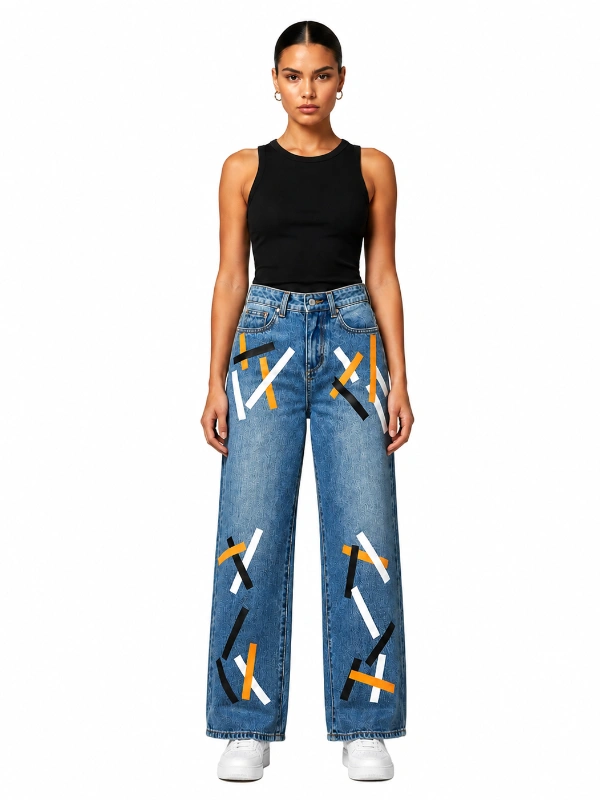
Custom Jeans Manufacturing Cost: Practical Planning Ranges
The first budget should be a range, not a promise. The table below assumes export production in China, an approved style, ordinary private-label packaging and roughly 500 or more pieces in one style and color. It excludes international freight, import duty, domestic delivery, sales tax or VAT, warehousing, marketing and returns.
| Product direction | Illustrative FOB planning range | Main cost drivers |
|---|---|---|
| Basic five-pocket jeans, rinse or simple enzyme wash | USD 14-20 per piece | Stock denim, standard hardware, efficient marker, limited handwork |
| Straight or wide-leg fashion jeans | USD 18-28 per piece | Higher consumption, développement du lavage, silhouette-specific fitting and finishing |
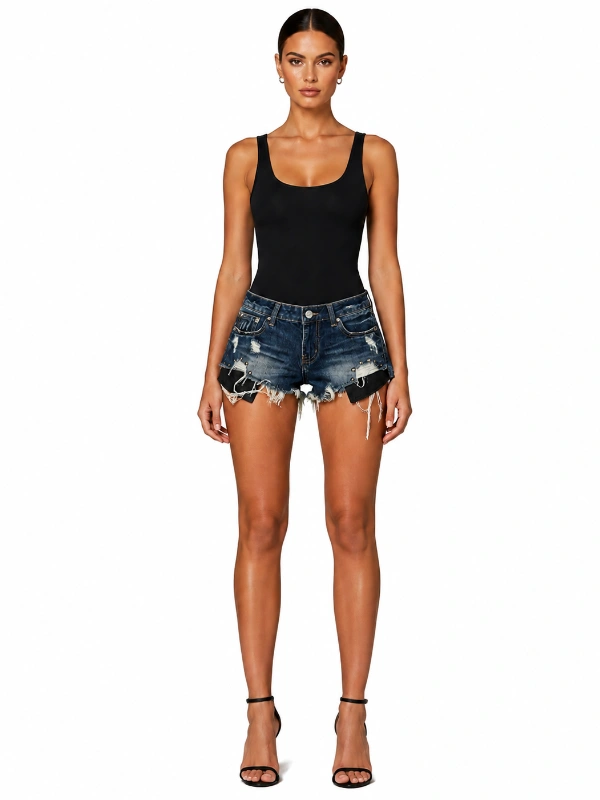
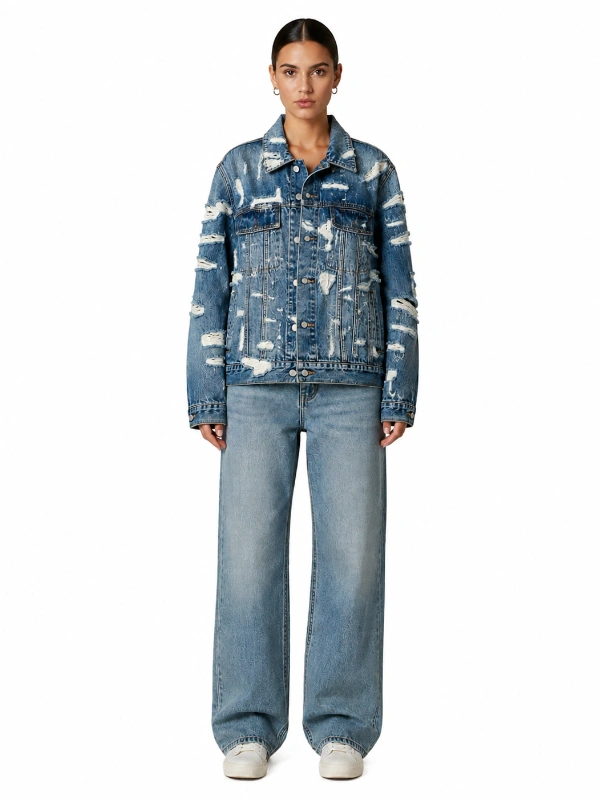
| Heavy vintage wash or controlled distressing | USD 22-36 per piece | Multiple wet and dry processes, abrasion, réparation, rejection risk and inspection |
| Cargo, paneled, printed or embroidered jeans | USD 25-45+ per piece | Extra components, sewing operations, artwork setup, placement control and slower throughput |
| Small test order of 50-100 pièces | Often 20-60% above an efficient 500-piece unit cost | Development allocation, minimum processing charges, stock material limits and line inefficiency |
Custom jeans manufacturing cost bands overlap because complexity matters more than the product name. A clean wide-leg jean in stock fabric can cost less than a slim jean with hand scraping, repairs and custom cast hardware. UN 14 oz fabric is not automatically more expensive than a 10 oz fabric; mill, teneur en fibres, yarn system, finition, order quantity and usable width all affect the material bill.
Use these ranges to test whether a business model is plausible. Do not use them to select a supplier without matching specifications. A quote becomes commercially meaningful only after the factory prices the same product, quantity and trade term.
The Nine Parts of a Jeans Cost
A useful custom jeans manufacturing cost sheet separates recurring production expenses from one-time or order-level expenses. That separation explains why the price falls as quantity rises and why a repeat order may differ from the first order.
- Shell fabric: denim consumption multiplied by the negotiated price per meter or yard, including the approved cutting allowance.
- Secondary materials: empocher, entoilage, stay tape, embroidery backing, patches and reinforcement.
- Cutting and sewing: marker preparation, spreading, coupe, bundling, sewing labor, fil, needles and line handling.
- Garment wash: traitement humide, dry finishing, chemicals, énergie, labor, séchage, handwork and wash rejection allowance.
- Hardware and branding: fermeture éclair, tack button, rivets, s'enclenche, étiquettes, leather or jacron patch, hangtag and barcode.
- Finition et emballage: garniture, pressage, mesures, metal detection when required, folding, bags and cartons.
- Development: modèle, grading, sample sewing, essais de lavage, artwork, molds and approval rounds.
- Quality and compliance: fabric or garment tests, inline control, final inspection and documentation.
- Factory overhead and margin: production planning, utilities, management, finance cost, capacity risk and profit.
A buyer should not demand the factory’s confidential profit calculation. The purpose of a custom jeans manufacturing cost breakdown is to see whether the product logic is coherent. If a quote claims premium denim, five manual finishing steps, custom hardware and a very low quantity but leaves no room for development or rejection risk, the number deserves questions.
How Fabric Consumption Changes Custom Jeans Manufacturing Cost
Fabric is often the largest material element in custom jeans manufacturing cost, but fabric cost per garment is not fabric price alone. The correct calculation is:
Fabric cost per piece = net marker consumption x fabric price x (1 + cutting and order allowance)
Net marker consumption comes from the production pattern, rapport de taille, largeur utile, nap or shade direction and marker efficiency. A sketch cannot produce a reliable value. For an early budget using 150 cm usable fabric width, the following ranges can help a buyer identify whether a quote is plausible.
| Adult jeans silhouette | Early net-consumption range | Why the range changes |
|---|---|---|
| Slim or fitted five-pocket | 1.25-1.55 m | Size range, augmenter, entrejambe, waistband layout and stretch direction |
| Straight or relaxed fit | 1.35-1.70 m | Leg width, entrejambe, cuff, pocket size and marker balance |
| Wide-leg or baggy fit | 1.55-2.05 m | Hem sweep, long inseam, large sizes and one-way shade cutting |
| Cargo or multi-panel jean | 1.60-2.20 m | Cargo pockets, rabats, gussets, panels and matching requirements |
These are planning ranges, not marker guarantees. A CAD marker using the approved graded nest should replace them before price confirmation. Add an agreed order allowance for end loss, splice loss, visible defects, shade segregation and recuts. A working allowance of 5-12% may appear in early budgets, but the correct value depends on fabric quality, roll length, inspection rules and factory performance.
A Custom Jeans Manufacturing Cost Example for Fabric
Assume a wide straight jean has 1.45 m net marker consumption in 150 cm usable width. The team allows 7% for bulk cutting and fabric loss, producing 1.5515 m ordered consumption. At USD 4.20 per meter:
1.45 x 1.07 x USD 4.20 = USD 6.52 fabric cost per garment
Round only after the calculation. At 500 pièces, a hidden USD 0.20 rounding difference changes the order by USD 100. Plus important encore, confirm whether the mill quote uses full width or usable width and whether the fabric price includes tax, transport to the garment factory or inspection.
Fabric weight should be measured consistently. ASTM D3776/D3776M-20(2025) covers mass per unit area of most fabrics and distinguishes full-piece, full-width, small-swatch and narrow-fabric options. A small swatch result may represent only that sample, not the lot. Connect the costing article to the approved denim fabric weight specification rather than buying by an unverified ounce label.
Why usable width matters
A cheaper fabric can produce a more expensive garment if its usable width creates a poor marker. Selvage, edge distortion and defects reduce the width available to the pattern. Ask the marker maker to compare total cost per garment, not price per meter. A five-cent fabric saving is irrelevant if consumption rises by ten cents.
Why size ratio matters
A marker containing mostly middle sizes can be more efficient than one dominated by the largest sizes. Confirm the sales ratio before price approval. If the ratio changes after the purchase order, the factory may need new markers and more fabric. Link the ratio to the approved jeans size grading and do not hide unapproved pattern reductions inside a cost target.
Modèle, Cutting and Sewing Cost
Construction contributes to custom jeans manufacturing cost through standard minutes, workstation capability, operation count and line efficiency. A basic five-pocket jean already includes many operations: front pocket preparation, coin pocket, zipper fly, back pockets, joug, rises, outseams, inseams, ceinture, passants de ceinture, hemming, buttonhole, hardware and labels.
Construction cost rises when the design adds:
- cargo pockets, rabats, gussets or utility straps;
- curved panels, contrast inserts or asymmetric pieces;
- double-needle or chain-stitch requirements in difficult locations;
- matched pocket artwork, plaids or directional prints;
- lined waistbands, shaped facings or extra stabilization;
- raw-edge appliques, repairs or deliberately exposed seams;
- embroidery that must be applied before assembly;
- very heavy fabric that slows handling and increases needle risk;
- stretch fabric requiring controlled feeding and recovery;
- special pressing, templates or checking fixtures.
The pattern and construction should be defined in a production-ready denim tech pack. A request for « premium stitching » cannot be timed. A seam diagram, type de point, thread specification and visible stitch density can.
Sample sewing is not bulk sewing
A sample room handles one garment with frequent stops, changes and checking. A production line balances repeated operations across many workers. The first sample price therefore should not be divided by the number of garments and treated as bulk labor. The sample fee pays for development time and uncertainty; the bulk price assumes the method is frozen.
Construction that creates repeated failures also increases custom jeans manufacturing cost through recuts, repairs and lower line efficiency. Use the guide de construction des coutures du denim to confirm thread, seam, reinforcement and needle choices before the pre-production sample.
Wash and Finishing Cost: The Most Underestimated Variable
Wash development can transform custom jeans manufacturing cost because denim washing is not a single operation. The final appearance may combine desizing, enzyme, stone or stone-alternative abrasion, blanchiment, neutralization, teinture, ramollissement, extraction, séchage, moustaches, grattage, affûtage, laser work, spray, résine, curing and repairs. Every added step consumes capacity and creates another point of variation.
| Wash direction | Illustrative processing allowance | Typical cost exposure |
|---|---|---|
| Rinse or simple enzyme | USD 0.80-1.80 per garment | Shorter route, fewer manual effects and lower shade risk |
| Stone/enzyme vintage wash | USD 1.50-3.50 per garment | More process control, abrasion, softening and shade sorting |
| Acid, bleach, tint or spray route | USD 2.50-5.50 per garment | Chimie, neutralization, protection, variation and extra inspection |
| Hand distressing, repairs or layered dry effects | USD 4.00-10.00+ per garment | Skilled hand time, templates, placement control and rejection risk |
The ranges are planning allowances, not washhouse quotations. Cost depends on local process, batch size, garment weight, water and energy conditions, chemical system, handwork minutes and quality target. A light-looking wash is not necessarily a cheap wash. Controlled highlights on every seam can require more work than an overall pale shade.
Develop the wash against an approved physical standard and retain recipe, machine, charger, timing and finishing notes. Le guide de développement du lavage du denim explains why shade, main, measurements and performance must be approved together.
Include expected wash loss in the order plan. If the purchase order requires 500 saleable pieces, cutting exactly 500 leaves no capacity for destructive tests, shade rejects, measurement failures or transit replacements. The correct overage is negotiated from process risk and quality history, not copied from another style.
Matériel, Étiquettes, Packaging and Decoration
Trims can move custom jeans manufacturing cost even when each line looks inexpensive, because a complete package includes more than one button and a zipper. Count the exact pieces per garment and include testing, spare quantities, molds and minimum purchase quantities.
| Trim group | Illustrative recurring allowance | Common hidden costs |
|---|---|---|
| Standard zipper, button and rivets | USD 0.70-1.50 | Finish, zipper length, spare parts, setting dies and pull testing |
| Custom logo hardware | USD 1.10-2.80 plus setup | Mold, plating minimum, artwork revision and finish approval |
| Etiquettes tissées, étiquette d'entretien, size label and hangtag | USD 0.20-0.65 | Language versions, low-volume minimums, barcode data and attachment |
| Patch and ordinary retail packaging | USD 0.30-1.20 | Embossing, material, warning text, recycled-content claims and cartons |
| Imprimer, embroidery or applique | USD 1.00-8.00+ | Artwork setup, stitch count, couleurs, coverage, placement and rejects |
Again, these are budget allowances. A metal supplier may quote a low component price but require a plating batch larger than the garment order. The unused balance is still a business cost unless it can be shared across styles. Le guide du matériel en jean covers button, rivet and zipper specification, attachment and wash compatibility.
Printed and embroidered artwork affects custom jeans manufacturing cost in three ways: setup, per-piece application and inspection. Artwork crossing a seam may require panel decoration before sewing. Large stitch counts slow embroidery and can distort stretch fabric. Multi-position graphics multiply handling even when each motif is small.
How MOQ Changes the Unit Price
MOQ changes custom jeans manufacturing cost because it is the point at which material minimums, process batches, line setup and development allocation become workable. It is not simply a factory refusing small orders. Different components can have different minimums:
- stock fabric may be available by roll, while custom-woven denim requires a mill production minimum;
- a washhouse may charge a minimum batch even if the order uses only part of it;
- custom-plated hardware may have a finish or mold minimum;
- labels and hangtags may have a supplier minimum per artwork;
- embroidery and printing include setup that must be spread across pieces;
- each color or wash can behave like a separate production batch;
- a very wide size range can reduce marker and line efficiency.
Custom Jeans Manufacturing Cost and One-Time Amortization
Assume a style carries USD 840 in order-level development and setup:
- pattern and grading: USD 220;
- two sample rounds: USD 260;
- essais de lavage: USD 180;
- custom hardware and artwork setup: USD 120;
- approval administration and pre-production records: USD 60.
| Quantité commandée | USD 840 allocated per piece | Commercial meaning |
|---|---|---|
| 100 pièces | USD 8.40 | Development is a major part of the unit economics |
| 300 pièces | USD 2.80 | Low-volume production becomes more workable |
| 500 pièces | USD 1.68 | Setup is spread across a practical commercial run |
| 1,000 pièces | USD 0.84 | Allocation falls, while material negotiation may improve |
| 3,000 pièces | USD 0.28 | One-time cost is small; capacity and sell-through matter more |
This simple division understates the real disadvantage of a 100-piece order. Small runs can also carry higher fabric prices, minimum wash charges, incomplete line balance and more expensive trims. Inversement, very large orders do not fall forever: material, labor, compliance, finance and factory margin remain real costs.
MOQ per style is not MOQ per collection
An order for 600 pieces split among three styles, two washes and two hardware finishes is not operationally equivalent to one 600-piece style. It may create 12 small combinations. Ask the factory to state MOQ by style, color or wash, tissu, trim finish and size range. Then build the assortment around shared components where it makes design sense.
Exemple travaillé: A 500-Piece FOB Jeans Budget
The following custom jeans manufacturing cost model uses one style, one medium-blue wash, five sizes, 500 pièces, 150 cm usable width and 11.5 oz cotton-rich denim. The silhouette is a wide straight five-pocket jean with standard private-label trims. It is an educational budget, not a factory offer.
| Cost item | Calculation or assumption | USD per piece |
|---|---|---|
| Denim shell fabric | 1.45 m x 1.07 allowance x USD 4.20/m | 6.52 |
| Pocketing and interlining | Standard cotton pocketing and waistband support | 0.45 |
| Thread and consumables | Core sewing and topstitch thread allocation | 0.18 |
| Matériel | Zipper, tack button and rivet set | 0.95 |
| Labels and hangtag | Main, care, size labels and one hangtag | 0.32 |
| Conditionnement | Bag, size sticker and export carton allocation | 0.28 |
| Cutting and sewing | Standard five-pocket construction | 3.40 |
| Garment wash | Enzyme vintage wash with controlled whisker direction | 2.20 |
| Finition | Coupe-fil, pressage, measuring and packing labor | 0.45 |
| Quality allocation | Inline checks, final inspection support and records | 0.40 |
| Recurring production subtotal | Materials plus recurring operations | 15.15 |
| Development and setup allocation | USD 840 / 500 pièces | 1.68 |
| Cost base before overhead and margin | USD 15.15 + USD 1.68 | 16.83 |
| Illustrative factory overhead and margin | 18% applied to the modeled cost base | 3.03 |
| Modeled FOB unit price | Rounded from the worked assumptions | 19.86 |
The arithmetic is not a claim that every factory uses an 18% factor or that this product should quote at USD 19.86. It demonstrates how to interrogate the number. Replace the fabric price, consumption, laver, trim and development inputs with supplier data. If the target price is USD 16, the team can see exactly which assumptions must change and whether those changes are acceptable.
Quantity sensitivity using the same cost base
If recurring production remained USD 15.15 and the same USD 840 were allocated across different quantities, un 18% illustrative overhead-and-margin factor would produce the following mathematical result:
| Quantity | Setup allocation | Modeled unit price |
|---|---|---|
| 100 | USD 8.40 | USD 27.79 |
| 300 | USD 2.80 | USD 21.18 |
| 500 | USD 1.68 | USD 19.86 |
| 1,000 | USD 0.84 | USD 18.87 |
| 3,000 | USD 0.28 | USD 18.21 |
Actual small-order pricing would often be higher than this table because recurring inputs do not stay constant at low volume. Actual high-volume pricing may improve through fabric and trim negotiation, but large orders also create finance, capacity and quality risk. The table isolates one variable: development allocation.
FOB Price Is Not Landed Cost
Custom jeans manufacturing cost at the factory gate and delivered inventory cost answer different questions. The selected Incoterms rule defines tasks, costs and risk transfer between seller and buyer; it does not set the product price or replace the sale contract. The International Chamber of Commerce publishes an Incoterms 2020 checklist. Its guidance notes that FCA is generally appropriate for container or multimodal delivery, while FOB is for goods placed onboard a vessel in sea or inland-waterway transport. Brands should agree the named place or port and rule version, not write « FOB China » without a port.
A practical landed-cost formula is:
Landed cost = product price + origin charges not included + freight + insurance + duty + customs and brokerage + destination handling + inland delivery + inspection and testing allocation
Taxes recoverable by the business may be handled differently in accounting, while non-recoverable taxes remain a cost. Confirm the treatment with a customs broker and accountant.
A landed-cost example
| Item | Illustrative USD per piece |
|---|---|
| Modeled FOB unit price | 19.86 |
| International freight and insurance allocation | 2.10 |
| Duty, customs and brokerage allocation | 4.80 |
| Destination handling and inland delivery | 1.25 |
| Third-party testing and inspection allocation | 0.60 |
| Illustrative landed cost | 28.61 |
The duty figure is deliberately an assumption. Classification depends on garment type, wearer category, composition des fibres, construction, country of origin and destination rules. U.S. buyers can research the current Harmonized Tariff Schedule published by the USITC. EU buyers can use the European Commission’s Access2Markets portal. Obtain professional classification advice before committing inventory.
Work backward from the retail model
If the planned retail price is USD 85 and the brand wants a 65% initial gross margin before marketing, returns, payment fees and business overhead:
Maximum landed cost = USD 85 x (1 – 0.65) = USD 29.75
The example landed cost of USD 28.61 fits inside that narrow target by USD 1.14. UN 10% promotion, high return rate or expensive fulfillment can erase the cushion. The sourcing team should model direct-to-consumer and wholesale channels separately before negotiating cents from construction.
How to Compare Two Factory Quotes
Compare custom jeans manufacturing cost by putting every quote into one sheet. Normalize currency, quantité, rapport de taille, delivery term and included services. Do not compare an EXW quote excluding packaging with an FOB quote including development and assume the first factory is cheaper.
| Comparison field | Questions to ask |
|---|---|
| Tissu | Mill and article? Composition? Poids? Usable width? Price basis? Consumption? |
| Laver | Which wet and dry steps? Handwork? Approved standard? Shade tolerance? |
| Construction | Same pattern, coutures, fil, empocher, reinforcements and measurements? |
| Trims | Standard or custom hardware? Branded zipper? Étiquettes, correctif, hangtag and bag included? |
| Development | Modèle, grading, échantillons, wash trials and molds included or charged separately? |
| Quality | Essai, inline control, final inspection and replacement allowance included? |
| Quantity | MOQ by style, wash and color? Mixed sizes? Overage or shortage tolerance? |
| Livraison | Exact Incoterms rule, named place, version, lead time and included origin charges? |
| Payment | Deposit, balance trigger, bank fees, currency and validity period? |
Ask each supplier to quote the same bill of materials and approval sample. If one factory recommends a change, price the original and the alternative separately. That protects the comparison and may reveal a useful value-engineering idea.
Final inspection should follow a documented plan rather than a slogan such as « 100% QC. » OIN 2859-1:2026 defines AQL-indexed acceptance sampling schemes for lot-by-lot inspection. Sampling does not guarantee every unit is defect-free; it balances inspection effort and statistical risk. The brand still needs defect definitions, measurement tolerances and critical-safety rules. Le denim quality inspection guide explains how to build those controls.
How to Reduce Custom Jeans Manufacturing Cost Without Weakening the Product
Share fabric across styles
One approved denim article used in a jean, skirt and short can improve purchasing leverage and reduce leftover fabric. Confirm that weight, recovery and wash behavior suit every silhouette before consolidating.
Reduce wash variants before reducing quality
Two well-developed washes usually create better purchasing and process control than five similar washes at tiny quantities. A smaller wash library also simplifies shade approval, photography and replenishment.
Use one hardware family
Shared button, rivet and zipper finishes can reduce plating minimums and spare inventory. Do not share a component when post length, wash chemistry or attachment requirements differ.
Move complexity to one focal area
A strong pocket treatment or one engineered print can communicate more clearly than small details across every panel. Fewer placements reduce handwork, measurement points and inspection time.
Improve the marker before changing the design
Review usable width, size ratio and pattern nesting. A slight pocket or facing adjustment may improve yield without changing the visible silhouette. Never shorten rise, inseam or grade to meet a consumption target without fit approval.
Approve quickly and freeze decisions
Late changes create new samples, artwork, essais de lavage, trims and production planning. A clear approval calendar can save more than a small unit-price negotiation. Use the jeans fit sample approval process to separate comments from final sign-off.
Build cost around sellable quality
Removing colorfastness or shrinkage testing does not remove the risk; it transfers the risk to returns and customer complaints. Align testing with product and market requirements. Refer to the denim colorfastness testing guide and the denim shrinkage control guide when setting the approval plan.
What to Send for an Accurate Custom Jeans Quote
A factory cannot calculate custom jeans manufacturing cost accurately from one front-view image. A useful request for quotation should include:
- technical flats showing front, back and important internal details;
- tableau de mesure, base size, grade rules and tolerance;
- target fabric composition, poids, stretch and hand;
- fit description and reference garment when available;
- seam, point, thread and reinforcement requirements;
- wash image plus written shade, contrast and hand direction;
- pénible, print or embroidery artwork with dimensions and placement;
- hardware and trim specification, including custom logos;
- label languages, care content, barcode and packaging needs;
- quantité par style, color or wash and size ratio;
- required tests, inspection level and compliance documents;
- destination, desired delivery date and requested Incoterms rule;
- target price presented as a goal, not as a substitute for specification.
Ask the supplier to list assumptions and exclusions. The most useful answer may be a range before sampling, followed by a confirmed price after pattern, marker, wash and trims are approved. A false-precision quote at the sketch stage is less valuable than an honest range with identified variables.
Custom Jeans Manufacturing Cost Checklist Before Ordering
- The quote matches the approved fabric article and usable width.
- Consumption comes from the graded production marker.
- Cutting and order allowances are visible and justified.
- The wash route and physical standard are identified.
- All hardware, étiquettes, artwork and packaging are itemized.
- Development charges and refund or credit terms are clear.
- MOQ is stated by style, couleur, wash and trim finish.
- Testing and final inspection responsibilities are assigned.
- The allowed shipment overage or shortage is written.
- The Incoterms rule includes a named place or port and version.
- Payment terms, currency and quote validity are stated.
- Freight, duty, brokerage and inland delivery are modeled separately.
- The retail and wholesale margin models use landed cost, not FOB alone.
- Changes after approval require a revised cost sheet.
Foire aux questions
How much does custom jeans manufacturing cost?
For early planning, a basic 500-piece five-pocket jean may fall around USD 14-20 FOB China, while fashion washes, wide fits, pénible, cargo details or decoration can move the budget toward USD 18-45 or more. The real price requires an approved fabric, modèle, laver, garnitures, quantity and trade term.
What is the usual MOQ for custom jeans?
There is no universal MOQ. It may start around 50-100 pieces when stock fabric and standard trims are available, while custom-woven fabric, exclusive washes or custom hardware can require several hundred pieces or more. Confirm MOQ by style, laver, color and component.
Why do small jeans orders cost more per piece?
Modèle, grading, échantillons, essais de lavage, artwork and setup are spread across fewer units. Small orders can also face fabric-roll minimums, washhouse batch charges, trim minimums and lower sewing-line efficiency.
How much denim fabric is needed for one pair of jeans?
For early planning with roughly 150 cm usable width, adult five-pocket jeans may use about 1.25-1.70 m, while wide-leg, baggy or cargo styles may use about 1.55-2.20 m. The final value must come from a graded CAD marker and actual size ratio.
What percentage of jeans cost is fabric?
There is no fixed percentage. In the worked 500-piece model, shell denim is USD 6.52 of a USD 19.86 FOB price, or about 33%. The share changes with fabric quality, garment complexity, laver, quantity and factory structure.
How much does a custom jeans sample cost?
Sample charges vary with pattern work, tissu, essais de lavage, trims and revision rounds. A simple development sample may cost under USD 100, while complex washed or decorated samples can cost several hundred dollars. Ask what is included and whether any fee is credited against bulk production.
What is included in an FOB jeans price?
FOB under Incoterms 2020 is a sea or inland-waterway rule in which delivery and risk transfer occur when goods are onboard the vessel at the named port. The commercial quote should still state exactly which product, emballage, origin and documentation costs are included.
Is EXW cheaper than FOB?
An EXW unit quote may look lower because the buyer carries more origin transport, clearance and handling responsibility. Compare the total cost at the same delivery point, not only the factory invoice price.
How much does denim washing add to the price?
A simple rinse or enzyme process may add roughly USD 0.80-1.80 in an early budget, while vintage, bleach, spray, hand distressing and repair can add several dollars or more. Obtain a washhouse quote against the approved garment and standard.
How do I calculate landed cost for imported jeans?
Add the product price, origin charges not included, freight, insurance, duty, customs and brokerage, destination handling, inland delivery, testing and inspection allocations. Verify classification and tax treatment for the destination with qualified professionals.
Can a factory confirm price before making a sample?
A factory can provide a planning range from a complete tech pack, but sampling and marker development reveal actual consumption, construction time, wash route and trim requirements. Final price is more reliable after those variables are approved.
What information produces the most accurate jeans quotation?
Provide technical flats, mesures, grade rules, spécification du tissu, référence de lavage, construction details, artwork, garnitures, conditionnement, quantity by color and size, testing requirements, destination, delivery date and requested Incoterms rule.
Conclusion finale
The lowest quoted unit price is not automatically the lowest custom jeans manufacturing cost. A reliable budget connects material consumption, temps de traitement, development, quality and logistics to the exact product the brand intends to sell. When every supplier prices the same specification and every assumption is visible, cost negotiation becomes a design and operations decision instead of guesswork.
Brands seeking a project-specific price can send Luokugg the tech pack, quantité, rapport de taille, fabric and wash direction, artwork, trim requirements, destination and requested trade term through the formulaire de devis denim personnalisé. The response can then separate development questions from confirmed production costs.