Denim seam construction determines whether a garment survives washing and wear, but it also determines how the product looks. The same line of stitching can join two panels, reinforce a stress point and create the raised edge that fades during washing. When the seam is poorly engineered, the factory may deliver skipped stitches, roping in the wrong place, puckering, broken thread or fabric failure. When it is engineered well, construction and appearance reinforce each other.
This is why a note such as “double stitch throughout” is not a complete instruction. It does not identify the seam configuration, stitch formation, needle spacing, thread size, stitch density, seam allowance or side from which the operation is sewn. It also says nothing about how the seam should behave after an enzyme wash, heavy abrasion or repeated use.
This guide is for fashion brands, technical designers and denim buyers developing jeans, jackets, shorts and skirts with an external manufacturer. It explains how to select seams and stitches by function, specify thread and reinforcement, prepare construction callouts and inspect washed bulk garments without turning the tech pack into a machine manual.
Treat the Seam as a System, Not a Line on a Sketch
A sewn joint is the result of several decisions working together. Fabric strength matters, but a strong fabric can be weakened by the wrong needle or excessive stitch density. Heavy thread may look appropriate on a 14-ounce denim, yet cause poor loop formation if the machine, needle and tension are not matched to it. A secure stitch can still fail if the seam allowance is too narrow and the fabric yarns pull away from the needle line.
ASTM D6193, Standard Practice for Stitches and Seams, describes seam engineering as a balance among stitch type, seam configuration, thread and material. It identifies strength, elasticity, durability, security and appearance as characteristics of a properly constructed seam. Those characteristics do not carry equal weight at every location. The crotch seam of rigid work jeans prioritizes strength and security. A stretch waistband also needs extension. A decorative yoke seam must survive wear while producing the intended wash contrast.
The intended wash belongs in this system from the beginning. Dry, unwashed denim may be stiff enough to feed cleanly through a folder. After desizing and softening, the seam can pucker or collapse. Abrasion can expose thread. A chainstitched hem may develop attractive roping, but only when the construction, fabric and washing action support it. Construction approval before washing is therefore provisional.
The Difference Between a Stitch and a Seam
A stitch is the structure created when one or more sewing threads interloop, interlace or pass through material. A seam is the configuration in which fabric components are joined or finished. One seam can use more than one stitch type. For example, a jeans side seam may be joined and overedged in one operation, then topstitched in another.
The distinction matters in a tech pack. “301 stitch” identifies a lockstitch formation, but it does not explain whether the panels are superimposed, lapped or folded. “Felled seam” describes an arrangement, but the factory still needs to know the stitch rows, visible side, width and stitch formation.
ISO 4915 classifies and illustrates stitch types. ISO 4916 classifies seam types by the number and arrangement of material components. A brand does not have to print an ISO code beside every operation, but using recognized terminology removes ambiguity when teams in different countries discuss the same construction.
Common Stitch Types Used in Denim Garments
Factories choose from many stitch formations, but a small group appears repeatedly in jeans and jackets. The correct choice depends on function, equipment, appearance and fabric behavior.
| Stitch type | Typical denim use | Key characteristic |
|---|---|---|
| 301 lockstitch | Topstitching, labels, pockets, fly details and general assembly | Neat on both sides and secure when balanced; limited seam extension compared with chainstitch |
| 401 two-thread chainstitch | Long assembly seams, waistband operations and authentic hems | Good extensibility and efficient sewing; chain side must be secured against unraveling |
| 504 three-thread overedge | Neatening raw edges and some light assembly | Wraps the cut edge; coverage depends on bite width, thread and density |
| 516 safety stitch combination | Joining and overedging inseams or side seams in one operation | Combines a chainstitch row with overedge coverage |
| 406 two-needle cover/chain formation | Selected waistband, binding or decorative applications | Parallel needle lines with underside coverage; application depends on folder and machine setup |
| 304 zigzag lockstitch family | Bartacks and programmed reinforcement | Concentrates stitches across a short stress area |
A 301 lockstitch uses interlaced needle and bobbin threads. It is easy to start and stop securely and produces a controlled appearance, making it useful for pockets, labels and visible topstitching. It does not have the same natural extension as a chainstitch. On high-stretch denim, the seam system must be tested so the thread does not break before the fabric reaches normal wearing extension.
A 401 chainstitch forms with needle and looper threads. It is common on long seams and traditional denim hems. The underside chain can contribute to the characteristic puckered hem after washing. Its ability to unravel from an unsecured end is also real. Hem ends, waistband ends and broken-thread repairs need a defined securing method.
Overedge stitches prevent raw edges from fraying uncontrollably. A safety stitch can join panels and finish the edge together, but it does not automatically replace a felled seam where the design calls for a flat, reinforced structure and visible rows. The specification should describe the required result, not choose a machine merely because it is fast.
Choose Construction by Garment Area
Inseam and outseam
These long seams influence strength, leg balance and wash appearance. Common options include safety-stitched seams, lapped or felled constructions, and a joined seam with one or two rows of topstitching. The choice affects thickness, production time and how the seam fades.
A true felled or lapped construction encloses or controls raw edges and creates a flat, durable seam. A mock-felled appearance may be produced by joining and overedging first, then folding the allowances to one side and topstitching. From outside, the two can look similar. Internally, the fabric layers and edge security differ. State which result is required, especially for premium or heritage-inspired products.
Front and back rise
The rise and crotch receive repeated tension during sitting and movement. Seam allowance, stitch elasticity and intersection bulk must be balanced. Reinforcing a weak crotch by adding more stitch rows can create a rigid perforated area. Test the fabric and seam combination instead of assuming that more thread always means more strength.
Waistband
A waistband combines shell fabric, possible interlining, belt loops, topstitching, buttonhole and closure. Stretch denim may need an internal component that supports recovery without making the edge harsh. The construction callout should state finished width, cut method, number of pieces, interlining, attachment, topstitch rows, seam margin and extension shape.
Front pockets and coin pocket
Pocket openings carry hand pressure and repeated loading. Specify the pocketing fabric, stay or reinforcement, seam type, topstitching and bartacks. A bartack placed too close to the cut edge can damage the denim; placed too far away, it may not protect the opening. The coin pocket needs a clean top edge and secure lower corners without a hard cluster that becomes uncomfortable after washing.
Back pockets
Back pockets are both functional and visual. Turned edges must be wide enough to remain secure after washing, while corner shape and topstitch rows must match the approved template. Decorative stitching should not weaken the pocket through excessive perforation. Pocket placement belongs in the fit specification as well as the sewing specification because small shifts change the apparent seat shape.
Hem
Define finished depth, turn-up count, stitch type, thread and visible distance from the edge. If chainstitch roping is part of the design, approve the washed hem rather than an unwashed stitch sample. A broad hem on a tapered leg may require easing or a shaped turn-up so it lies flat.
Denim jacket seams
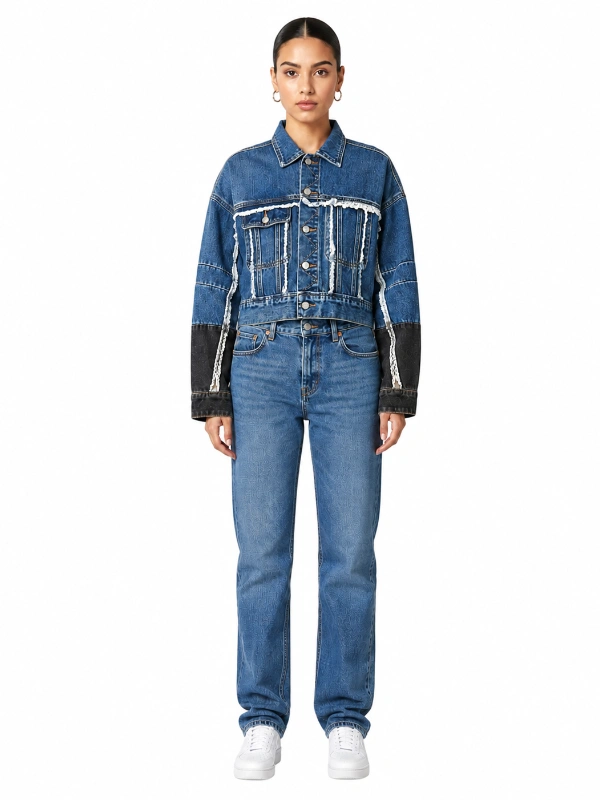
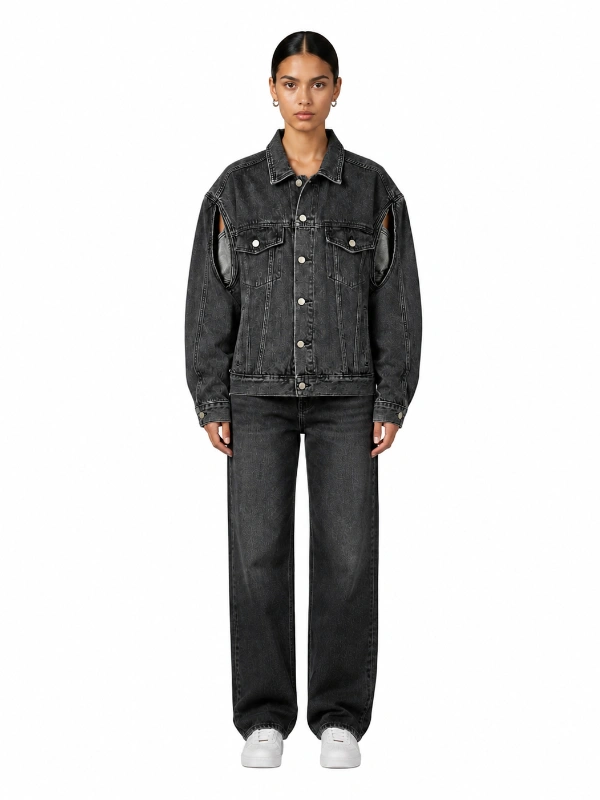
Jackets add armholes, sleeve plackets, collars, cuffs and front facings. Shoulder and armhole seams need enough mobility for the intended fit. Collar points and cuff corners create layer buildup. Decorative panel seams may cross pockets or embellishment. The sewing sequence must keep those intersections controllable rather than forcing the operator to stitch through unnecessary bulk.
The jeans fit sample approval guide explains how seam choices can alter rise, leg balance and pocket position even when nominal measurements remain unchanged.
Specify Sewing Thread Properly
Thread should be specified by function, not color alone. Include fiber or construction, size system, color reference, finish if relevant and application. If the brand accepts an equivalent, define what must remain equivalent: appearance, strength, shrinkage, abrasion performance and wash response.
Spun polyester
Spun polyester is widely used for apparel assembly because it offers consistent strength and a cotton-like surface. It is available in many sizes and colors. Its behavior under washing differs from cotton, so the sample must confirm seam puckering and appearance.
Core-spun thread
Core-spun constructions combine a continuous-filament core with a spun outer wrap. They can provide high strength for their apparent size and a surface suitable for apparel sewing. Cotton-wrapped versions may be chosen when the outer thread is intended to respond more naturally in denim finishing, but the exact result depends on dye, wash and supplier.
Cotton thread
Cotton can support an authentic washed appearance and may shrink or abrade in a visually desirable way. It also requires careful evaluation for strength, sewing performance and end use. Do not select it from a mood board without sewing and washing the actual construction.
Continuous-filament polyester
Filament thread can offer high strength and abrasion resistance with a smoother appearance. That appearance may or may not match a vintage product. Use it where the technical need and visual standard agree.
Thread size influences more than boldness. A heavier thread needs a compatible needle eye, tension, hook or looper setup and stitch length. It also creates larger holes in the fabric. Specify assembly thread separately from visible topstitch thread when they serve different purposes.
Color approval should happen after washing. An unwashed golden thread can become duller beside a heavily bleached denim; a dark thread may retain contrast while the fabric fades. If the thread is meant to tone down with the garment, approve that result physically.
Needle, Stitch Density and Tension Work Together
Needle selection
The needle must penetrate the fabric and form the stitch without cutting yarns, deflecting, heating excessively or damaging elastane. Its size and point are selected for the denim construction, thread and operation. Thick intersections may need changes in presser-foot control, feed and machine speed rather than a larger needle alone.
Needle damage can appear later. A panel may leave sewing with no obvious hole, then show broken elastane or yarn damage after washing and extension. For stretch denim, inspect needle lines after the wash and a controlled stretch test.
Stitches per inch
SPI affects seam strength, elasticity and appearance. Too few stitches may reduce security or create a coarse look. Too many can perforate dense denim, concentrate tension and increase puckering. Heavier topstitch thread often requires a longer stitch to form cleanly.
As a development starting point, many denim operations fall somewhere between roughly 6 and 12 stitches per inch, with bold topstitching toward the lower-density end and finer assembly toward the higher-density end. This is not a universal pass range. The factory should propose a setting based on the fabric, thread and machine, then the brand should approve the sewn and washed result.
Thread tension
Balanced tension sets the interlocking or interlooping point correctly without drawing the seam into ridges. Symptoms of poor balance include bobbin thread showing on top, needle thread showing excessively underneath, loose loops, seam grin and puckering. Tension can change as cones empty, operators rethread machines or fabric thickness changes at intersections, so it belongs in line control rather than sample-room setup alone.
Design Seams for the Wash Process
Denim washing reveals the structure of a seam. Fabric relaxes, thread and fabric may change at different rates, raised edges abrade and folded layers dry differently from single plies. These effects can be attractive when controlled and defective when accidental.
Seam puckering
Puckering can come from excessive sewing tension, differential feeding, thread shrinkage, fabric relaxation, a dense stitch line or an unsuitable seam structure. Pressing may hide it temporarily. Evaluate after the approved wash and conditioning period. If the problem appears only after laundering, compare thread and fabric dimensional change before changing the pattern.
Roping
Roping is the irregular high-low fading often seen around chainstitched hems and folded seams. It is created by the interaction of construction, feeding, fabric structure and abrasion. Brands seeking a heritage look may want visible roping; clean contemporary jeans may require a flatter edge. Put a photograph or physical standard in the wash approval rather than using the word alone.
Seam twist and torque
A straight stitch line cannot correct unstable fabric torque. If the inseam rotates after washing, check fabric skew, cutting direction and wash conditions before blaming the operator. See the denim shrinkage and leg-twist guide for the relationship between fabric stability, pattern compensation and post-wash seam position.
Abrasion and thread exposure
Stone, enzyme, sanding and localized abrasion can weaken thread as well as fabric. A decorative raised seam may expose thread intentionally, but structural stitches should retain adequate security. Make wash panels and complete garment samples using the nominated thread, not a substitute that happens to be the same color.
The factory’s process record and the buyer’s visual standard should be linked. Luokugg’s denim wash development guide explains how shade bands, recipes and bulk loads are controlled. Any wash change that affects hand or abrasion should trigger a construction review at sensitive seams.
Reinforce Stress Points Without Overbuilding
Reinforcement should spread or resist the force at a known location. It should not create a hard edge that transfers failure into the surrounding fabric. Before adding a bartack, rivet or extra patch, identify how the garment is loaded.
Bartacks
Bartacks are common at front pocket openings, fly ends, belt-loop ends and selected cargo-pocket points. Specify finished length, thread, direction, density or approved machine program, and exact placement. A dense bartack through too many layers can become stiff and may cut weak denim after abrasion.
Rivets
Rivets can reinforce pocket corners and contribute to brand identity. They require a compatible post length, cap, hole size and setting pressure. Check pull security, sharp edges, surface finish and reaction to laundry chemicals. A rivet should clamp the layers without crushing the fabric into an early tear point.
Backing and patches
Internal backing supports embroidery, studs, distressed holes and heavy decoration. Its weight, edge, color and wash behavior matter. A stiff square of backing behind a soft washed panel can show through on the outside. Shape the reinforcement to distribute load and avoid uncomfortable corners.
Belt loops
Belt loops experience pulling during dressing and wear. Define loop width, finished length, position and attachment. Top and bottom bartacks must catch a stable area of waistband construction. If the loop is inserted into the waistband seam, the operation and visible result should be shown in section detail.
Cargo pockets and tabs
Large pockets add fabric weight and leverage. Reinforce the points where the pocket opening, flap, tab or gusset transfers load to the leg. The custom cargo jeans manufacturing guide covers pocket engineering and development considerations for more complex utility styles.
Frayed, Distressed and Embellished Denim Need Boundaries
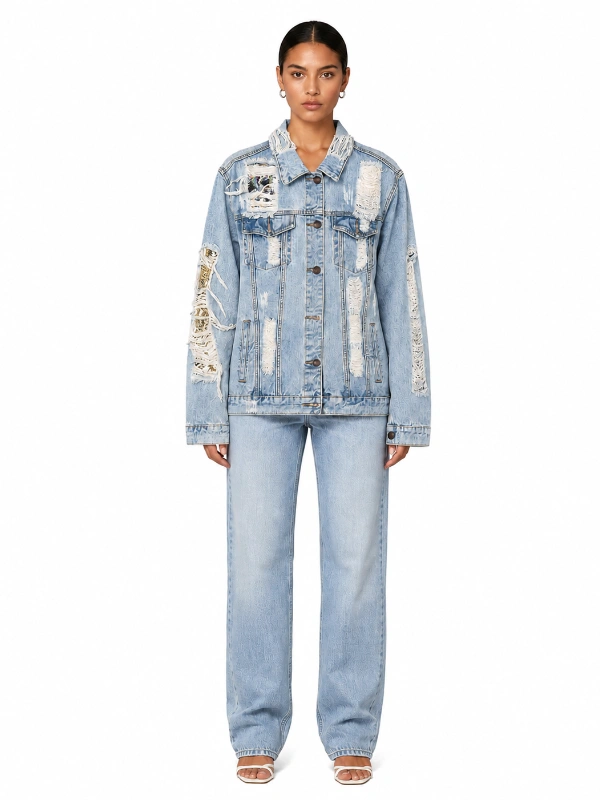
Raw edges are not unfinished instructions. A frayed hem or exposed seam needs an approved fringe depth, edge shape and containment stitch. State whether loose threads should remain, be trimmed to a maximum length or be removed after washing. The production team also needs a rejection rule for cuts that extend into the securing stitch.
Distressing near a seam reduces the amount of sound fabric carrying the load. Keep critical abrasion away from the stitch line unless the design includes hidden reinforcement. When a rip crosses a panel seam, approve its position after washing because the opening can grow as the fabric softens.
Studs, sequins, rhinestones and patches change both weight and stiffness. Their attachment thread or hardware may react differently from the denim in washing. Test decoration security, sharp edges, backing comfort and seam distortion. A visually dense embellishment can require a lighter internal support rather than a heavier outer seam.
Test Seam Performance, Not Thread Strength Alone
A strong thread can move failure into the fabric. A laboratory result is useful only when the seam, fabric and direction represent the product. Agree on the test specimen, conditioning, wash state, method and acceptance requirement before comparing results.
ISO 13935-1 describes a strip method for determining the maximum force required to rupture a straight seam when force is applied perpendicular to it. The current ISO 13935-2:2026 describes a grab method. Curved seams, intersections and decorated areas may need product-specific tests because a straight laboratory seam does not reproduce every garment condition.
Seam slippage is a different failure. The sewing thread may remain intact while fabric yarns pull away and create an opening beside the seam. ISO 13936-1 addresses resistance of woven-fabric yarn systems to slippage at a sewn seam. Looser constructions and seams cut in certain directions can be more sensitive, so assess the nominated fabric rather than relying on its weight.
A practical denim test plan can include:
- seam strength or rupture behavior before and after washing;
- seam slippage where the fabric construction presents a risk;
- extension and recovery for stretch-denim seams;
- bartack and belt-loop pull checks;
- button, rivet, snap and zipper attachment tests;
- decoration security after the intended wash;
- visual grading for puckering, skipped stitches and roping;
- wear trials at the crotch, pocket openings, knees and waistband.
Do not turn a laboratory number into a marketing claim without context. Use it to approve a construction, compare alternatives and investigate failures. Retain the test report with the exact fabric, thread and sample version.
Write Construction Callouts the Factory Can Reproduce
A useful callout answers what, where, how and from which side. For a visible seam, it should also answer what the brand expects after washing.
Compare these two instructions:
Weak: Double stitch side seam.
Useful: Join side seam with 516 safety stitch, allowances toward back; two rows visible topstitching at 6 mm needle spacing, approved heavy contrast thread, 8 SPI target; match washed approval sample.
The second callout may still need a cross-section drawing, seam allowance and thread code, but it gives the sample room a reproducible direction. Include:
- seam and stitch identification or a cross-section sketch;
- seam allowance and fold widths;
- visible side and allowance direction;
- number of stitch rows and needle spacing;
- edge-stitch or topstitch distance;
- thread code, size and color by operation;
- SPI target or approved range;
- bartack, rivet or backing position;
- start and stop security;
- washed appearance standard and tolerance.
Show enlarged details for waistband ends, fly bottom, crotch intersection, pocket corners, collar points, cuffs and unusual raw edges. A front and back flat drawing cannot explain every layer. Add a section drawing when the order of folds matters.
Keep the bill of materials connected to callouts. “Thread A” should point to a BOM line with supplier, article, size, color and approved alternative. The same applies to pocketing, backing, interlining, binding and reinforcement tape. See the complete denim tech pack guide for version and approval control.
Control Seam Construction During Bulk Production
The approved sample proves that the construction can be made. Bulk control proves that the line continues to make it. Sewing conditions change as operators, needles, thread cones, folders and fabric thickness change.
Pre-production meeting
Review the sealed sample, construction sheet and critical operations with the line team. Identify which seams require special machines, folders, templates or operator skill. Confirm thread availability and machine setup before cut pieces wait on the line.
First-off pieces
Inspect initial output from each critical operation. Check seam allowance, stitch formation, SPI, tension, alignment, raw-edge coverage and reverse appearance. Wash an early garment where the finish can expose defects. Correcting settings after thousands of units have reached laundry is late.
In-line inspection
Check at the operation, not only at the end of the line. A skipped stitch hidden inside the waistband is easier to repair before belt loops and labels are attached. Use a defect sample board so operators and inspectors share the same standard.
Post-wash inspection
Look for broken or abraded thread, seam puckering, open chain ends, excessive roping, exposed seam allowance, distorted panels and decoration damage. Compare with the approved wash standard under consistent lighting.
Final audit
Sample across sizes, colors, sewing lines and wash loads. Record defects by operation and location, not just as “sewing issue.” Repeated failures at one pocket corner suggest a process problem that should be contained and corrected.
Construction records should be part of the larger private-label jeans production process, linking sampling, PP approval, bulk washing and final inspection.
Troubleshoot Common Denim Sewing Defects
Skipped stitches at thick intersections
Check needle condition and size, presser-foot control, feed, thread path, machine timing and the abrupt change in layer height. A hump-jumping aid or redesigned seam sequence may solve the transition more cleanly than increasing tension.
Broken topstitch thread after washing
Review thread abrasion, needle damage, stitch density, tension and wash severity. Inspect whether the thread failed on raised areas that receive concentrated abrasion. Test the actual thread and wash together before substituting a heavier size.
Puckering beside a clean stitch line
The stitch may look balanced while feeding or differential shrinkage creates puckering. Compare unwashed and washed samples. Reduce unnecessary tension, evaluate thread shrinkage and ensure the operator is not stretching one ply.
Wavy stretch-denim seams
Excessive presser-foot pressure, differential feeding or operator handling may extend the fabric during sewing. Check recovery after rest and washing. Adjust feeding and handling before shrinking the pattern to hide the wave.
Seam opening without broken thread
This suggests fabric yarn slippage or an inadequate seam margin. Review the fabric construction, seam direction, stitch density and allowance. More thread strength alone will not keep yarns from moving away from the seam.
Chainstitch unraveling
Find the unsecured or damaged chain end. Define backtacking, overlapping, knotting or seam capture according to the operation. Trimming a chain too close can release the structure during washing.
Uneven twin-needle spacing
Check the needle gauge, folder, seam guide, operator control and layer bulk. If the seam shape is too tight for the fixed gauge, use a suitable operation rather than forcing the machine around the curve.
Raw edge escaping the overlock
Review cut accuracy, knife trimming, bite width, feeding and seam allowance. Increasing overedge width may hide a cutting problem without restoring the intended finished dimension.
Denim Construction Approval Checklist
- Every structural seam has a seam type, stitch type and allowance.
- Visible rows include spacing, SPI, thread size and color.
- Thread, needle and stitch settings have been tested on the nominated fabric.
- Stretch seams extend and recover without thread breakage.
- Waistband, rise, inseam, outseam and hem constructions match the sealed sample.
- Pocket openings, belt loops, fly ends and decoration have defined reinforcement.
- Frayed and distressed areas have approved boundaries and hidden support where needed.
- Chainstitch starts and ends are secured.
- Critical seams have been checked after the intended wash.
- Puckering, roping and abrasion match the visual standard.
- Required seam strength, slippage and attachment tests are documented.
- Bulk inspection covers different lines, sizes, fabric lots and wash loads.
Frequently Asked Questions
What is the strongest seam construction for denim jeans?
There is no single strongest construction for every location. Strength depends on the denim, seam configuration, stitch type, thread, stitch density, allowance and direction of force. Felled or lapped seams and safety-stitched assemblies are common, but the selected system should be tested on the actual fabric after washing.
What is the difference between lockstitch and chainstitch in jeans?
A lockstitch interlaces needle and bobbin threads and is secure with a neat appearance. A chainstitch interloops needle and looper threads, generally offers more extension and can create characteristic washed effects. Chain ends need proper securing to prevent unraveling.
Why do denim seams pucker after washing?
Puckering can result from excessive thread tension, differential feeding, dense stitching, thread shrinkage or fabric relaxation. Washing reveals differences that may not be visible in an unwashed sample, so the complete thread, stitch and fabric combination must be approved after processing.
How many stitches per inch should denim use?
The correct SPI depends on fabric weight and density, thread size, stitch type, operation and desired appearance. Many denim operations use a working range around 6 to 12 SPI, but the factory should test and propose the setting. Excessive density can perforate fabric and cause puckering.
Where should jeans be reinforced?
Common stress points include front pocket openings, fly ends, crotch intersections, belt-loop ends and some cargo-pocket or decoration attachments. Reinforcement may use bartacks, rivets, seam structure or internal backing according to the load and design.
Should topstitch thread be approved before or after washing?
Approve it after the intended wash. Washing can change thread color, surface, shrinkage and abrasion while the denim fades around it. The final contrast and seam appearance cannot be judged reliably from an unwashed thread card.
How do you stop a frayed denim seam from opening further?
Use a defined containment stitch, backing or stable seam structure beyond the approved frayed area. Specify the maximum fringe depth, securing line and trimming rule. Test the edge through the production wash because fraying grows during abrasion.
What seam information belongs in a denim tech pack?
Include seam and stitch type, allowance, fold direction, visible side, stitch rows, spacing, SPI, thread specification, edge distance, reinforcement, start and stop security, and the approved post-wash appearance. Add cross-section drawings for complex areas.
Final Takeaway
Good denim construction is not defined by the greatest number of stitches or the heaviest available thread. It is a balanced system that gives each seam enough strength, elasticity, durability and security while preserving the intended washed appearance. Specify the joint, not just the visible line. Test the real fabric and wash. Reinforce known loads, and inspect the process before defects are multiplied in bulk.
Brands developing custom jeans, jackets or shorts can send Luokugg the tech pack, fabric specification, wash reference, construction details and target quantity through the custom denim quotation form. If the seam construction is not finalized, identify the required appearance and end use so the technical team can propose a sample-ready solution.