Denim shrinkage control is not a final-inspection problem. It is a product-development decision that begins with the fabric roll and continues through pattern engineering, washing, pressing and bulk approval. When those stages are treated separately, a pair of jeans can pass an early fitting and still finish short, tight or visibly twisted after the production wash. The factory may have followed the measurement chart exactly before washing; the finished garment can still be wrong.
Two issues are often discussed as though they were the same. Shrinkage is a dimensional change: the waistband, inseam or another measured area becomes smaller after processing or laundering. Leg twist is rotational distortion: an inseam or outseam moves around the leg instead of hanging in its intended position. Both are influenced by the fabric and wash, but they need different controls. Adding length to a pattern may compensate for shrinkage. It will not correct an unstable twill or an inadequate skew specification.
This guide is written for denim buyers, fashion brands, technical designers and production teams preparing jeans for commercial manufacturing. It explains what to test, where problems begin, how to document acceptable results and when a fabric should be rejected rather than “fixed” in the pattern.
What Actually Changes During a Denim Wash
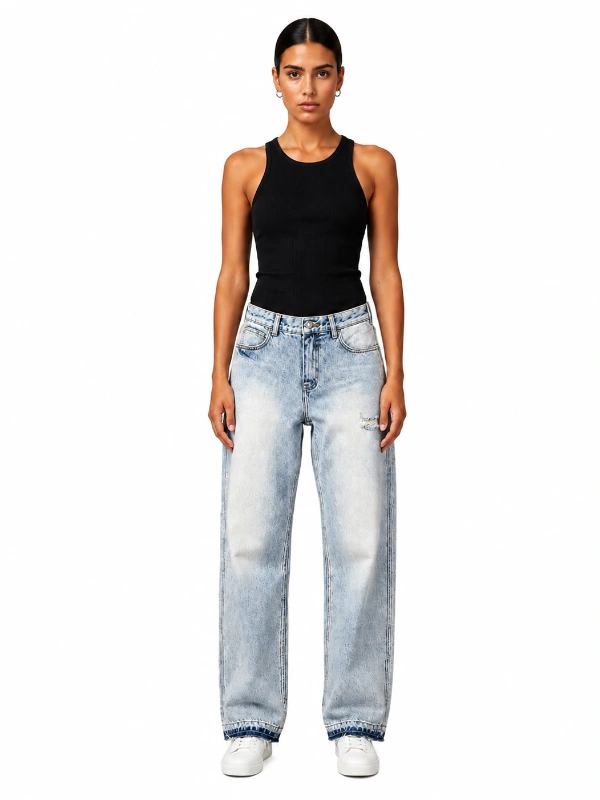
Denim does not leave the loom as a neutral, motionless material. Warp yarns have been spun, dyed, sized and held under tension. The fabric has been woven, finished, rolled and stored under conditions that influence its width and stability. During desizing and washing, yarns swell, tensions relax and the fabric seeks a more stable geometry. Drying then locks in part of that change.
The garment wash adds further variables. Water temperature, bath ratio, cycle time, drum action, chemistry, extraction and drying conditions all influence the result. Abrasive treatments can remove surface fiber and indigo. Enzymes can change the hand and surface. Tumble drying can increase relaxation compared with line drying. Pressing can temporarily recover a measurement that is lost again after the customer washes the garment.
This is why “fabric shrinkage” cannot be copied blindly from a mill data sheet. Mill data is useful, but the brand is selling a finished garment. The relevant number is the change produced by the actual manufacturing route and the care method stated on the label. The same greige fabric can behave differently in a dark rinse, a soft enzyme wash and an aggressive vintage wash.
The recognized framework is straightforward. ISO 5077 covers determination of dimensional change after specified washing and drying procedures. Brands working with U.S. methods may use AATCC procedures; the association lists AATCC TM135 for dimensional change and TM179 for skew change. The important commercial point is not which standard name appears in an email. It is that the wash procedure, conditioning, measurement points and acceptance limits are agreed before the result is used.
Shrinkage, Skew and Leg Twist Are Different
Shrinkage
Shrinkage is calculated from the difference between the original and final measurement:
Shrinkage (%) = (measurement before treatment - measurement after treatment) / measurement before treatment × 100
Report warp and weft results separately. A single average hides useful information. Warp shrinkage primarily influences vertical dimensions such as inseam and rise. Weft shrinkage affects width measurements such as waist, thigh and leg opening. A result below zero indicates growth rather than shrinkage, which is especially relevant to stretch fabrics.
Skew
Skew describes the angular displacement of the filling yarns from a line perpendicular to the selvage. Denim mills may mechanically skew the fabric on purpose to counteract the torque created by a twill construction. In this context, a skewed roll is not automatically defective. The question is whether the supplied skew level is controlled and suitable for the fabric construction and intended wash.
Leg twist
Leg twist is the visible garment result when the fabric torque and manufacturing variables are not adequately balanced. The inseam may rotate toward the front or back of the leg; the outseam may no longer hang straight. Right-hand and left-hand twills tend to rotate in different directions, while broken twill is often selected where reduced rotational tendency is desired. That is a construction tendency, not a guarantee. Finishing, cutting direction, pattern balance and washing still matter.
A tolerance should therefore state how leg twist is assessed. “No twisting” sounds clear but is not measurable. A better standard identifies the garment size, wash condition, conditioning period, measurement method and maximum seam displacement or angle acceptable to the brand.
Why Fabric Weight Is Not a Complete Specification
Denim is commonly bought in ounces per square yard, while many mills also quote grams per square metre. The conversion is:
1 oz/yd2 = approximately 33.906 g/m2
| Denim weight | Approximate metric weight | Typical development consideration |
|---|---|---|
| 8 oz/yd2 | 271 g/m2 | Light hand; useful for softer garments, but wash and seam puckering need careful review. |
| 10 oz/yd2 | 339 g/m2 | Versatile for lighter jeans and fashion silhouettes. |
| 12 oz/yd2 | 407 g/m2 | A common middle ground for structure, comfort and wash development. |
| 14 oz/yd2 | 475 g/m2 | More substantial hand; sewing, drying and wash penetration may require adjustment. |
| 16 oz/yd2 | 542 g/m2 | Heavy construction; pattern ease, seam bulk and processing capacity become important. |
CottonWorks notes that denim used for trousers, jeans and jackets commonly sits within an 8 to 16.5 oz/yd2 range. Weight, however, cannot predict shrinkage or twist by itself. Two 12-ounce fabrics can differ in yarn count, yarn spinning, weave, density, finishing, cotton quality, stretch content and residual tension. They may look similar on a hanger and behave differently after three wash cycles.
Ask the mill whether the quoted weight is loomstate, finished or washed. A number without that reference point is incomplete. Desizing removes size; washing and drying alter moisture and structure. If the specification says only “12 oz denim,” the buyer and supplier may be discussing different stages of the same cloth.
Fiber Blend, Stretch and Recovery
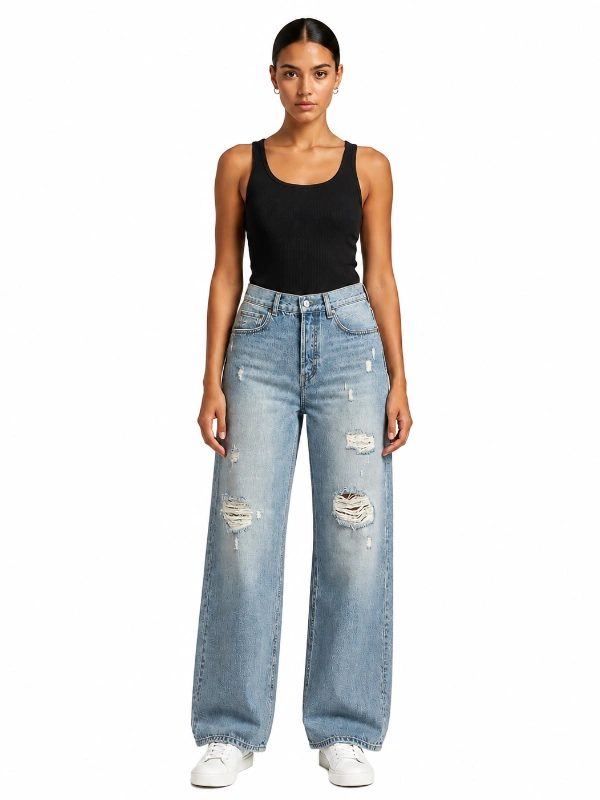
Rigid denim is usually easier to discuss because there is no elastane recovery curve to manage. It is not automatically easier to fit. A 100% cotton fabric may relax, shrink and soften substantially through development. An unsanforized fabric needs a product strategy built around its expected change; a sanforized fabric still needs verification under the intended garment process.
Stretch denim introduces another distinction: extension is not recovery. A fabric can stretch comfortably during a fitting and still grow at the knee, seat or waistband after several hours of wear. Composition alone does not resolve this. One percent elastane in two fabrics may produce different stretch because the yarn type, insertion direction, weave and finishing are different.
Request at least the following for stretch styles:
- fiber content and yarn arrangement, including the direction of stretch;
- available stretch under the agreed test load;
- growth after a defined extension and time;
- recovery after a defined rest period;
- dimensional change after the intended garment wash;
- performance after repeated home-laundering cycles.
ISO lists strip-test methods for determining fabric elasticity under ISO 20932-1. Whatever test method the brand chooses, use the same conditions for fabric approval, sample diagnosis and bulk disputes. Results taken under different loads or rest times should not be compared as though they were equivalent.
A Practical Testing Sequence Before Sampling
A sound development sequence uses small, inexpensive decisions to protect later, expensive ones. It should not begin with cutting a complete size range.
1. Confirm the exact fabric identity
Record mill, article number, dye lot, composition, weave, nominal weight, finished width, stretch direction and finishing route. Keep a sealed approval cutting. A mill swatch with no article number is a color reference, not a production specification.
2. Condition and mark test specimens
Let the fabric reach the agreed testing atmosphere. Mark sufficient distances in warp and weft, away from the selvage and obvious defects. Measure before treatment without pulling or smoothing the specimen into the number you expect.
3. Apply the intended wash and dry route
Use the proposed garment process where possible. If the laboratory method is being used as a proxy for consumer laundering, document the cycle, temperature, detergent, load, drying method and number of cycles. “Wash test passed” is not enough information for a later production team to reproduce the result.
4. Recondition, then measure
Measure only after the agreed conditioning period. Record warp change, weft change and skew. Note surface appearance, hand, shade, stretch and any edge curling. A fabric can meet the shrinkage limit and still be unsuitable because the hand becomes board-like or the shade moves outside the design intent.
5. Sew a wash trial garment
A flat specimen cannot show leg twist, pocket movement, seam puckering or differential shrinkage between shell fabric, pocketing, waistband reinforcement and sewing thread. Use a complete garment in the base size. Measure before and after washing, then photograph it flat and on a form or fit model.
6. Repeat before trusting the average
One specimen can be misleading. Test enough material to expose roll variation and process variation. When a result is close to the acceptance limit, increasing the sample count is cheaper than discovering during bulk production that the first result was unusually favorable.
Translating Test Results Into the Pattern
The measurement chart should define finished-garment dimensions unless the commercial agreement clearly states otherwise. Buyers buy the garment after its approved wash, not the unwashed shell leaving the sewing line. Pattern compensation is then based on verified process data.
Suppose the target finished inseam is 80 cm and the validated process produces 4% length shrinkage. A simple starting calculation for the pre-wash dimension is:
Required pre-wash dimension = finished target / (1 - shrinkage rate)
In this example, 80 / 0.96 = 83.33 cm. That does not mean the pattern inseam should automatically be set to 83.33 cm. Seam construction, sewing take-up, pressing and measurement method still affect the garment. The calculation provides a controlled starting point; the physical sample confirms it.
Do not apply one shrinkage percentage to the entire pattern. Waistband construction may behave differently from the body. A bias-cut yoke, fused waistband, pocket bag and rigid embroidery can each restrict or redirect movement. Use point-of-measure results from the wash trial to adjust relevant pattern areas, then check the balance of the garment rather than chasing each number independently.
For guidance on documenting those points, see the denim tech pack guide for jeans sampling. The version number of the pattern, measurement chart and wash standard should move together. A revised pattern tested against an old wash recipe produces a result that cannot be diagnosed cleanly.
Wash Development and Approval
Wash approval is often treated as a color decision. It is also a measurement and performance decision. A vintage sample with the perfect shade but unacceptable seam rotation is not production-ready.
During development, separate the creative standard from the process record. The creative standard defines what the buyer sees: shade, contrast, abrasion, whiskers, hand, distressing and overall character. The process record documents how the laundry produced it. The brand may not need every chemical detail, but the manufacturer must control the reproducible recipe, loading and machine conditions.
High-abrasion washes deserve particular attention. CottonWorks explains that denim wet processing and abrasive action remove surface fiber and dye, changing softness and appearance. That same processing can amplify weak yarns, enlarge distressed areas and change measurements. Read the companion denim wash development guide for shade bands, wash standards and bulk consistency controls.
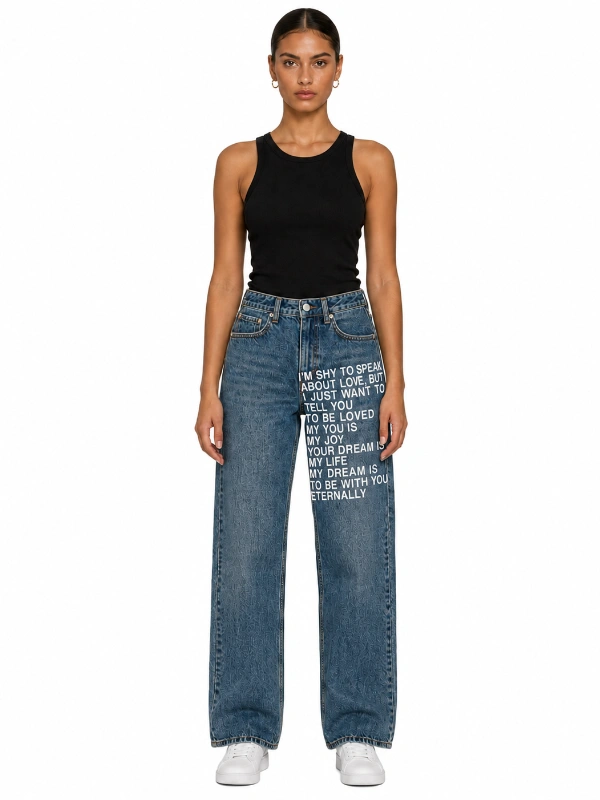
Decorated denim adds one more reason to approve the finished state. A print, embroidery panel, patch or stud layout can resist shrinkage locally. Artwork placed accurately on the unwashed leg may move relative to the knee or pocket after processing. For a statement style such as custom printed straight-leg jeans, placement tolerances should be measured after washing.
Bulk Cutting, Washing and Quality Control
A good pre-production sample proves that the design can be made. It does not prove that every roll and laundry load will behave identically. Bulk control needs checkpoints that identify variation before it spreads through the order.
Fabric receipt
- Verify roll article numbers, dye lots, width, weight and visible defects.
- Test dimensional change by lot when the order uses multiple lots.
- Create a shade grouping before cutting; do not mix rolls casually within one garment.
- Relax fabric for the agreed period before spreading, especially where residual tension is a known risk.
Spreading and cutting
- Keep the approved face and cutting direction consistent.
- Control selvage alignment without forcing the fabric square.
- Use splice rules that prevent shade or defect problems inside a garment bundle.
- Keep tickets that connect cut bundles to the roll and lot.
Sewing
- Check inseam and outseam feeding; differential ply feeding can create apparent twist.
- Control seam margin, stitch density and waistband application.
- Avoid stretching panels during sewing, particularly on elastic fabrics.
- Measure representative garments before washing so sewing variation is not confused with wash shrinkage.
Laundry
- Control load weight, machine, recipe, cycle time, extraction and drying endpoint.
- Use the approved shade range rather than a single photograph viewed on a phone.
- Separate rewash decisions from first-pass production data.
- Measure garments from different loads, not only the first approved load.
Final inspection
Condition garments before final measurement. Inspect seam position on a flat surface and, where silhouette matters, on a form. Confirm finished dimensions, twist, shade, hand, appearance and decoration placement. A useful inspection report identifies the size, color, wash load and sample quantity; a page of pass marks with no traceability has little value in a repeat order.
A custom denim manufacturer should be able to connect these records from fabric approval through bulk inspection. For smaller programs, the same logic applies even when fewer formal documents are used. The control points can be lean; they should not be invisible.
Troubleshooting Common Failures
The inseam is correct, but the jeans are too short
First confirm the measurement method and conditioning. Then compare pre-wash and post-wash rise, inseam and overall outseam. The apparent shortage may be distributed across several vertical areas. Check whether pressing temporarily changed the result and whether the production dryer stopped at the same endpoint as the approved sample.
The first sample fits, but bulk garments vary by load
Look beyond the pattern. Compare fabric lots, laundry loading, extraction and drying. If every load begins with a slightly different garment moisture content or ends at a different dryness, dimensional results can drift. Establish load-level records and measure early output before the entire order is processed.
The leg twists only after home laundering
The factory wash may have masked residual instability or used a process that differs from the care label. Test the approved garment through the stated consumer-care cycle. Review mill skew data, cutting direction and fabric construction. Do not solve the complaint only by rotating a pattern leg unless the revised garment has been validated through repeated laundering.
Stretch jeans grow at the knee and seat
Finished measurements may pass while recovery fails in wear. Review fabric growth and recovery, elastane heat history, pattern ease and wash conditions. A tighter pattern can hide weak recovery during a brief fitting but may create discomfort without solving bagging after several hours.
The wash shade is approved, but measurements are not
Treat the sample as unapproved. Visual and dimensional approvals belong to the same finished garment. If the recipe is adjusted to improve measurements, recheck shade and hand; if the pattern is adjusted, recheck fit and decoration placement. There is no clean shortcut around another controlled trial.
What to Put in the Tech Pack and Purchase Order
The following information gives the mill, garment factory and laundry a shared target:
- fabric mill, article number, fiber content, weave and approved color;
- nominal weight with the measurement stage clearly stated;
- finished width and stretch direction;
- warp and weft dimensional-change limits under the named procedure;
- stretch, growth and recovery requirements where applicable;
- approved skew range or mill skew specification;
- finished-garment leg-twist acceptance method and tolerance;
- garment wash reference, shade range and recipe version;
- pre-wash control measurements and finished measurement chart;
- care-label method used for verification;
- sample size, conditioning time and test frequency for bulk control;
- retained fabric, wash panel and garment standards.
If chemical safety certification is part of the buying requirement, identify it separately from physical performance. OEKO-TEX STANDARD 100, for example, concerns testing textile components for harmful substances. It does not replace dimensional-change, stretch or leg-twist testing. A fabric can meet a chemical requirement and still be unsuitable for the pattern or wash.
Brands preparing a new order can use this list alongside Luokugg’s overview of private-label jeans manufacturing from tech pack to bulk production. Before requesting a quotation, state the style count, quantity, size range, intended wash and whether the fabric is nominated or factory-sourced. Those details make an early cost discussion more meaningful.
Frequently Asked Questions
What is an acceptable shrinkage percentage for denim jeans?
There is no universal percentage that suits every denim. The acceptable limit depends on whether the fabric is sanforized or unsanforized, the wash route, fiber blend, silhouette and finished measurement tolerance. The brand should approve separate warp and weft limits based on the actual fabric and garment process, then verify them in bulk.
Does heavier denim shrink less than lightweight denim?
Not necessarily. Fabric weight alone does not predict dimensional stability. Yarn, weave, density, residual tension, sanforization, fiber blend and wash conditions all affect the result. Compare fabrics using the same test method and finished-garment process.
What causes leg twist in jeans?
Leg twist is mainly associated with torque in the twill fabric as it relaxes during washing, but mill skewing, fabric finishing, cutting direction, garment construction and laundering also influence the visible result. It should be assessed on a complete washed garment.
Can a pattern maker remove denim leg twist?
A pattern adjustment may compensate for a stable, measured tendency, but it should not be used to disguise uncontrolled fabric variation. Confirm the fabric construction, skew and wash first. Any pattern correction must be tested through the intended wash and repeated laundering.
Should jeans be measured before or after washing?
Both measurements are useful. Pre-wash measurements help control sewing and predict the process; post-wash measurements determine whether the garment meets the commercial finished specification. The customer-facing size chart should normally be based on the approved finished state.
How do you test stretch denim for bagging?
Measure extension, growth and recovery under defined loads, times and rest periods, then evaluate the finished garment after wear simulation and laundering. Fiber content alone is not enough. The test conditions must stay consistent when comparing suppliers or lots.
Does sanforized denim still need shrinkage testing?
Yes. Sanforization reduces residual shrinkage but does not prove the performance of the finished garment. The brand still needs to test the actual fabric with its garment wash, construction, drying process and care method.
When should a factory run shrinkage tests for a bulk jeans order?
Test during fabric approval, before pattern compensation is finalized, at the pre-production stage and again when bulk fabric lots arrive. Additional checks are appropriate when lots, wash recipes, machines or drying conditions change.
Final Takeaway
Shrinkage and leg twist become expensive when they are discovered late, not because they are mysterious. The practical solution is to connect fabric data, garment testing, pattern compensation and wash approval in one traceable sequence. Ask for separate warp and weft results. Define skew and twist with measurable limits. Approve the garment after its real wash. Then keep checking the process during bulk production.
For a new jeans project, send Luokugg the fabric article or sourcing brief, finished measurement chart, intended wash, target quantity and care method through the custom denim quotation form. That information allows the development team to identify stability risks before sampling rather than after the first bulk wash.