Jeans fit sample approval is the point where a design becomes a repeatable product, not simply the moment when one pair looks good on one person. A useful approval confirms three things at the same time: the garment measurements are correct, the jeans hang and move as intended, and the factory has enough information to reproduce that result across sizes and production lots.
A fit meeting can go wrong without anyone making an obvious mistake. The sample room may measure the waist along the top edge while the buyer measures it lower down. The approved fit model may have changed. A vintage wash may have shortened the rise and tightened the thigh. A wide-leg sample can match every line in the chart and still collapse at the knee because the fabric is too soft. The numbers pass, but the product does not.
This guide is written for fashion brands, denim buyers, technical designers and product developers working with an external jeans manufacturer. It explains how to build a point-of-measure chart, set realistic tolerances, run a disciplined fit session, approve a size set and hand a stable standard into bulk production.
Start by Separating Three Measurement Systems
Many fit disputes begin because body measurements, garment measurements and pattern measurements are treated as interchangeable. They are related, but they answer different questions.
Body measurements describe the customer
Body measurements define the population the brand intends to fit. Waist girth, hip girth, body rise and stature help create a sizing strategy, but they do not tell a factory the finished width of a pair of jeans. The garment needs ease, shaping and design allowance. A fitted stretch jean may use little or even negative ease in a selected area. A rigid baggy jean needs positive ease and a controlled distribution of volume.
ISO 8559-1 describes anthropometric definitions used to build body-measurement data and size profiles. Its practical lesson for a brand is simple: a size label such as S, M or 30 does not define a body unless the brand has documented what that size is meant to fit.
Garment measurements describe the product
The specification chart records the finished dimensions of the jeans at named points of measure. These are the numbers used to evaluate samples and bulk garments. ISO 18890 defines main garment measurement points and methods, while allowing additional points to be agreed between the parties. A brand can use its own POM system, but each point must be drawn and described clearly enough that different people obtain comparable results.
Pattern measurements describe the engineering
Pattern dimensions include seam allowances, shaping, dart or yoke suppression, sewing take-up and wash compensation. They are not normally the same as finished garment dimensions. A buyer who asks a pattern maker to make the pattern waist equal to the finished waist ignores seam construction and process change. The finished target belongs in the spec; the pattern maker determines how to achieve it.
Keep these systems connected, but do not collapse them into one table. The body chart explains who the product should fit. The garment chart explains what the factory must deliver. The pattern and construction records explain how it will be made.
Define the Fit Before Reviewing the Sample
Words such as slim, relaxed, baggy and wide leg are useful product language, but they are weak technical instructions. A fit brief should state where the garment is intended to sit, where it should follow the body and where volume should be visible.
Before the first fit sample, answer the following:
- Is the waistband designed for the natural waist, high hip or low hip?
- Should the waist feel secure, relaxed or intentionally oversized?
- Is the seat shaped close to the body or dropped?
- Where should the crotch point sit relative to the body?
- Does the leg fall straight from the thigh, open from the knee or taper to the hem?
- Should the hem stack on footwear, break once or finish clean above the shoe?
- Is the silhouette intended to look structured or fluid?
- What undergarment, belt and footwear should be used during fitting?
A reference garment can help, provided its role is specific. State whether it is the standard for rise, leg shape, waistband comfort, fabric hand or overall appearance. “Copy this pair” creates hidden assumptions. A reference may fit well but use a different stretch percentage or wash, so its measurements cannot always be transferred directly.
Choose and Control the Fit Model
The fit model is part of the development standard. Record the model’s relevant body measurements, not only the size they usually wear. For jeans, waist, high hip, full hip, thigh, height and inside leg are a useful minimum. Depending on the silhouette, body rise and calf can also matter.
Use one approved base-size model through the main fit rounds whenever possible. If the model changes, compare body measurements and posture before deciding that the sample changed. Two people with the same waist and hip can carry volume differently. Pelvic angle, seat shape, thigh distribution and stance affect drag lines and waistband position.
The model should stand naturally before the garment is adjusted. Repeatedly pulling the waistband into position or smoothing wrinkles by hand can make a poor pattern look acceptable for a photograph. Ask the model to sit, walk, bend the knee and step up. The fit needs to work between poses, not only in a still front view.
For e-commerce brands, the approved fit model should represent the body profile used to build the size chart, not simply the person available on the day. ISO 8559-3 describes methodology for creating body-measurement tables and intervals. A small brand may not conduct a full anthropometric study, but it should still choose a target customer and keep its block consistent across related styles.
Build a Jeans POM Chart That Two Teams Can Use
A strong point-of-measure chart contains five parts: a POM code, a plain-language name, a diagram, a written method and a target with tolerance. If any one part is missing, a familiar term can still be measured differently.
Typical jeans POMs include:
| POM | Why it matters | Method detail that must be defined |
|---|---|---|
| Waist | Controls position and comfort | Aligned or natural position; along top edge or seam; relaxed or extended |
| High hip | Controls upper fit below waistband | Distance down from a named waist reference |
| Full hip | Controls seat ease and silhouette | Fixed distance below waist or identified fullest level |
| Front rise | Affects waist position and front crotch | From crotch intersection to top edge, following seam shape |
| Back rise | Affects coverage, seat and waistband angle | Same reference logic as front rise |
| Thigh | Controls mobility and upper-leg shape | At crotch or a fixed distance below; measured perpendicular to grain or seam |
| Knee | Controls taper, flare and break | Fixed distance from crotch or hem |
| Leg opening | Defines the finished hem profile | Inside edge or finished seam-to-seam width |
| Inseam | Controls length and knee placement | Crotch point to finished hem along inseam |
| Outseam | Checks overall length and balance | With or without waistband; state start and end points |
| Waistband height | Affects support and rise | Finished height, including or excluding seam |
| Fly length | Affects function and proportion | From named waistband point to bottom stop or visible stitch |
| Pocket placement | Affects visual balance and function | Reference from center back, yoke, side seam or waistband |
Do not overload the chart with measurements that nobody uses. Every POM should protect fit, function, appearance or legal labelling. At the same time, do not omit a visually important placement because it is difficult to measure. Back-pocket spacing, yoke depth and knee panel position can change the character of the style even when the main girths pass.
Use the same POM codes across the sketch, measurement chart and fit comments. The denim tech pack guide explains how version control keeps those files aligned. If a POM method changes after the first sample, change its revision and remeasure the approved reference; otherwise, old and new results will appear to disagree.
How to Measure Jeans Consistently
Measurements are reliable only when the garment and method are controlled. Before measuring, confirm the sample number, pattern version, fabric lot, wash code, size and conditioning status. Close the zipper and button unless the method says otherwise. Lay the garment on a flat table without stretching it into shape.
For a straight measurement, place the tape flat and avoid following a curved seam unless the specification explicitly requires an “along seam” method. Do not lift the tape over thick belt loops or hardware. If bulky construction affects the path, state the method in the diagram. Measure half-girths consistently and label them clearly; writing “waist 42 cm” without saying it is a half measurement invites a serious ordering error.
Denim needs a defined smoothing rule. A rigid washed garment may not lie perfectly flat, while stretch jeans can be extended accidentally with very little force. “Gently smoothed, without tension” is common language, but the team should demonstrate it on the approval sample. For elasticated or stretch waist styles, the chart may need relaxed and extended measurements with a stated force.
Use calibrated tapes and compare operator technique. When the buyer and factory differ repeatedly on one POM, arrange a short video showing the garment position and tape path. This is more useful than exchanging ten spreadsheets with red numbers.
Set Tolerances Without Weakening the Fit
A tolerance is the acceptable production variation around a target. It is not permission to change the target, and it is not a substitute for accurate pattern making. If the waist target is 42 cm with a tolerance of plus or minus 1 cm, a sample measuring 43 cm may be technically within tolerance. It should not automatically become the new standard for grading or the next production run.
Tolerances should reflect measurement importance, construction difficulty, fabric behavior and the commercial effect of variation. A pocket position can be visually sensitive at a few millimetres. A long outseam may require a wider numeric tolerance without causing a fit failure. Stretch and heavily washed products may need process-aware limits, but a difficult wash is not a reason to accept an unstable waistband.
The table below is an example framework, not a universal standard:
| Measurement group | Example working tolerance | Approval note |
|---|---|---|
| Half waist and half hip | Often +/- 0.5 to 1.0 cm | Use tighter control where fit or size claims are sensitive |
| Front and back rise | Often +/- 0.5 cm | Assess with crotch shape and waistband position |
| Thigh, knee and half opening | Often +/- 0.5 to 1.0 cm | Check symmetry and silhouette, not width alone |
| Inseam and outseam | Often +/- 1.0 cm | Consider wash shrinkage and leg-twist method |
| Pocket and artwork placement | Often +/- 0.3 to 0.5 cm | Visual sensitivity may justify a tighter limit |
| Small construction details | Style-specific | Set a limit that the machine and operation can reproduce |
Approve tolerances before bulk production, not during a failed inspection. Mark critical POMs that affect size, comfort or legal claims. For non-critical points, allow the factory enough room for normal process variation. A specification with an unrealistically tight tolerance on every line creates false failures and encourages selective measuring rather than better manufacturing.
Run a Useful Fit Session
Begin with identification. Read the sample label aloud or record it in the fit notes: style, sample stage, size, date, fabric, wash and pattern version. Measure the garment before placing it on the model. If several critical POMs are outside tolerance, decide whether fitting it will provide useful information. A waist that is 4 cm large can distort every observation below it.
Review the garment in a consistent order:
- Waist position and security: Does the waistband sit at the designed level? Does it gap, roll, pinch or slide?
- Front and back balance: Are the side seams vertical? Does one waistline dip? Is fabric being pulled toward the front or back?
- Rise and crotch: Look for vertical pulling, horizontal folds, excess length, tightness and restricted movement.
- Seat and hip: Check coverage, drag lines and whether pocket bags or yoke seams distort the shape.
- Thigh and knee: Confirm ease in standing, sitting and walking. Check that the knee shaping meets the body at the intended level.
- Leg profile: Step back. Compare left and right legs, seam position, drape, taper or flare and hem break.
- Details: Review pocket access, fly function, belt-loop position, artwork and trim comfort.
Photograph front, back and side views at the same distance and camera height. Add detail photos only when they identify a problem. Mark the issue on the image and connect it to a written action. “Crotch looks strange” is an observation. “Remove 0.7 cm front-rise length at the lower fly area; maintain back rise; submit revised pattern and washed fit sample” is an instruction.
Do not prescribe a pattern correction unless the team understands the cause. A diagonal drag line can come from insufficient width, incorrect length, body asymmetry, grain distortion or a wash issue. The brand can state the desired result and approve the proposed correction. The pattern maker should retain responsibility for pattern balance.
Fit Sample, Size Set and PP Sample Serve Different Purposes
Development or proto sample
The first sample tests whether the design can be interpreted and assembled. Substitute fabric or trims may be acceptable if they do not invalidate the questions being asked. Do not approve final drape, shrinkage or waistband comfort from a substitute that behaves differently from production material.
Fit sample
The fit sample develops the base size and pattern balance. Use the intended or closely matched fabric and the correct wash route as early as possible. Several fit rounds are normal for a new block or complex silhouette; repeated rounds caused by incomplete comments are avoidable.
Size set
A size set checks grading across selected sizes. It is not necessary to fit every size on every round, but the set should expose the grade. Brands often review the smallest, base and largest sizes, with additional sizes where the range changes proportion or uses a separate block. Measure every submitted size and fit at least the sizes most likely to reveal problems.
Pre-production sample
The PP sample confirms the exact bulk fabric, wash, trims, labels, construction, measurements and workmanship before the line starts. It should not be used to reopen an unresolved base fit. If the PP sample changes fit, identify what changed: fabric lot, wash, pattern, construction or measurement method.
Top-of-production sample
A TOP sample checks the real production line output. It confirms that the approved standard survived marker making, cutting, sewing, washing and finishing at bulk scale. It is a production verification sample, not an opportunity to quietly approve a new fit after the order has been made.
The complete sequence is described in the guide to private-label jeans manufacturing. Small orders can combine certain submissions, but the decision behind each stage still needs to be answered.
Account for Wash, Shrinkage and Stretch Before Approval
Denim fit must be approved in the commercial finished state. The garment wash changes dimensions, hand, friction and drape. A raw sewing sample may reveal construction problems, but it cannot confirm the final rise, thigh ease or hem length of a heavily washed jean.
Measure important samples before and after washing. This helps distinguish a pattern issue from a process issue. If the unwashed garments are consistent and the washed garments vary, investigate the laundry and fabric lots. If variation exists before washing, inspect cutting and sewing first.
The denim shrinkage and leg-twist guide explains how warp and weft change should be tested and translated into pattern compensation. Fit approval should use the same wash version as that testing. A revised enzyme time, drying endpoint or softener can change the result enough to require another check.
Stretch denim needs two assessments. The first is initial fit: can the wearer fasten, sit and move comfortably? The second is recovery: does the waistband, knee and seat return after movement and wear? A sample that looks excellent for five minutes can bag after several hours. Record the stretch and recovery requirement in the fabric specification, then test the finished garment rather than relying on elastane percentage.
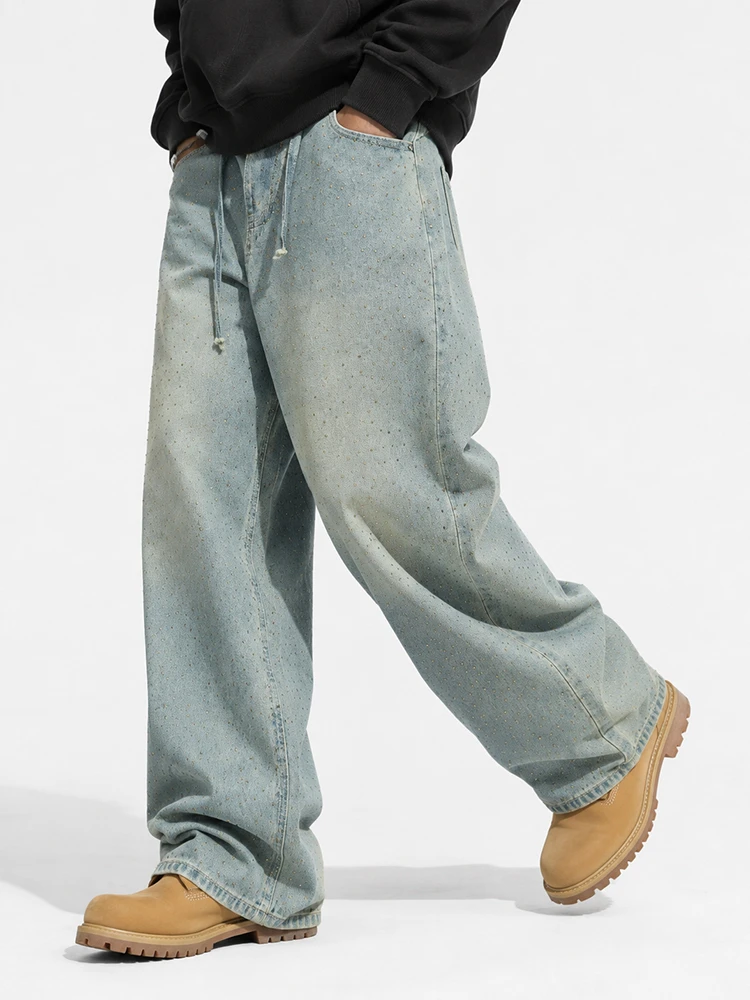
Strong fading can also alter perception. A light center leg with darker side seams may make a leg look narrower. Abrasion at the thigh or knee draws attention to position. Review physical measurements first, then visual balance. Luokugg’s denim wash development guide covers shade standards and bulk wash consistency in more detail.
Diagnose Common Jeans Fit Problems
The back waist gaps
Check the fit model’s waist-to-hip relationship, waistband length and shape, back-rise angle, yoke shaping and stretch recovery. Simply reducing the top edge can create side-seam movement or discomfort. Pin the proposed correction symmetrically, then confirm sitting comfort.
Horizontal folds appear below the front fly
Possible causes include excess front-rise length, insufficient front width, an incorrect crotch curve, waistband position or a stiff fly assembly. Observe the folds in standing and sitting. Do not shorten the rise based on one front photograph if the wearer already lacks movement.
The inseam pulls toward the front
Review front-to-back leg balance, thigh shape, grain, crotch geometry and fabric torque. If the seam moves only after washing, investigate skew and leg twist before rotating the pattern. Compare left and right legs and measure the sample before and after washing.
The knee looks low in larger sizes
The vertical grade may not match the target population, or the longer rise and inseam may have been distributed poorly. Check knee location as a distance from the crotch and as a visual proportion. Larger circumferences do not always require the same proportional increase in every vertical measurement.
The wide leg collapses inward
The leg may have enough width but lack the fabric body needed for the intended silhouette. Check grain, front-to-back width distribution, wash softness and hem construction. Adding circumference can make the garment larger without restoring a clean vertical fall.
The crotch feels tight even though the rise passes
Rise length is only one part of crotch fit. Check crotch extension, curve shape, hip width, thigh width and waistband position. A tape measurement can pass while the three-dimensional shape still lacks room.
The waistband measures correctly but feels loose after wear
Review fabric growth, waistband reinforcement and construction. A relaxed measurement taken before wear does not show recovery. Fit-test the garment after a defined wear period and remeasure it after rest.
Hand the Approved Fit Into Bulk Production
Final fit approval should create a controlled reference package, not a message saying “looks good.” Include:
- signed sample identification and clear approval status;
- approved pattern version and graded nest version;
- final POM chart, diagrams, targets and tolerances;
- approved fabric article, lot requirements and relaxation rule;
- approved wash code, shade range and dimensional-change data;
- construction details that influence fit;
- fit model measurements and dated fit photographs;
- size-set comments and approved exceptions;
- PP sample and retained sealed reference;
- bulk measurement frequency and escalation rule.
During production, factories should measure representative garments before and after washing. Checking only finished units makes diagnosis harder. Sample across sizes, fabric lots, operators and wash loads. Critical POM failures should trigger containment while the affected quantity is still identifiable.
Use tolerances consistently. A garment outside tolerance is not automatically wearable or unwearable; it is outside the agreed production standard. The disposition may be rework, second quality, concession or rejection, but that commercial decision should be documented. Repeatedly accepting an off-target measurement can shift the product fit without anyone formally changing the spec.
A capable custom denim manufacturer should be able to trace the approved pattern, wash and measurement standard through sampling and production. For an OEM project, the buyer normally supplies a more developed block and specification. For an ODM project, the factory may propose the starting block, but the brand still needs to approve who the product fits and how the finished garment will be measured.
Common Approval Mistakes to Avoid
- Approving by photograph only: images cannot confirm comfort, movement, fabric recovery or exact dimensions.
- Fitting the wrong sample: an unlabeled garment or outdated pattern version makes comments unreliable.
- Changing several variables at once: a new fabric, wash and pattern in one round may improve the sample without revealing why.
- Using tolerance to excuse a bad target: within tolerance does not mean the intended fit has been achieved.
- Correcting the garment on the model without measuring the pins: the next sample room cannot reproduce a vague visual adjustment.
- Approving only the base size: a good medium does not prove that the smallest and largest sizes are balanced.
- Ignoring post-wear recovery: stretch jeans can pass an initial fitting and fail after normal movement.
- Starting bulk with open comments: unresolved fit decisions become expensive production decisions.
Jeans Fit Approval Checklist
- The fit intent and target customer are written clearly.
- The approved fit model’s body measurements are recorded.
- The sample label matches the reviewed pattern, fabric and wash versions.
- Every critical POM has a diagram, method, target and tolerance.
- The garment has been conditioned and measured without unintentional tension.
- Front, back and side balance have been assessed.
- Waist, rise, crotch, seat, thigh, knee, leg and hem have been reviewed in movement.
- Pocket, fly, trim and artwork positions support the fit.
- Fit comments state the issue, desired result and next action.
- Photos and pinned corrections are measured and attached to the revision.
- The size set confirms the grade at the selected size extremes.
- The PP sample uses bulk fabric, wash, trims and construction.
- Bulk measurement frequency and failure escalation are agreed.
Frequently Asked Questions
What is a jeans fit sample?
A jeans fit sample is a development garment used to evaluate the base-size measurements, pattern balance, ease, silhouette, comfort and movement before production. It should be identified by pattern version, fabric, wash, sample stage and size.
Can jeans be approved if the measurements pass but the fit looks wrong?
No. Passing measurements confirm only the listed dimensions. The jeans can still have poor balance, an unsuitable crotch shape, incorrect volume distribution, fabric collapse or uncomfortable movement. Both measurements and physical fit must be approved.
What measurements are most important for jeans?
Critical measurements usually include waist, high hip or full hip, front rise, back rise, thigh, knee, inseam, outseam and leg opening. Waistband height, fly length, yoke depth and pocket placement may also be critical depending on the style.
What is the difference between a fit sample and a size set?
A fit sample develops and approves the base size. A size set checks whether the approved base pattern grades correctly into selected smaller and larger sizes. A size set should not be used to hide unresolved base-fit problems.
How many fit sample rounds are normal for custom jeans?
There is no fixed number. A known block with a simple modification may need fewer rounds than a new silhouette, unfamiliar fabric or complex wash. The goal is not to minimize rounds at any cost; it is to make each round answer clear questions without repeating avoidable errors.
Should a fit sample use the final denim fabric and wash?
Yes, as early as practical. Substitute material may be useful for checking construction, but final drape, measurements, stretch recovery and comfort should be approved in the intended fabric and wash. The PP sample should use bulk materials and processing.
How should measurement tolerances be chosen?
Set tolerances according to fit importance, measurement length, fabric behavior, construction capability and visual sensitivity. Tolerances should be achievable in production without allowing the intended fit to drift. They must be agreed before bulk inspection.
Who should approve a jeans fit sample?
The brand’s authorized product or technical representative should give commercial approval, supported by the pattern maker, factory technician and fit model observations. The approval record should identify the decision-maker and the exact sample version.
Final Takeaway
A good fit is not created by adding more measurements to a spreadsheet. It comes from a stable relationship between the target body, garment specification, pattern, denim fabric and wash. Define the silhouette before the first sample. Measure the same way every time. Fit the correct version on a controlled model. Use size sets to test the grade and a PP sample to prove production readiness.
Brands preparing a new jeans style can send Luokugg the tech pack, target body or reference block, sample size, size range, fabric direction, wash reference and order quantity through the custom denim quotation form. A complete brief allows the development team to identify fit risks before sample rounds begin.