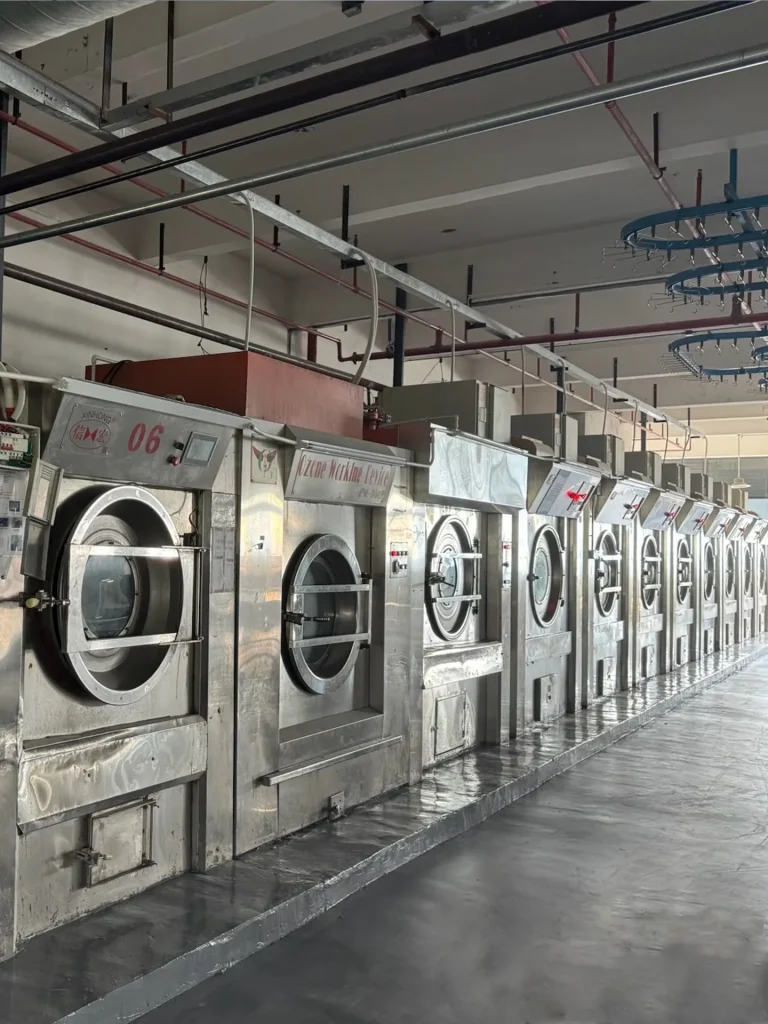
Ligne de production automatisée de lavage à l'ozone à Zhongshan, Guangdong1
2026 Approvisionnement international en vêtements en denim & Guide de contrôle des risques de la chaîne d’approvisionnement
je. Identifier les usines sources & Vérifier les résultats
Dans la phase initiale de sourcing, la plus grande peur est de rencontrer « intermédiaires » déguisés en usines sources majeures. Pour vérifier leurs véritables capacités, nous adoptons une approche en deux étapes:
- [Contrôle de qualification documentaire]: Les entreprises locales authentiques de lavage et de fabrication doivent posséder les « Trois certificats et un document »—Licence commerciale, Approbation de l'EIE, Permis de rejet de polluants, et certificat d'acceptation de sécurité incendie.
- [Inspection de pénétration sur site]: Ignorez les commerciaux qui se vantent de la superficie de l'usine; la seule norme pour évaluer la capacité de production quotidienne est de compter les machines à laver. Une usine a besoin d'au moins 10 machines à laver en marche pour traiter des commandes à grande échelle.
- [Le vétéran’Le coup ultime]: Demandez directement au directeur de l'usine le « Calendrier de production de l'atelier, » « Grand livre d'entretien de l'équipement, » et « Grand livre chimique de la passerelle ZDHC. »
II. Répartition du devis & Paris sur les délais
- Méfiez-vous du piège des bas prix: La structure des coûts est transparente: Tissu (40%) + Lavage (30%) + Travail (20%) + Profit (10%). Les citations qui réduisent considérablement cette valeur de référence signifient des tissus déclassés ou un lavage écologique ignoré.
- Verrouillage des pénalités de délai: Ajouter directement une clause de pénalité de retard: « 0.5% du montant total de la commande compensé par jour de retard. »
- Pack technique (TP) Modification de la ligne rouge: Les modifications non autorisées provoquent généralement un 7 à 15 jours de délai. Exigez toujours un rapport d’évaluation de l’impact du changement.
III. Contrôle de la qualité des tissus: Laboratoire vs. Tests à l'aveugle
[Lignes rouges des tests en laboratoire (ASTM/AATCC)]
- Tolérance de poids: ±5% (ASTM D3776)
- Rétrécissement: Déformation ≤3 %, Trame ≤2% (AATCC 135)
- Résistance à la traction: Chaîne ≥40kgf, Trame ≥30kgf (ASTM D5034)
[Astuces de test à l'aveugle en atelier]
- Saisissez la jambe: Prime 100% le coton est solide et résistant. S'il semble mou et laisse des plis morts, il’est mélangé avec du polyester bon marché.
- Frottement du dos de la main: Le coton de grande qualité a une texture naturelle et rugueuse.. Rejetez tout ce qui semble gras comme le plastique.
- Tirez un fil et brûlez-le: Le pur coton brûle en cendres avec une odeur de papier. S'il s'agglutine en une perle en plastique dur, il’c'est un mélange de poly-coton.
IV. Lavage écologique: Processus vs. Test d'eau minérale
- Grattez les moustaches: Une bonne transition laser/ozone s’estompe doucement. Si vous pouvez gratter la poudre blanche avec un ongle, il’peinture à la main avec pigments bon marché.
- Le test de trempage dans l’eau minérale: Faire tremper un morceau dans de l'eau minérale pendant 15 minutes. Le lavage haut de gamme à l'ozone et aux enzymes laisse l'eau claire; un lavage acide agressif rend immédiatement l'eau noire et boueuse avec une odeur aigre.
V. Les angles morts de l’artisanat: QI contre. Domaines clés
- Classement AQL du Québec: NQA critique 1.5, NQA majeur 2.5, QI mineur 4.0. La détection des métaux identifie le fer ≥0,8 mm.
- Sentez la couture croisée à l'entrejambe: Un bon savoir-faire s'aligne à plat. Les marchandises de qualité inférieure gonflent et se déchirent dans les 1 à 3 mois suivant la friction..
VI. Conformité internationale & Résumé d'initié
Pour gérer les achats mondiaux, les obstacles à la conformité doivent être éliminés (CPSIA, ATTEINDRE, OEKO-TEX 100, GRS, HAUT CINQ).
Acheteur vétéran’s Chant d'inspection rapide
« Le tissu glissant cache le polyester; La décoloration par frottement à sec signifie un colorant de qualité inférieure. »
« Les fondus rigides qui grattent en poudre sont 9/10 un lavage pigmentaire. »
« Un entrejambe bombé et des points de suture en désordre exposent une main-d’œuvre bon marché. »
« L’eau qui devient noire avec une odeur aigre prouve un lavage acide non écologique. »
VII. Perspective finale sur l'approvisionnement professionnel
En conclusion, la complexité de 2026 le commerce mondial exige plus que la simple conformité sur papier. Que vous soyez une nouvelle startup ou un détaillant établi, professionnel Approvisionnement en vêtements en jean implique une compréhension approfondie des normes techniques et de la réalité sur le terrain de l’usine. En mettant en œuvre les mesures de contrôle des risques évoquées dans ce guide, vous pouvez réduire considérablement les échecs de production en vrac et construire une chaîne d'approvisionnement résiliente qui garantit votre marque’la réputation de qualité supérieure.
Envoyer une demande