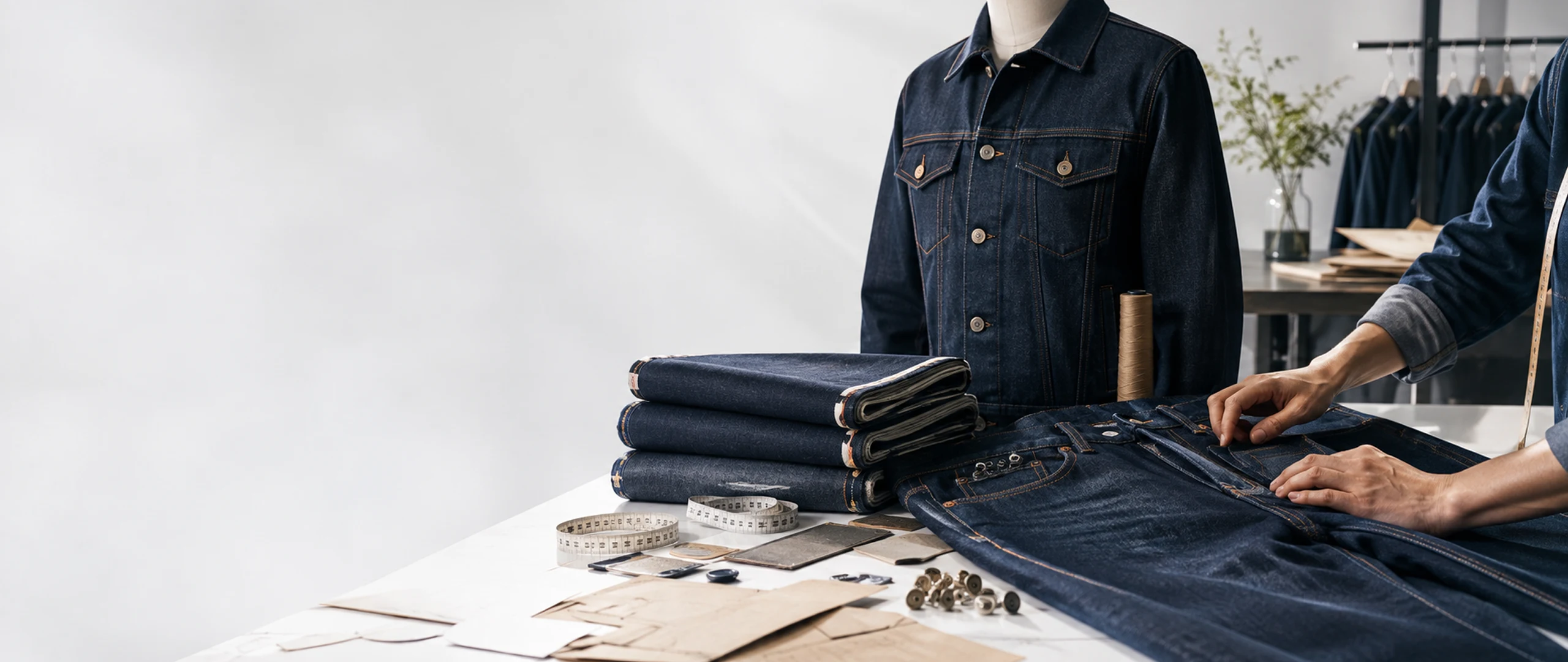
Private label denim jacket manufacturing begins long before bulk sewing. For a fashion brand, the real work is translating an idea into a repeatable product: selecting denim, engineering the fit, developing the wash, specifying trims and labels, approving samples and defining the quality standard that production must follow. When these decisions are controlled early, a denim jacket becomes much easier to reproduce across sizes, colors and repeat orders.
What Private Label Denim Jacket Manufacturing Actually Means
The term private label is sometimes used for little more than attaching a new brand label to an existing garment. That model can work for businesses that need speed, but it offers limited product differentiation.
A more developed private label program allows the brand to control the fabric, pattern, wassen, pocket construction, hardware, stitching, labels and packaging. The finished product is therefore built around the brand’s specifications rather than being a generic jacket with a different neck label.
This distinction matters in denim. A standard jacket pattern made in a different fabric and wash can already look noticeably different. Change the shoulder, body length, zakken, buttons and surface treatment as well, and the product has very little in common with the original base garment.
For buyers, private label denim jacket manufacturing should therefore be treated as a product-development process rather than a printing or labeling service.
Brands that need complete custom development can review Luxappare’s op maat gemaakte denimproductie capabilities, while existing jacket styles can be explored in the custom denim jackets collection .
Choose the Right Production Model Before Developing the Jacket
Not every brand requires the same level of factory involvement. Some buyers arrive with graded patterns, approved fabrics and complete technical packages. Others have only reference images and a clear idea of the customer they want to serve.
These projects should not be managed in the same way.
| Production Model | What the Brand Provides | Factory Responsibility | Best For |
|---|---|---|---|
| OEM | Technical drawings, measurements and specifications | Inkoop, sampling and production to supplied requirements | Established brands with technical development teams |
| ODM | Ideas, references, sketches or target products | Pattern, sourcing, sampling and technical development | Brands needing product-development support |
| Private Label Customization | Brand direction and selected product base | Modify wash, versieringen, etiketten, packaging and selected design details | Brands seeking faster market entry |
For a completed tech pack, Luxappare's OEM-denimproductie route is the more direct option. Brands working from inspiration images or initial concepts can use ODM denim development to build the pattern and specification before production.
Defining this responsibility at the beginning prevents a common sourcing problem: the buyer assumes the factory will redesign a pattern, while the factory assumes it is expected only to reproduce the supplied measurements.
A Strong Private Label Denim Jacket Starts With a Useful Product Brief
A useful inquiry gives the manufacturer enough information to understand both the product and the commercial objective. It does not need to contain every technical detail on day one, but it should go beyond a single reference photo.
Before starting private label denim jacket manufacturing, prepare as much of the following information as possible:
- Target customer and retail market
- Heren, dames- of unisex-pasvorm
- Reference images or physical garment
- Desired silhouette
- Preferred denim weight
- Rigid or stretch construction
- Target wash shade
- Custom pockets or panels
- Buttons and metal hardware
- Borduurwerk, printing or patches
- Brand labels and packaging
- Order quantity and size range
A target price is also useful when it is realistic. It allows the factory to recommend materials and construction methods that fit the commercial position of the garment.
Without a target, a manufacturer may propose a premium heavy fabric and expensive custom hardware for a jacket that is ultimately expected to sell in a lower price category.
Fabric Selection Comes Before Wash Development
The denim fabric is the foundation of the jacket. Its weight, weave, fiber composition, yarn character and finishing influence how the garment feels before washing and how it changes afterward.
CottonWorks explains that denim appearance and finishing depend on the relationship between fiber, yarn, verven, fabric construction and garment finishing. Zijn Denim Basics resource is useful background for brands that want to understand why similar-looking denim fabrics can behave differently during finishing.
Lichtgewicht denim
A lighter denim can produce a softer jacket with more drape. It may be appropriate for shirt jackets, women’s collections, warm climates or brands that want denim without a heavy workwear feel.
Middelzwaar denim
Midweight constructions are widely useful because they retain recognizable denim structure without making the garment excessively heavy. They also work with a broad range of commercial wash treatments.
Heavy denim
Heavy denim can create a rigid, premium or workwear-inspired product. It also makes collars, cuffs, plackets and pocket seams substantially thicker, which changes both sewing difficulty and comfort.
The correct choice depends on the product, not on the assumption that a heavier fabric automatically means better quality.
Brands can use Luxappare’s ontwikkeling van op maat gemaakte denimstoffen to evaluate weight, samenstelling, color and fabric character before the jacket sample is finalized.
Fit Should Be Developed Before the Jacket Is Loaded With Details
One of the more expensive product-development mistakes is spending time perfecting embroidery, buttons and washing before the base pattern fits correctly.
The first sample should answer basic questions. Does the shoulder sit where the designer intended? Is the chest volume correct? Does the jacket close cleanly? Are the sleeves proportioned to the body? Is the length right for the target customer?
These questions apply whether the design is slim, regular, bijgesneden, boxy or oversized.
During a fitting, review:
- Neckline position
- Shoulder width
- Chest and back width
- Armhole depth
- Sleeve length
- Bicep circumference
- Front and back body length
- Hem or waistband width
- Pocket position on the body
- Movement when arms are raised
A jacket should be reviewed on a person or form rather than only measured flat. Two garments can have identical chest measurements while creating different silhouettes because of shoulder position, armhole shape and fabric structure.
Construction Details Determine Whether the Jacket Feels Commercial or Premium
Most customers never see the production pattern, but they notice when a collar does not sit correctly, a front placket twists or pocket flaps are uneven. Construction quality becomes especially visible in denim because seams often become more pronounced after washing.
A private label denim jacket specification may define:
- Topstitch width and thread color
- Shoulder and yoke construction
- Pocket shape and reinforcement
- Collar construction
- Cuff and sleeve placket details
- Front button spacing
- Hem or waistband structure
- Bar tack placement
The sample room also needs to manage bulk at seam intersections. A heavy denim jacket may contain several fabric layers where the collar meets the front placket or where a pocket flap attaches to the body.
Changing fabric after the sample is approved can therefore create construction problems even when the replacement looks visually similar.
Wash Development Is Part of Private Label Denim Jacket Manufacturing
Wash is one of the most effective ways to give a private label jacket its own identity. The same pattern can become a clean dark indigo jacket, a commercial medium-blue style, a faded vintage garment or a heavily distressed streetwear piece.
CottonWorks’ technical material on denim finishing describes processes including stone washing, enzyme treatment and softening. In commercial production, a final appearance may use several processes together.
The correct sequence depends on the fabric and design. A jacket with embroidery, patches or printed artwork also requires planning because decorative processes may react differently to washing.
A wash reference should define more than “vintage blue.” Buyers should evaluate:
- Overall shade
- Seam contrast
- Fading around pockets
- Collar and cuff abrasion
- Garment softness
- Distressing intensity
- Tint or cast
- Final measurements after wash
Luxappare's op maat gemaakte denimbewerking service can support washing, verontrustend, borduurwerk, afdrukken, patches and other surface treatments during product development.
Practical rule: never approve a private label jacket’s fit only before washing. The approved production garment should be evaluated after the intended wash because finishing can change both dimensions and fabric behavior.
Private Label Branding Is More Than a Neck Label
Branding is where an otherwise well-developed garment can begin to feel generic if the details are treated as an afterthought.
Depending on the collection, private label denim jackets can include:
- Custom main label
- Size label
- Care and composition label
- Leather or jacron patch
- Custom metal buttons
- Aangepaste klinknagels
- Borduurwerk
- Screen printing
- Woven patches
- Hangtags
- Branded polybags
- Custom carton markings
Metal hardware deserves early attention because custom molds and finishes can have different minimum quantities and development times from the garment itself.
A brand developing 100 jackets may discover that a completely custom metal button has a much higher supplier minimum. In that situation, using an existing button shape with a coordinated finish may be commercially smarter for the first order.
The objective is not to customize every component. It is to choose the components that customers actually notice and that reinforce the brand’s identity.
Sampling Is Where Private Label Denim Jacket Manufacturing Becomes Measurable
A sample converts design ideas into a physical production standard. This is why sample development should not be rushed merely to reach the bulk order faster.
Concept Review
Confirm the silhouette, reference product, target market, fabric direction, branding and estimated quantity.
Pattern Development
Build or adjust the pattern around the intended fit rather than relying only on generic size specifications.
First Prototype
Review proportion, bouw, pocket placement and basic measurements before final wash details are locked.
Fit Revision
Document changes to shoulder, chest, sleeve, length and other measurements in a clear revision sheet.
Wash and Trim Approval
Develop the final wash, hardware, labels and surface details on the corrected garment.
Goedkeuring vóór productie
Approve the complete garment using production fabric, final measurements, bouw, wash and branding.
A first sample does not need to be perfect to be useful. Its purpose is to reveal what needs to change before the cost of those changes is multiplied across a bulk order.
Revision comments should be measurable. “Make it slightly shorter” is weaker than “reduce center-back length by 2 cm.” The second instruction can be applied and checked objectively.
What Determines the Cost of a Private Label Denim Jacket?
Unit price should be evaluated against the actual specification. A simple dark-rinse jacket and a distressed jacket with custom hardware may use a similar amount of denim, yet their labor and finishing costs can be very different.
Typical cost drivers include:
- Denim fabric price
- Fabric consumption
- Number of sewing operations
- Wash complexity
- Manual distressing
- Embroidery or printing
- Op maat gemaakte metalen hardware
- Labels and patches
- Verpakking
- Bestelhoeveelheid
Brands working to a target price should identify which details carry the most commercial value. A distinctive wash and strong fit may influence the customer more than an expensive hidden construction detail.
This is where a manufacturer should be able to suggest alternatives rather than simply removing quality. Cost engineering means finding a more efficient way to achieve the design, not making the garment worse.
Low MOQ Private Label Denim Jackets Require Smart Product Planning
Low MOQ production can be useful for new brands, test drops and limited capsule collections. Luxappare currently offers selected low MOQ denim programs starting from 100 pieces depending on the style and specification.
More information is available through the op maat gemaakte denimproductie met lage MOQ dienst.
The garment MOQ, Echter, is only part of the equation. A fabric mill, custom button supplier or packaging vendor may operate with a different minimum.
Small brands can control this by reducing unnecessary variables. Instead of developing three completely different fabrics and four metal finishes, a first collection may use one fabric and one hardware family across several styles.
This allows private label denim jacket manufacturing to remain commercially realistic at a smaller volume while still creating enough differentiation through fit, wash and branding.
Quality Control Should Be Defined Before Bulk Production Begins
Quality cannot be managed effectively when the standard is simply “make it good.” The factory and buyer need measurable criteria.
| Inspectiegebied | Wat te controleren | Typical Risk |
|---|---|---|
| Afmetingen | Chest, shoulder, sleeve, length and hem | Pasvormveranderingen na het wassen |
| Pockets | Positie, dimensions and symmetry | Visible left/right mismatch |
| Collar | Vorm, symmetry and roll | Uneven collar or excess bulk |
| Hardware | Finish, functie en bevestiging | Loose or mismatched buttons |
| Wassen | Schaduw, fading and hand feel | Variation outside approved range |
| Stitching | Density, broken stitches and seam security | Weak seams or inconsistent topstitching |
| Branding | Label, patch and artwork position | Incorrect placement or orientation |
A physical approval sample should remain available during production so the factory has a visual standard in addition to written measurements.
Brands that require testing for harmful substances can review OEKO-TEX-STANDAARD 100 .
For chemical-management programs involving denim dyeing and finishing, the ZDHC Lijst van stoffen met beperkte productiebeperking is another relevant industry reference.
The Best Private Label Program Is Designed for Repeat Orders
A successful first order should leave behind more than finished inventory. It should create a manufacturing record that can be used again.
Keep the final:
- Pattern version
- Measurement specification
- Fabric code
- Goedgekeurd wasmonster
- Button and trim specification
- Label artwork
- Packaging instructions
- Production comments
This becomes important when the brand reorders the jacket months later. Without controlled references, a repeat order can slowly drift away from the original fit and wash.
If the original fabric is discontinued, a replacement should be tested rather than automatically substituted. The new fabric may shrink or fade differently even if its pre-wash color is similar.
The same discipline allows a successful jacket to become a product family. The approved fit may later be produced in black, light blue or distressed denim without rebuilding the entire development process.
What Brands Should Expect From a Private Label Denim Jacket Manufacturer
A useful manufacturer does not need to agree with every idea immediately. In fact, technical questions are often a positive sign.
If a factory asks about fabric weight, wassen, measurement tolerance, trim minimums or intended retail positioning, it is trying to understand whether the design can be manufactured consistently.
A capable supplier should be able to explain:
- Which fabric options are practical
- What information is missing from the tech pack
- Whether the wash can be reproduced consistently
- Which trims may create MOQ issues
- What sample stages are required
- How long development is expected to take
- Which measurements are affected by washing
- How production quality will be controlled
Brands can review examples of denim styles and finishes in the Luxappare custom denim product gallery before preparing a development inquiry.
For a new project, the custom denim manufacturing contact page can be used to send product references, hoeveelheid, fabric direction and production requirements.
Buyer recommendation: do not select a factory only because it gives the fastest quotation. In private label denim jacket manufacturing, the quality of the questions a supplier asks before quoting can be as important as the number on the quotation itself.
Frequently Asked Questions About Private Label Denim Jacket Manufacturing
What is private label denim jacket manufacturing?
Private label denim jacket manufacturing is the development and production of denim jackets for a brand using customized specifications such as fabric, fit, wassen, etiketten, knoppen, borduurwerk, patches and packaging.
Can I manufacture private label denim jackets without a tech pack?
Ja. Brands without a completed tech pack can use ODM development from sketches, reference photographs or physical samples. Measurements and technical standards still need to be established before bulk production.
Can I customize the denim fabric?
Ja. Denim can be selected according to weight, samenstelling, strekken, kleur, construction and wash performance. Fully custom fabric may require a higher minimum than using an available mill fabric.
Can I add my own buttons, labels and patches?
Ja. Private label projects can include branded main labels, care labels, pleisters, knoppen, klinknagels, borduurwerk, afdrukken, hangtags and packaging. Individual trim suppliers may have their own minimum quantities.
What is the MOQ for private label denim jackets?
MOQ depends on fabric, wassen, trims and product complexity. Luxappare supports selected low MOQ custom denim projects starting from approximately 100 stukken, subject to the final specification.
Can I develop a custom vintage wash?
Ja. Denim jackets can be developed in dark rinse, medium blue, light vintage, washed black, distressed and other finishing directions. A physical wash sample should be approved before bulk production.
How many samples are normally needed?
The number depends on the complexity of the jacket. A project may require an initial prototype, fit revision, wash sample and final pre-production sample. More complex construction or washing may require additional revisions.
What should I send when requesting a quotation?
Send reference images or a tech pack, expected quantity, maatbereik, fabric direction, wash requirement, branding details and target delivery schedule. Providing more complete information allows the manufacturer to prepare a more meaningful quotation.
Start Your Private Label Denim Jacket Manufacturing Project
Send Luokugg your jacket reference, technical drawings, doelhoeveelheid, denim fabric direction, wash requirements and private label details. Our team can review the product structure and development requirements before sampling and bulk production.