A denim fabric specification is the written agreement that turns a swatch into a repeatable production material. It tells the mill, garment factory, laboratory and buyer exactly which fabric is being ordered, which condition is being measured, how it must perform and what evidence releases the bulk lot. Without that document, phrases such as “12 oz blue stretch denim” leave most of the important decisions open.
Two fabrics can carry the same fibre blend and nominal weight yet make very different jeans. One may feel dry and structured; the other may collapse after washing. One may stretch comfortably and recover cleanly; the other may bag at the knee before lunch. A difference in usable width can change marker consumption. A difference in shrinkage can change finished measurements. A change in skew can turn a straight inseam into visible leg twist.
This guide is written for fashion brands, technische ontwerpers, merchandisers and sourcing teams buying denim for custom jeans. It explains what belongs in a practical specification, how to distinguish nominal claims from measured results, how to connect fabric data with garment wash and fit, and how to approve a bulk lot without relying on colour memory or a supplier catalogue. It also includes formulas, worked examples, an approval workflow and a specimen specification matrix.
Why a Swatch Is Not a Denim Fabric Specification
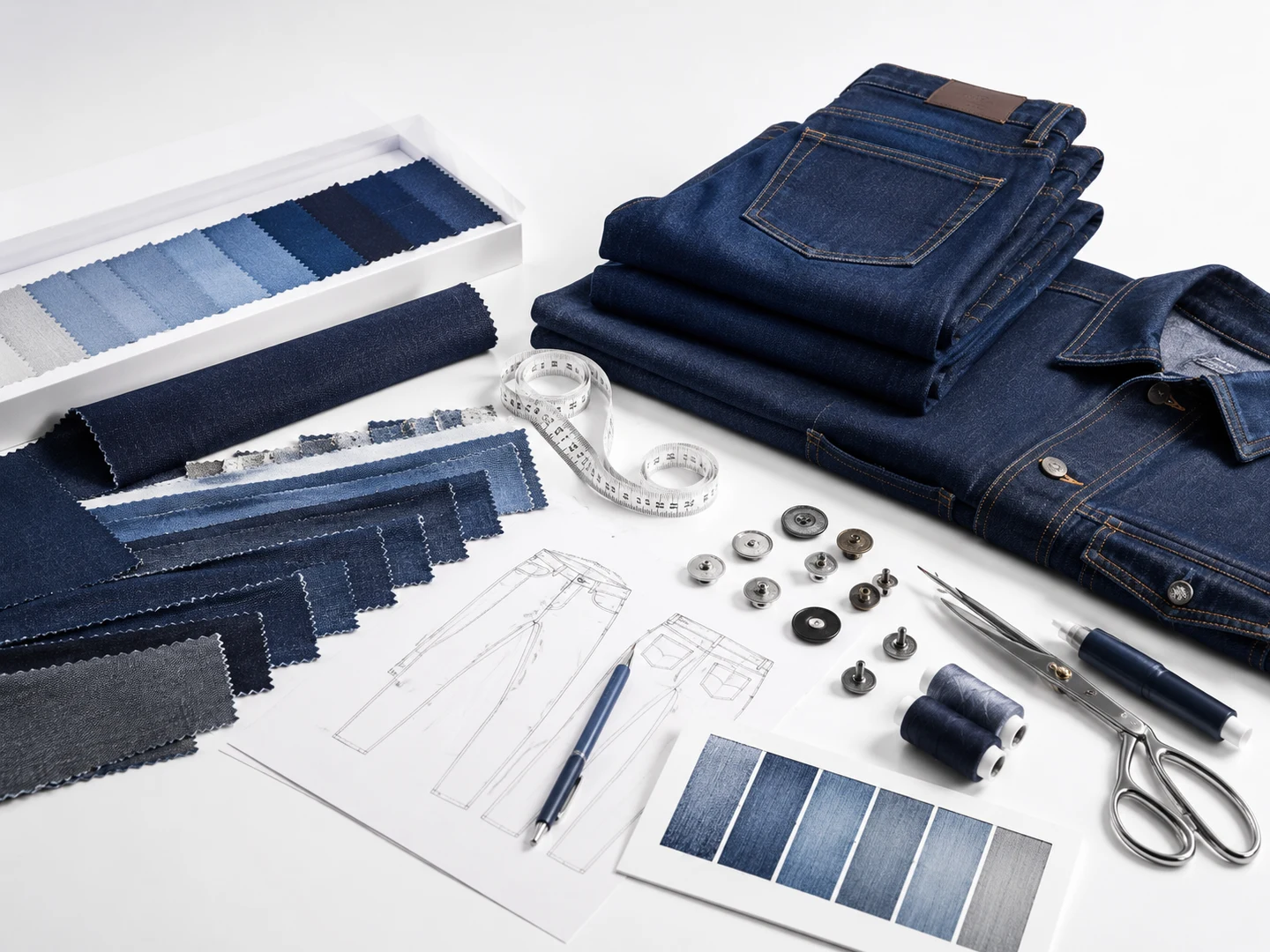
A swatch is excellent for touch, kleur, surface character and early design decisions. It is weak evidence for a production contract unless its identity and condition are known. A hand-cut piece may have no roll number, no finish stage and no record of where across the width it came from. It cannot show roll-to-roll shade variation, bruikbare breedte, defect distribution or the full behaviour of a garment wash.
A useful approval package has three different elements:
- Written specification: the measurable construction, performance and tolerance requirements.
- Physical standard: the sealed fabric and washed-garment references that define appearance and hand.
- Production evidence: lot-specific inspection and test results proving that the delivered material matches both.
None replaces the others. A lab report cannot fully describe visual slub character. A beautiful hand standard cannot prove wet crocking or tear strength. A specification copied from the mill catalogue may describe the article in general but not the actual production lot.
Use one controlled name
A brand may call a fabric “Heritage Indigo 12.5,” the mill may call it article XZ-417B and the garment factory may call it supplier code D-08. Put all three names on the same page. When a later email says “use the approved blue denim,” the team should be able to trace that sentence to one article, kleur, finish and approval date.
Start With the Jeans, Not the Test List
The most common specification mistake is asking for every available test before defining what the garment must do. Begin with the product requirement profile. A rigid straight jean, a fitted flare, a soft wide-leg style and a heavy workwear jacket do not need the same balance of drape, kracht, stretch and shrinkage.
Write a short use statement:
- product type and target fit;
- customer and intended use;
- target season and climate;
- desired structure, drape and hand;
- rigid, comfort-stretch or high-stretch behaviour;
- planned garment wash and visual effects;
- care instruction under consideration;
- target market and applicable requirements;
- expected retail position and durability claim;
- order quantity, repeat potential and price basis.
Bijvoorbeeld: “Relaxed five-pocket jean for year-round menswear; structured but broken-in hand after a medium vintage wash; no deliberate stretch; stable knee and seat; machine wash and tumble dry; target finished fabric around 12.5 oz/yd2.” That statement gives the mill and garment developer a direction. “Need premium denim” does not.
The planned wash belongs in the brief because it can change mass, dikte, hand, kracht, schaduw, stretch and dimensions. Select the fabric and wash together. De Ontwikkelingsgids voor denimwassing explains how visual references become a controlled production recipe.
Lock the Material Identity and Measurement Stage
A denim fabric specification should begin with identity, before any pass/fail value:
| Identity field | What to record | Why it matters |
|---|---|---|
| Mill and manufacturing site | Legal supplier and actual production facility | The same trader may source similar articles from different mills. |
| Article code | Mill code plus buyer/factory cross-reference | Descriptions such as “12 oz indigo” are not unique identifiers. |
| Colour and dye route | Colour code, indigo/sulphur route, bottom/top treatment where relevant | The unwashed shade and washdown character depend on the route. |
| Finish code | Mill finish, sanforization, skewing, coating, resin or softener | Finish changes dimensions, hand and test results. |
| Lot identity | Dye lot, finishing lot, roll numbers and manufacturing date | Bulk evidence must trace to the material actually cut. |
| Condition tested | Loomstate, finished roll, conditioned specimen, washed fabric or garment | The same property can change substantially between stages. |
| Approved references | Sealed swatch and washed garment IDs, date and sign-off | Appearance needs a controlled comparison standard. |
Never write a weight, width or shade value without naming the stage. “Gewicht: 420 GSM” could mean loomstate cloth, finished roll or fabric removed from a washed garment. Those are different materials for decision-making purposes.
Fibre Composition and Yarn System
Fibre content is usually written as percentages by mass, but a correct total does not tell the buyer where each fibre sits. In stretch denim, elastane may be in the weft only. Polyester may be part of a core-spun stretch yarn rather than spread uniformly through the cloth. Recycled cotton may be blended in one yarn system. The location changes performance and labelling implications.
Record:
- declared fibre percentages and test basis;
- warp and weft fibre composition separately where useful;
- type and placement of stretch yarn;
- virgin, recycled or certified fibre claim and supporting chain of evidence;
- cotton origin claim only when documented;
- blend tolerances permitted by the buyer and target-market rules;
- supplier declaration and independent verification frequency.
Do not infer performance from elastane percentage. Two fabrics containing 2% elastane can have different stretch, growth and recovery because yarn construction, weven, density, finishing and test load differ. Specify the behaviour you need.
Ringgesponnen, open-end and slub language
If yarn character is part of the product, state it precisely. “Ring-spun look” is not the same as a ring-spun yarn. Slub should be approved visually and, where the programme requires it, by yarn or surface parameters agreed with the mill. Avoid adding technical terms only because they sound premium; each declared construction detail reduces sourcing flexibility and should serve the design.
Weven, Twill Direction, Yarn Count and Fabric Count
Denim is commonly woven as a warp-faced twill, but the specification should not stop at the word denim. Record the weave repeat and twill direction, zoals 3/1 right-hand twill, 3/1 left-hand twill, 2/1 twill or broken twill. These choices influence surface line, hand, drape and how the cloth may torque during wet processing.
Construction data can include:
- warp and weft yarn count, with the numbering system stated;
- ends and picks per unit length, measured in the specified state;
- weave repeat and twill direction;
- indigo warp and undyed/coloured weft description;
- single, plied, core-spun or dual-core yarn details where relevant;
- slub or nep character;
- selvedge construction for narrow-width programmes;
- face/back identification and approved cutting direction.
State the yarn-count system. A value written only as “10” is incomplete because cotton count (Ne), tex and other systems run differently. The same rule applies to fabric count: specify ends and picks per inch or per centimetre, not just two unexplained numbers separated by a multiplication sign.
Construction tolerances should reflect what affects the product. A small change in picks can alter weight, cover, tear behaviour and wash appearance. Yet over-tight limits that exceed normal process capability can reject usable fabric without improving the jeans. Review mill history before setting the range.
Specify Weight in GSM and Ounces Correctly
Fabric weight is mass per unit area. Denim is commonly discussed in ounces per square yard, while laboratories and technical sheets often use grams per square metre (GSM). Use both for communication, but select one as the controlling unit and avoid rounding twice.
GSM = oz/yd2 x 33.906
oz/yd2 = GSM / 33.906
For a target of 12.5 oz/yd2:
12.5 x 33.906 = 423.825 GSM, usually communicated as approximately 424 GSM
If an illustrative tolerance is +/-5%, the corresponding range around 424 GSM is:
424 x 0.95 = 402.8 GSM
424 x 1.05 = 445.2 GSM
Whether +/-5% is acceptable is a buyer decision, not an automatic textile rule. Also state whether the target applies to conditioned finished fabric before garment washing. Moisture, residual size, compressive shrinkage and washing can move the measured mass.
ASTM D3776/D3776M-20(2025) provides options for measuring mass per unit area. A small swatch result represents the submitted sample and may not represent the whole lot. Bulk acceptance requires an agreed sampling plan.
Weight alone does not define quality or durability. A dense 11.5 oz fabric can outperform a loosely constructed 13 oz fabric for a particular use. De Gewichtsgids voor denimstof covers product selection and ounce/GSM interpretation in more detail.
Full Width, Usable Width and Real Fabric Cost
Nominal width is what the supplier calls the article. Full width includes the complete fabric from edge to edge under the agreed method. Usable width is the portion available for marker placement after excluding unusable selvedge, edge distortion or specified edge zones. The cutting room needs usable width.
ASTM D3774-18(2024) covers measurement of full and usable width for rolls or short specimens. The purchase specification should say which width is controlled and how often it is checked.
Compare price per square metre before marker effects
Suppose Fabric A costs USD 4.20 per linear metre at 1.50 m usable width:
USD 4.20 / 1.50 = USD 2.80 per usable square metre
Fabric B costs USD 4.05 per linear metre at 1.45 m usable width:
USD 4.05 / 1.45 = USD 2.79 per usable square metre
The area prices are almost identical. Fabric B may still cost more per jean if the narrower width prevents large leg panels from nesting efficiently. Run the approved graded pattern through both widths. De jeans fabric consumption guide explains marker length, size ratio and booking allowance.
State a minimum usable width, not only an average. An average can pass while several narrow rolls disrupt the marker. Record width variation within and between rolls and define the disposition for out-of-range material.
Finishing Route and Fabric Hand
Finishing is part of the article identity. Compressive shrinkage, skew correction, singeing, desizing, mercerising, hars, coating, brushing, softener and calendaring can change appearance and behaviour. If the buyer approves one finish and bulk arrives with another, the yarn and weave can match while the jeans do not.
Record the mill process route at the level needed to protect the product. Do not demand proprietary recipe details that are unnecessary for control; do require an article/finish code that remains stable.
Hand feel needs a physical reference because words such as soft, dry, crisp and compact are subjective. A useful hand approval has:
- a sealed unwashed fabric standard;
- a washed garment or panel standard made with the approved recipe;
- conditioning time before comparison;
- identified face/back and warp direction;
- lighting and review environment;
- an agreed decision owner;
- a replacement rule when the physical standard ages or becomes damaged.
If stiffness or drape is critical, use a specified instrumental method alongside the hand standard. The instrument does not replace design judgement; it helps the team recognise drift.
Stretch, Growth and Recovery
Stretch tells how far the fabric extends under a defined force. Growth describes how much extension remains after the force is removed and a stated recovery period has passed. Recovery describes return toward the original dimension. These are related, but one percentage cannot stand in for all three.
A fabric that stretches 30% may feel comfortable during fitting and still make poor jeans if residual growth leaves loose knees and seat. Omgekeerd, very high recovery with insufficient working stretch may feel restrictive. Connect the targets to fit, pattern reduction and customer movement.
The specification needs:
- test method and current edition;
- richting van het monster, usually weft for common stretch denim;
- applied load or extension condition;
- hold time and number of cycles;
- recovery interval before growth is measured;
- fabric condition and conditioning atmosphere;
- minimum/maximum stretch and maximum growth;
- sampling across rolls and lots.
ASTM D3107-26 covers stretch, growth and recovery for woven fabrics made wholly or partly from stretch yarns under specified conditions. The standard itself notes limitations for acceptance testing between laboratories, so buyer and supplier should align equipment, conditions and comparative practice rather than exchange unexplained percentages.
Evaluate the finished garment as well. Pocketing, waistband construction, seam type, wash and fit block change how fabric behaviour reaches the wearer. De herstelgids voor denimstretch connects laboratory data to knee bagging, seat growth and waistband rolling.
Dimensional Change, Skew and Leg Twist Risk
Denim changes dimension through relaxation, swelling, warmte, mechanical action and finishing response. Record warp and weft dimensional change separately, with sign convention stated. Do not write only “shrinkage 3%” because one direction may shrink while the other grows.
A complete requirement states:
- specimen type: fabric panel or finished garment;
- conditioning and benchmark placement;
- wash temperature, cycle, detergent and load;
- drying method and endpoint;
- number of cycles;
- measurement interval after drying;
- warp/length and weft/width limits;
- whether the result applies before or after the production wash.
AATCC TM150-2025 addresses dimensional changes of garments after home laundering under defined washing and drying options. Fabric-stage methods and garment-stage methods answer different questions; select the one that matches the approval decision.
Skew is not the same as shrinkage
Skew describes angular distortion of the yarn system. Twill torque, mill skewing and garment washing can contribute to visible leg twist. A fabric can meet warp and weft shrinkage limits and still show unacceptable rotational movement in a finished jean.
AATCCTM179-2025 determines change in fabric skew after home laundering. Pair fabric evidence with a garment trial using the intended pattern, panel orientation, seam construction and wash. De denim shrinkage and leg twist guide provides the production workflow.
Schaduw, Cast, Crocking and Washdown
Indigo is expected to change. The specification has to control how it starts, how it transfers during handling and how it moves through the intended wash. A single colour reading on unwashed cloth is not enough.
Use four connected controls:
- Unwashed shade and cast: compare bulk fabric with the sealed master under controlled lighting.
- Roll and side-to-side shade: map variation so the cutting room can prevent panel mismatch.
- Crocking: define dry and wet colour transfer requirements using the named method and grading scale.
- Washdown: process representative panels or garments with the approved recipe and compare shade, contrast and cast.
A mill can supply cloth inside its unwashed shade range while the garment wash exposes a different red/green cast or abrasion character. The bulk wash trial therefore belongs in fabric approval. Keep an unwashed standard, washed standard and first-bulk-lot standard with traceable IDs.
Do not choose generic colourfastness grades from another brand’s manual. Dark raw-look denim, a heavily bleached fashion wash and a white garment with indigo panels create different transfer risks. Set limits from product use and customer expectation. De denim colourfastness testing guide covers crocking, laundering and dye-transfer planning.
Tensile, Tear, Seam and Surface Performance
Strength requirements should target the actual failure mode. Breaking strength measures resistance to a specified tensile procedure. Tear strength measures propagation of an initiated tear. Seam performance involves fabric, draad, stitch and seam geometry. Passing one does not prove the others.
Relevant controls can include:
- breaking force and elongation in warp and weft;
- tear strength in both directions;
- seam strength or yarn slippage at critical constructions;
- abrasion resistance for high-contact products;
- pilling or surface change for soft/stretch qualities;
- pocket reinforcement and attachment performance;
- strength retention after the approved wash route;
- distressed-zone residual strength where the design removes yarns.
ASTM D1424-25 covers force required to propagate a single-rip tear using a falling-pendulum apparatus. Other tear procedures can produce different values, so never list “tear strength” without the method. Likewise, a tensile limit should name the grab or strip procedure, specimen condition and direction.
Test both before and after the aggressive production wash when the finish can weaken the fabric. Bleach, hars, heavy abrasion, laser and repeated mechanical treatment may change the risk more than the unwashed mill data suggests. A mill certificate on raw cloth cannot approve a heavily distressed finished jean.
How to Sample Rolls and Lots
A technically perfect method applied to one convenient swatch can give a misleading lot decision. Sampling should reflect where variation occurs: between dye lots, between rolls, across width and along roll length.
The sampling plan should define:
- what constitutes one lot;
- number or proportion of rolls selected;
- random or stratified roll selection;
- distance from roll ends;
- left, centre and right specimen positions;
- specimen direction and face orientation;
- conditioning before test;
- individual-result and average requirements;
- retest, hold and rejection procedure;
- retained sample size and retention time.
Average-only limits can hide an unusable extreme. Suppose five usable-width readings are 151, 151, 150, 149 En 144 cm. The average is 149 cm, but the 144 cm section may not fit the marker. Where the cutting requirement is minimum width, control the minimum as well as summary statistics.
The same principle applies to shade. A lot average does not prevent a visibly dark back panel from being sewn to a light front. Roll-level shade grouping and bundle traceability belong downstream.
Build a Test and Tolerance Matrix
A practical matrix is more useful than a paragraph of wishes. Each row should answer seven questions: what property, which method, what condition, which direction, what limit, how often and who decides.
| Property | Method/condition | Requirement format | Frequency | Release evidence |
|---|---|---|---|---|
| Vezelsamenstelling | Named quantitative analysis method | Declared blend with agreed tolerance | New article and scheduled verification | Lot-linked report/declaration |
| Mass per unit area | ASTM D3776 option and conditioned state | Target GSM with range | Defined rolls per lot | Individual and average results |
| Usable width | ASTM D3774 option | Minimum cm | Each roll or agreed sampling | Roll inspection record |
| Stretch/growth | Named load, cycles and recovery interval | Stretch range and maximum growth | Each finishing lot | Directional raw data |
| Dimensionale verandering | Named wash/dry procedure and cycles | Warp and weft ranges | Each lot and wash validation | Before/after dimensions |
| Skew change | Named method and direction | Maximum percentage plus garment review | Each lot/route | Calculation and specimen image |
| Shade and cast | Controlled light source and washed panel route | Inside approved range | Roll shade grouping | Shade map and retained standards |
| Tear/breaking performance | Named method, direction and condition | Minimum individual/average values | New article and each agreed lot | Laboratory report |
Do not write “international standard” in the method column. ASTM, AATCC, ISO and buyer methods are not interchangeable labels. Record the designation and edition used in the contract, then review it when the standard changes.
Worked Rigid-Denim Specification
The following is an illustrative development brief for a relaxed rigid jean. It demonstrates structure, not universal pass values.
| Field | Example requirement | Control note |
|---|---|---|
| End use | Relaxed five-pocket jean, medium vintage wash | Evaluate cloth after the approved garment wash. |
| Composition | 100% cotton | Subject to named composition method and market rules. |
| Bouw | 3/1 right-hand twill, indigo warp, undyed weft | Yarn count and fabric count held in technical annex. |
| Finished weight | 424 GSM target; illustrative 403-445 GSM range | Conditioned finished roll, controlling unit GSM. |
| Usable width | 150 cm minimum | Must support the approved production marker. |
| Finish | Specified compressive shrinkage and skew-control finish | Finish code cannot change without approval. |
| Dimensionale verandering | Illustrative warp -2.0% naar 0%; weft -1.5% naar +0.5% | Only under the named development wash/dry route. |
| Skew change | Illustrative maximum 2.0% | Also assess leg twist on the washed size-set garment. |
| Schaduw | Within sealed unwashed and washed ranges | Roll shade map required before cutting. |
| Strength | Buyer-defined warp/weft tear and breaking limits | Check retention after the approved wash where relevant. |
| Defects | Agreed fabric-inspection system and point limit | Zero-tolerance defects listed separately. |
The dimensional and skew values are examples to show format. They must be validated against the real mill capability, pattern compensation, wash recipe and finished appearance. A specification is not improved by choosing the smallest number on a generic checklist.
Check the combined result
Make a size-set or selected-size trial in the production-intent fabric. Measure before and after washing, then check balance, seam position, outseam/inseam rotation, pocket alignment, hand and shade. A cloth can pass every isolated fabric row and still be wrong for the intended jean.
Worked Stretch-Denim Decision
Suppose two candidate fabrics both declare 98% cotton and 2% elastane and both weigh approximately 400 GSM. Under the same agreed internal test condition, Fabric A stretches 28% and shows 3% growth after the defined recovery interval. Fabric B stretches 35% and shows 7% growth.
| Property | Fabric A | Fabric B | Development question |
|---|---|---|---|
| Declared blend | 98/2 | 98/2 | Where and how is elastane introduced? |
| Gewicht | 400 GSM | 400 GSM | Same condition and method? |
| Stretch | 28% | 35% | Which range supports the fit and pattern reduction? |
| Growth | 3% | 7% | Is knee/seat bagging acceptable after wear simulation? |
| Hand | Compact | Soft | Which matches the product brief after washing? |
| Decision | Potential candidate | Requires recovery review | Make matched garments before approval. |
Fabric A is not automatically better. Fabric B may suit a close, comfort-led fit if its growth can be controlled through construction and finishing; Fabric A may suit a structured flare. The example shows why composition and weight cannot replace performance data.
Use the same pattern and wash for comparison where possible. Otherwise, the fit result mixes fabric behaviour with pattern differences. Record every sample version in the denim tech-pakket.
From Swatch Approval to Bulk Release
A controlled approval path prevents the team from treating an attractive first swatch as permission to cut production.
- Define the product requirement. State fit, hand, structure, wassen, care and risk priorities.
- Review candidate data. Compare article identity, bouw, MOQ, lead time, price, width and available test evidence.
- Approve a development swatch. Seal and code the selected visual/hand direction.
- Test representative yardage. Verify weight, breedte, strekken, krimp, scheef, colourfastness and strength as relevant.
- Make garment trials. Develop fit and wash using traceable fabric.
- Freeze the article and finish. Connect the final fabric to the approved pattern and wash recipe.
- Review bulk lot evidence. Confirm roll identity, inspectie, shade map and required test results.
- Approve first bulk output. Check the first cut, sewn garment and wash load before free-flow production.
- Retain references. Keep sealed cloth, washed standard, reports and lot records for claims and repeat orders.
A certificate of analysis is evidence, not automatic approval. Check whether the report names the same article, kleur, finish, lot and test condition. A report for last season’s lot cannot prove this season’s delivery.
Use status words consistently
Mark every submission as pending, approved, approved with named exception, rejected or superseded. “OK for now” is dangerous in a supply chain because it can be forwarded as full approval. Add approver, date and version.
Incoming Fabric Inspection at the Jeans Factory
Even approved fabric needs incoming control. Transport, opslag, roll variation and lot substitution can change what reaches the cutting floor.
The factory should verify:
- inkooporder, artikel, kleur, lot and roll identity;
- received versus invoiced length;
- full and usable width;
- fabric weight under the agreed sampling plan;
- visual defects and their coordinates;
- schaduw groepering, side-to-side and end-to-end variation;
- bow/skew condition where required;
- roll tension, creasing, moisture or packaging damage;
- lot-specific test status;
- relaxation requirements before spreading;
- hold/release decision and authorised concessions.
ASTM D5430-26 provides a framework for visually inspecting and grading fabrics, while buyer and seller still need to agree acceptance criteria. De denim fabric inspection guide explains point calculation, worked roll data and shade controls.
Do not release cutting from an average pass if a zero-tolerance defect, wrong lot or unusable width condition remains. A narrow roll can waste marker length; a shade-mixed recut can create mismatched panels even when both rolls passed separately.
How the Specification Changes Cost and MOQ
A tighter specification can improve consistency, but every added requirement has a sourcing consequence. A custom yarn, exact colour, narrow weight tolerance, special finish or small lot may reduce the mills able to supply it. Additional testing has sample, laboratory and lead-time costs. The answer is not to remove control; it is to control what matters.
Separate three commercial levels:
- Stock article: existing construction and colour, subject to current availability and repeatability.
- Repeat mill article: established construction made again to a mill minimum and schedule.
- Custom development: new yarn, bouw, colour or finish with development trials and a higher commitment.
Ask the supplier which fields can change without creating a new article. A different finish on the same greige construction may still require a separate minimum. A custom colour can create its own dye lot. De custom jeans MOQ guide shows how mill metres convert into garment-equivalent quantity.
Normalise cost by usable output
Do not compare only price per metre. Include usable width, marker yield, defect allowance, shade segregation, krimp, minimum purchase and leftover balance. A nominally cheaper fabric can cost more per accepted jean.
A basic material-cost bridge is:
Fabric cost per ordered garment = booked metres per garment x price per metre
If booked consumption is 1.72 m and fabric is USD 4.20/m:
1.72 x USD 4.20 = USD 7.224, or USD 7.22 per ordered garment before variance
Then reconcile actual fabric issued, returned and consumed against accepted garment output. De custom jeans manufacturing cost guide connects material to the full FOB cost stack.
Common Denim Fabric Specification Failures
| Weak specification | Why it fails | Better control |
|---|---|---|
| “12 oz denim” | No stage, methode, tolerance, breedte, construction or performance. | State conditioned finished weight plus complete article identity. |
| “98% cotton, 2% elastane” | Composition does not define stretch, growth or recovery. | Add directional performance under a named method. |
| “Breedte 150 cm” | May mean nominal or full width, not usable width. | State minimum usable width and measurement option. |
| “Shrinkage max 3%” | No direction, sign, cycle, wash/dry method or material stage. | Give separate warp/weft ranges under the defined procedure. |
| “Colour as approved” | Standard may be unidentified, aged or unwashed. | Use coded unwashed and washed physical standards. |
| “Good recovery” | Subjective and not linked to load or time. | Set stretch/growth requirements and garment wear review. |
| One test report for all bulk | The sample may not represent multiple lots or finishes. | Define lot and sampling frequency by risk. |
| Average values only | Extremes can still disrupt markers, shade or performance. | Use individual and average limits where needed. |
| Approve mill fabric without garment wash | Final shade, hand, strength and dimensions remain unknown. | Run representative garment trials before bulk release. |
| Change supplier under the same marketing name | Construction and behaviour may change while the description stays. | Treat a new mill/article/finish as a controlled change. |
What to Send With a Denim Fabric RFQ
A useful RFQ gives the supplier enough context to recommend an article without guessing the product.
- producttype, fit and target consumer;
- design image, tech pack or reference garment;
- rigid/stretch requirement and intended movement;
- target composition and claim requirements;
- target finished weight and controlling unit;
- minimum usable width;
- weven, twill direction and visual surface direction;
- schaduw, cast and dye-route preference;
- planned garment wash, drying and distressing;
- required dimensional, skew and colourfastness performance;
- critical strength and surface requirements;
- order quantity, colours and expected repeat volume;
- target market and required documents;
- target price basis and delivery date;
- requested swatch, yardage, report and bulk lead times.
Ask the mill or garment factory to return:
- article/colour/finish codes;
- complete technical data sheet with test methods;
- current stock or production status;
- MOQ per article and colour;
- price per metre or yard and width basis;
- sample yardage and bulk lead time;
- available lot-specific test data;
- shade and roll policy;
- certification scope and named certificate holder where claimed;
- change-notification procedure;
- swatch and sample shipment identity.
If the supplier proposes an alternative, request a side-by-side gap table. “Similar quality” should be translated into differences in composition, bouw, gewicht, breedte, strekken, krimp, schaduw, finish, MOQ, price and lead time.
Bulk Fabric Release Checklist
- The mill, artikel, colour and finish codes match the approved specification.
- Dye/finish lots and every roll are traceable.
- Composition evidence supports the intended product label.
- Weight results use the agreed method, condition and sampling plan.
- Usable width meets the production marker requirement.
- Construction and twill direction match the sealed standard.
- Stretch, growth and recovery meet the product-specific range.
- Warp and weft dimensional change meet the named procedure.
- Skew evidence is supported by a garment leg-twist review.
- Unwashed shade, roll shade and washed appearance are approved.
- Crocking and other colourfastness results suit the product risk.
- Tear, breaking and wash-damage risks are controlled.
- Visual inspection and zero-tolerance defects are resolved.
- All concessions identify quantity, risk, owner and expiry.
- Retained swatches, reports and wash standards carry version IDs.
- The first bulk cut and wash cannot free-flow before approval gates.
Veelgestelde vragen
What is a denim fabric specification?
A denim fabric specification is a controlled document identifying the material, bouw, finish, test methods, performance limits, toleranties, sampling and approved references used to order and release bulk fabric for garment production.
What information should be on a denim fabric spec sheet?
Include mill and article codes, samenstelling, yarn and weave details, twill direction, gewicht, full and usable width, colour/dye route, finish, stretch and recovery, dimensionale verandering, scheef, kleurechtheid, kracht, visual-defect criteria, methods, tolerances and sampling frequency.
How do you convert denim ounces to GSM?
Multiply ounces per square yard by approximately 33.906 to obtain grams per square metre. Divide GSM by 33.906 to obtain oz/yd2. Use one unit as the controlling specification to avoid rounding disputes.
Is a heavier denim always stronger?
Nee. Weight is only mass per unit area. Yarn quality, weven, density, finish, tear behaviour, tensile performance and garment washing also affect durability. Test the failure modes relevant to the finished product.
What is the difference between full width and usable width?
Full width measures the complete fabric from edge to edge under the named method. Usable width is the portion available for marker placement after excluding unusable selvedge or edge zones. Jeans consumption should use usable width.
Why must stretch denim specify growth and recovery?
Stretch measures extension under a defined condition, while growth shows residual extension after the force is removed. A fabric can stretch comfortably but recover poorly, causing loose knees, seat growth or waistband distortion.
How should denim shrinkage be specified?
State warp and weft dimensional-change limits separately and name the specimen, wash temperature, cycle, detergent, drying method, number of cycles, conditioning and measurement interval. A single unexplained shrinkage percentage is incomplete.
What is denim skew and why does it matter?
Skew is angular distortion of the yarn system. Changes during finishing and laundering can contribute to visible leg twist. Control fabric skew with a named method and confirm the result on garments made with the approved pattern and wash.
Can a mill test report replace a washed garment sample?
Nee. Mill data describes selected fabric properties under stated methods. A garment sample shows how the fabric interacts with pattern, naden, trims and the production wash. Bulk approval needs both technical evidence and product evaluation.
How often should bulk denim fabric be tested?
Frequency should follow risk, lot definition, process stability and buyer requirements. New articles and finishes need broader validation; repeat lots still require lot-specific identity, inspection and critical-property checks under an agreed sampling plan.
Why can two 12 oz denim fabrics perform differently?
They may differ in fibre, yarn system, weven, density, breedte, afwerking, strekken, herstel, krimp, scheef, colour route and strength. Nominal weight controls only one property and cannot predict fit, hand or wash response by itself.
What should happen if bulk denim fails one specification?
Place the affected lot on hold, verify sampling and method, identify the cause and assess product impact. The authorised buyer should then reject, vervangen, reprocess or issue a written concession covering the exact quantity and risk before cutting.
Laatste afhaalmaaltijd
A strong denim fabric specification does not try to control every number a laboratory can produce. It controls the material identity and the few properties that decide whether the finished jeans fit, Look, wassen, wear and repeat as intended. Each value has a method, condition, richting, tolerance, sampling rule and owner.
Brands can send Luokugg the product design, target fit, reference fabric, richting wassen, hoeveelheid, target market and performance priorities through the op maat gemaakt denim-offerteformulier. The team can then shortlist suitable articles, develop garment trials and return a production-ready fabric approval route rather than a catalogue description.