Finding a custom denim manufacturer is easy. Finding one that can turn a design idea into a commercially reliable pair of jeans is much harder. For fashion brands, wholesalers and private-label businesses, denim development is not simply a matter of choosing a fabric, sending a reference photo and waiting for the factory to copy it. A successful denim product is the result of several connected decisions involving fabric construction, 糸, stretch recovery, パターンエンジニアリング, 収縮, 衣服の洗濯, ステッチ, ハードウェア, finishing and production control.
This is also why two pairs of jeans that look almost identical in a photograph can perform very differently after ten washes. One may retain its shape, color balance and hand feel, while the other develops twisting seams, excessive shrinkage, poor recovery or inconsistent fading. The difference usually starts much earlier than the sewing line.
For brands working with an experienced custom denim manufacturer, the real objective should therefore be to build a repeatable product specification rather than simply approve one attractive sample. This guide explains how that process works and which decisions have the greatest influence on the final product.
What Does Custom Denim Manufacturing Actually Include?
Custom denim manufacturing means developing denim garments according to a buyer’s own specifications rather than purchasing existing wholesale styles. Depending on the project, this may include custom jeans, デニムジャケット, スカート, ショートパンツ, シャツ, dresses or other denim garments.
A serious private label denim manufacturer should normally be able to work with a technical package, reference garment, sketch, measurement chart or design concept. From there, the product is translated into fabric specifications, garment patterns, 工事詳細, wash standards and production instructions.
This distinction matters. Private-label denim is not only about replacing a factory label with your own logo. If the brand controls the silhouette, ファブリック, 洗う, トリム, packaging and measurements, the product becomes a genuine private-label development rather than a generic stock garment.
Brands that want to understand the development options in more detail can review our ODM denim development services and OEM denim manufacturing process.
1. Denim Fabric Should Be Chosen Before the Wash
One of the most common mistakes in denim sourcing is selecting a wash before selecting the right base fabric. Buyers often show a factory a vintage wash, faded blue reference or distressed jean and ask for the same appearance. But the final wash is heavily influenced by the fabric underneath it.
Denim character begins with yarn construction, 繊維組成, weave, 藍染め, weight and finishing. CottonWorks explains that denim’s appearance is influenced by yarn, indigo, weaving, garment design and subsequent washing and finishing. Brands that want a deeper technical overview can consult the CottonWorks Denim Basics guide.
In practical product development, a rigid 100% cotton denim will behave differently from a cotton-elastane stretch denim. A fabric designed for loose vintage jeans also requires different performance characteristics from denim intended for fitted women’s skinny jeans. Even when the color is similar, the final garment may react differently during enzyme washing, stone washing, bleaching or mechanical abrasion.
This is why professional denim sourcing should begin with questions such as: What silhouette is being developed? How much stretch is required? Is recovery important? Should the garment feel rigid, 柔らかい, compact or drapey? Is the target customer buying heritage denim, fashion denim or comfort denim?
Buyers developing their own fabric specification can also review our custom denim fabric sourcing and development options.
2. Fabric Weight Alone Does Not Determine Denim Quality
Denim is commonly discussed in ounces, but fabric weight should never be treated as a simple quality score. A heavier denim is not automatically better, just as a lighter fabric is not automatically cheaper or lower quality.
Weight should match the product concept. A relaxed summer jean may require a softer and lighter construction, while a structured workwear-inspired jacket may benefit from a heavier fabric with greater body. Vintage-inspired straight-leg jeans may require a fabric that develops visible abrasion and character, whereas fitted styles may depend more heavily on stretch recovery.
Fiber quality, 糸構造, 織り密度, finishing and dimensional stability can be just as important as nominal fabric weight. For this reason, an experienced デニム衣料品メーカー should evaluate the complete fabric specification rather than recommending materials based on ounce weight alone.
3. Pattern Engineering Is Where Fit Becomes Repeatable
A good-looking development sample does not automatically mean the fit is production-ready. Denim patterns must account for the physical behavior of the selected fabric and the changes that occur during garment washing.
This becomes especially important around the waist, hip, 上昇, 大腿, knee and inseam. Small changes in these areas can completely alter how a jean sits on the body. A few centimeters of additional thigh room may change a slim fit into a relaxed fit. A change to the front rise or back rise can affect both comfort and visual proportion.
Pattern development should therefore be linked directly to the approved fabric and approved wash. Creating a pattern on one denim quality and later changing to a very different fabric can cause unexpected fit changes.
Professional development normally involves comparing garment measurements before and after washing. This helps the factory understand how much shrinkage must be compensated for in the pattern. It also allows buyers to establish realistic measurement tolerances before bulk production.
4. Shrinkage Must Be Engineered Into the Product
Shrinkage is not something that should be discovered after production. It should be considered during fabric testing, pattern development and wash approval.
Denim garments experience mechanical and chemical processes during finishing. Depending on the fabric and wash recipe, the garment may change in length, width, hand feel and surface appearance. If these changes are not considered during development, finished jeans may no longer match the intended measurement chart.
This is particularly important for private-label brands selling online. Customers cannot physically try the garment before purchase, so consistent sizing has a direct relationship with returns, reviews and repeat purchases.
A reliable custom jeans manufacturer should therefore control measurement at more than one stage rather than only checking the garment immediately after sewing.
5. Denim Washing Is Product Development, Not Decoration
Washing is one of the most technically demanding parts of denim manufacturing because it simultaneously affects appearance, 手の感触, dimensions and garment character.
A wash standard may involve several processes depending on the required result. Enzyme treatment, stone washing, 軟化, 着色, bleaching and different dry-finishing methods can all contribute to the final appearance. CottonWorks provides a useful overview of denim garment finishing, including common washing and finishing processes.
The important point for buyers is that a wash should be treated as a controlled specification. Saying “medium blue vintage wash” is not precise enough for repeatable production.
The development team should instead establish an approved physical wash standard showing the acceptable shade, abrasion intensity, whisker position, contrast, seam effect and overall hand feel. This approved sample becomes the benchmark for bulk production.
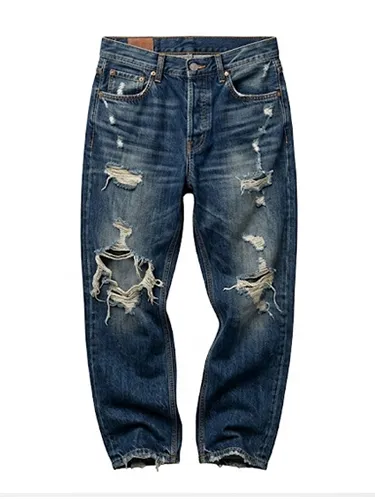
For distressed products, the position and intensity of grinding, ひげ, fading and destruction should also be controlled. Handmade effects naturally introduce some variation, but the permitted range should still be defined.
6. Why Wash Variation Happens in Bulk Denim Production
Denim is particularly sensitive to production variation because the finished appearance is created through interaction between material and process. Even small differences in fabric lots, machine loading, 処理時間, temperature or finishing conditions can influence the final shade.
Buyers should not expect industrial denim washing to behave like digital printing, where every unit can be mathematically identical. The objective is instead to establish an acceptable commercial range.
This is why shade bands are useful. Rather than approving only one single garment, the buyer and factory can establish acceptable lighter, standard and darker boundaries. Bulk garments can then be evaluated against those approved limits.
This approach is particularly important for brands producing repeat orders. Without a reference system, a second production run may slowly drift away from the appearance of the original bestseller.
7. Sampling Should Reduce Risk Before Bulk Production
Sampling is sometimes viewed as a delay between design and production. In reality, it is one of the cheapest opportunities to identify problems.
A structured denim development project may move through several sample stages. An early prototype checks proportion and construction. A wash sample establishes appearance and hand feel. A fitting or size-set stage checks measurements across different sizes. A pre-production sample confirms the final combination of fabric, トリム, ラベル, construction and finishing.
Not every order requires exactly the same sampling sequence, but skipping critical approvals to save a few days can create much larger problems later. Once hundreds or thousands of garments have been cut, sewn and washed, correcting a pattern or fabric mistake becomes expensive.
Brands interested in product development details can explore our custom denim crafting capabilities.
8. The Tech Pack Is the Language Between Brand and Factory
A strong technical package reduces interpretation. Reference photographs are useful for communicating direction, but photographs alone rarely contain enough information to manufacture a consistent product.
A practical denim tech pack should identify the garment style, measurement points, 工事詳細, ステッチ, ファブリック, wash direction, トリム, ラベル, packaging and artwork requirements.
For jeans, buyers should pay particular attention to waistband construction, rise measurements, yoke shape, ポケットの配置, fly construction, inseam and outseam stitching, belt-loop dimensions, hem construction, hardware finish and label placement.
When these details are not specified, the factory has to make assumptions. Those assumptions may be technically reasonable but still different from what the designer intended.
9. Small Construction Details Have a Large Effect on Perceived Quality
Customers rarely evaluate denim quality by reading a technical specification. They judge it through touch, fit and small visual details. This makes construction consistency extremely important.
Pocket symmetry, topstitch spacing, bartack positioning, belt-loop alignment, zipper installation, waistband shape and seam puckering can all influence how premium a garment feels. None of these elements is individually dramatic, but together they determine the impression of workmanship.
Hardware also matters. ボタン, リベット, zippers and metal trims should be evaluated not only for appearance but also for compatibility with garment finishing. The final surface effect needs to work with the wash direction and brand identity.
10. Low MOQ Denim Manufacturing Requires More Planning, Not Less
Emerging brands often search for a low MOQ denim manufacturer because they want to test a new fit, wash or market before committing to larger inventory. This is a sensible strategy, but small-batch production still requires proper development.
In fact, smaller orders make product planning particularly important because fixed development costs are spread across fewer garments. Custom fabric weaving, special hardware, unique labels, complicated washing or numerous colorways can increase cost even when the sewing quantity is limited.
A better approach is to decide which elements truly need to be customized. For an early collection, a brand may use an available denim base while investing more heavily in fit, 洗浄, ラベルとパッケージ. As order volume grows, more specialized fabric development can be introduced.
Buyers developing smaller collections can learn more about our low MOQ custom denim manufacturing approach.
11. MOQ Should Be Evaluated by Component, Not Only by Garment Quantity
When a factory discusses minimum order quantity, buyers often focus only on the number of finished garments. In reality, different materials may have their own minimum quantities.
ファブリック, custom buttons, リベット, 革パッチ, 織りラベル, printed packaging and specialty finishing may each have separate production requirements. A garment order may be technically possible at a smaller quantity while a highly customized accessory requires a larger purchase.
Understanding these component-level minimums allows brands to make smarter decisions. One custom button can sometimes create more sourcing difficulty than an entire basic sewing operation.
12. Sustainable Denim Starts With Measurable Decisions
Sustainability has become an important part of denim sourcing, but meaningful improvement requires more than adding environmental language to a product page. Brands need to decide which parts of the supply chain they want to address and how those decisions will be verified.
Cotton sourcing is one area. Organizations such as Better Cotton work across the cotton supply chain and provide standards and sourcing frameworks for more responsible cotton production.
Garment design is another area. の Ellen MacArthur Foundation’s Jeans Redesign project has explored how durability, material selection, recyclability and circular design can be considered when jeans are developed.
Washing technology is equally important. CottonWorks also provides information on denim sustainability and finishing technologies.
For buyers, the practical lesson is simple: environmental objectives should become part of the product specification. Instead of asking whether a factory is “持続可能な,” ask specific questions about material sourcing, chemical management, finishing processes, durability and traceability that are relevant to your collection.
13. Durability Is Also a Commercial Issue
Durable denim is often discussed from an environmental perspective, but it is equally important from a brand perspective. Garments that lose shape, develop unexpected seam failures or perform poorly after normal use create returns and damage customer trust.
Durability begins with product design. Fabric strength, シーム構造, stress-point reinforcement, hardware attachment and wash intensity all influence the life of the garment.
A heavily distressed design, for example, intentionally removes or weakens material in selected areas. The visual effect therefore needs to be balanced against the expected use of the product. Good denim development is often an exercise in balancing appearance, comfort, manufacturing feasibility, cost and durability.
14. Quality Control Must Follow the Approved Standard
Generic inspection is not enough for custom denim. A quality-control team needs to know what was actually approved.
Measurements should be compared with the approved specification and tolerance. ファブリック, 色, wash effect, ステッチ, トリム, labels and packaging should be checked against the corresponding standards.
For washed denim, visual inspection is particularly important. A pair of jeans can pass measurement inspection while still being commercially unacceptable because the shade is too dark, whiskers are misplaced or abrasion is inconsistent.
The best production systems therefore connect development approvals with final inspection rather than treating design, production and quality control as separate departments.
15. How to Brief a Custom Denim Manufacturer
The clearer the first briefing, the faster a factory can understand the project. Buyers do not need to know every manufacturing term, but they should communicate the product’s commercial purpose.
| Development Item | Information to Provide | Why It Matters |
|---|---|---|
| Product Type | ジーンズ, ジャケット, スカート, ショートパンツ, shirt or other denim garment | Defines the basic development route |
| Target Fit | Slim, straight, relaxed, baggy, bootcut, flare or custom silhouette | Guides pattern engineering and fabric choice |
| Fabric Direction | Rigid/stretch, 目標体重, composition and hand feel | Influences fit, wash and cost |
| ウォッシュ | Reference sample, photo or physical wash standard | Defines the visual identity of the garment |
| Measurements | Size chart or reference garment | Reduces fit interpretation |
| Branding | ラベル, パッチ, ボタン, リベット, embroidery and packaging | Determines private-label requirements |
| Target Market | Retail channel, consumer group and target price range | Helps align product engineering with commercial goals |
16. Why Reference Garments Are More Useful Than Reference Photos
Pinterest images, ecommerce screenshots and fashion photographs are excellent for communicating mood, but they cannot reveal everything a manufacturer needs to know.
A physical reference garment allows the development team to evaluate fabric hand feel, 重さ, 工事, 測定値, ステッチ, pocket shape, wash intensity and finishing much more accurately.
If sending a physical reference is impossible, provide detailed photographs from the front, back and inside, together with close-ups of important construction details. A measurement chart should still be supplied whenever fit needs to be reproduced accurately.
17. Factory Communication Is Part of Product Quality
Many production problems begin as communication problems. A technically capable factory can still produce the wrong result if comments are unclear or approvals constantly change.
Each sample round should therefore have one consolidated set of comments. Buyers should clearly identify which details are approved, which must be changed and which should remain unchanged.
Comments such as “make it better” または “wash needs more vintage feeling” leave too much room for interpretation. More useful feedback identifies the actual area: reduce thigh width, lower the back pocket, increase abrasion at the front thigh, soften the overall hand feel or reduce contrast around the whiskers.
The objective is not to use complicated technical vocabulary. The objective is to make every revision measurable or visually understandable.
18. The Cheapest Quote Is Rarely the Cheapest Production
Denim quotations should always be evaluated together with the specification. A lower price can result from a different fabric, simpler wash, cheaper trims, different construction or reduced quality-control requirements.
Comparing two factories without confirming that both are quoting the same specification can therefore be misleading. The important question is not simply, “What is your price per piece?” It is, “What exactly is included in that price?”
For private-label businesses, the real cost of manufacturing also includes failed samples, delayed launches, inconsistent repeat orders, quality claims and unsold inventory. A slightly higher unit price can be commercially better when it produces a more consistent product.
19. When Should a Brand Use OEM and When Should It Use ODM?
OEM and ODM are often used interchangeably in apparel sourcing, but they describe different starting points.
OEM denim manufacturing is generally appropriate when the brand already has a developed design, technical package, reference garment or clear specification and needs a factory to manufacture it.
ODM development is more useful when a buyer has a market direction but still needs support with fabric selection, styling, construction or product development.
Many real-world private-label projects sit somewhere between these two models. A buyer may provide the silhouette and measurements while the factory recommends suitable denim fabrics and develops the wash.
You can compare these approaches through our ODM denim manufacturer and OEM製造 pages.
20. How to Choose the Right Custom Denim Manufacturer
The best factory is not necessarily the largest factory or the factory with the lowest quotation. It is the supplier whose capabilities match the type of denim product your business is trying to build.
Before placing an order, evaluate whether the manufacturer understands fabric behavior, garment fit and washing rather than sewing alone. Ask how samples are developed, how wash standards are approved, how measurements are controlled after washing and how bulk shade variation is managed.
It is also worth discussing repeat orders. If a style becomes successful six months later, can the supplier reproduce a similar fabric, color and wash? Product repeatability is one of the most overlooked aspects of supplier selection.
Buyers looking for existing development references can browse our denim product gallery or learn more about wholesale denim manufacturing.
From One Sample to a Repeatable Denim Product
The purpose of custom denim development is not simply to create one impressive sample. It is to create a product that can be reproduced commercially.
That requires a connected workflow. Fabric influences washing. Washing influences shrinkage and hand feel. Shrinkage affects patterns and measurements. Construction affects durability. Trims influence both appearance and manufacturing cost. Quality control must then measure the finished garment against all of these approved standards.
When these decisions are made separately, problems appear later in production. When they are developed together, the factory and brand have a much better chance of achieving consistent fit, wash and quality.
For emerging labels, established fashion businesses and denim wholesalers, choosing the right custom denim manufacturer should therefore be treated as a product-development decision rather than simply a purchasing decision.
If you are preparing a new denim collection, you can start by sending us your sketches, テックパック, reference garment, target wash or product photographs. Our development team can review the project and help determine an appropriate route for fabric sourcing, sampling and production.
Start Your Custom Denim Project
Looking for a private label denim partner for jeans, ジャケット, スカート, shorts or other denim garments? Explore our manufacturing capabilities or send us your project specifications for review.
Frequently Asked Questions About Custom Denim Manufacturing
What is a custom denim manufacturer?
A custom denim manufacturer produces jeans and other denim garments according to a buyer’s own specifications. Customization can include fabric, 衣服の寸法, patterns, 洗浄効果, ステッチ, ハードウェア, ラベル, 刺繍, printing and packaging.
What is the difference between private label denim and wholesale denim?
Wholesale denim usually involves purchasing existing designs or ready-developed styles. Private label denim manufacturing gives the buyer greater control over the design, フィット, ファブリック, 洗う, trims and branding of the product.
Can a denim manufacturer develop a product from a reference photo?
A reference photo can be used to understand the design direction, but a physical reference garment, technical package or measurement chart normally provides more accurate information. Important details such as fabric weight, ストレッチ, internal construction and exact measurements cannot always be identified from photographs.
Why does denim fabric need to be selected before wash development?
Different denim fabrics react differently to washing and finishing. Fiber composition, 糸, weave, 藍染め, fabric weight and stretch can influence fading, 収縮, hand feel and the overall appearance of the finished garment.
Why can bulk denim washing look slightly different from the approved sample?
Denim washing is a physical manufacturing process rather than a digital color process. Fabric lot variation and finishing conditions can create natural shade differences. Professional production therefore uses approved wash standards and acceptable shade ranges to control bulk consistency.
What should I send to a private label jeans manufacturer?
Ideally, provide a tech pack, 測定チャート, reference garment or detailed design images. Information about the target fabric, 洗う, フィット, 量, トリム, branding and target market will also help the manufacturer evaluate the project accurately.
Can small fashion brands manufacture custom denim?
はい. Low-MOQ denim manufacturing can be suitable for emerging fashion brands that want to test new products without carrying excessive inventory. しかし, the complexity of custom fabric, ハードウェア, washing and packaging still needs to be considered when planning a smaller production run.
What causes sizing problems in washed denim jeans?
Sizing problems can result from fabric shrinkage, pattern construction, wash processes or inconsistent measurement control. For this reason, garment measurements should be evaluated after the approved wash rather than relying only on measurements before finishing.
Is heavier denim always better quality?
いいえ. Denim weight needs to match the intended product. Fabric construction, yarn quality, dimensional stability, recovery, finishing and suitability for the garment can be more important than weight alone.
How should a brand compare quotations from different denim manufacturers?
Compare quotations only after confirming that each supplier is pricing the same fabric specification, 洗う, 工事, トリム, ラベル, packaging and quality requirements. A lower unit price may reflect a different product specification rather than a genuinely lower manufacturing cost.