
Custom cargo jeans manufacturing looks straightforward until a design reaches the sample room. Compared with a conventional five-pocket jean, cargo denim adds more pattern pieces, more seam intersections, more hardware, more pocket engineering and often a heavier washing treatment. Every additional detail affects fit, cost, production time and the consistency of the finished garment. For fashion brands, getting the product right requires more than sending a reference photo to a factory.
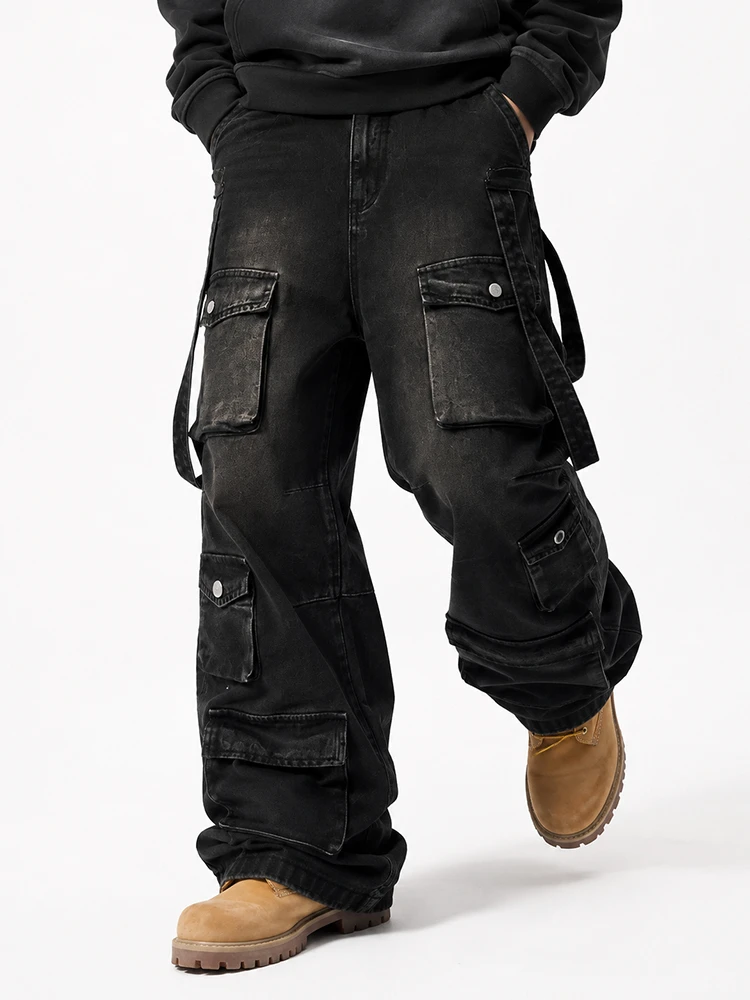
Why Custom Cargo Jeans Manufacturing Is More Complex Than Standard Jeans
A basic five-pocket jean already requires careful control of fabric, 収縮, pattern balance, sewing and washing. Cargo jeans add another layer of engineering. Large patch pockets may sit on the thigh, knee or lower leg. Some designs include bellows, flaps, スナップ, ジッパー, webbing, straps, drawcords, D-rings or decorative panels. These details change both the appearance and the physical behavior of the garment.
A pocket that looks well proportioned on a flat sketch may become too bulky after being sewn onto a heavy denim leg. A long hanging strap may look correct on a sample but twist during washing. A large thigh pocket can make the leg collapse inward if the fabric is too soft. Even pocket placement can change the visual proportion of the wearer.
This is why professional custom denim manufacturing should treat cargo jeans as an engineered garment rather than a standard jean with extra pockets added at the end.
Begin Custom Cargo Jeans Manufacturing With a Clear Product Brief
Reference photographs are useful for communicating style direction, but they are not a technical specification. A photograph does not reveal fabric weight, pocket depth, internal construction, seam allowance, shrinkage or hardware attachment. Two factories can look at the same image and interpret it in completely different ways.
Before asking for a quotation, a brand should define the basic commercial and technical direction of the product.
- Target customer and market positioning
- Men’s, women’s or unisex fit
- Rigid or stretch denim
- Target fabric weight
- Straight, baggy or stacked leg shape
- Number and position of cargo pockets
- Required straps, snaps and zippers
- Wash color and vintage character
- Size range
- Estimated quantity
A technical pack should eventually contain front and back drawings, a measurement chart, pocket dimensions, artwork, hardware specifications, stitch details and branding positions. If the brand does not have a complete technical department, the product can be developed through an ODM denim development process using sketches, reference garments and design concepts.
Brands with completed patterns, measurements and specifications may instead use デニムのOEM製造 for sample development and production.
Choosing the Right Denim Fabric for Cargo Jeans
Fabric selection has a greater effect on cargo jeans than many buyers expect. Large pockets, double-layer panels and hanging details add weight to the garment. If the denim is too light or too fluid, these components can pull the leg out of shape. If the fabric is excessively heavy, the garment may become stiff and uncomfortable once multiple layers are assembled.
Denim should therefore be evaluated by construction rather than weight alone. Yarn size, 織り密度, finishing and fiber composition all affect the way the material behaves. CottonWorks provides a useful technical overview of denim construction and fabric weight .
Rigid denim
Rigid cotton denim is often suitable for oversized and streetwear-oriented cargo jeans because it gives the leg structure. It also allows pockets and panel seams to remain visible rather than collapsing into the garment.
The trade-off is that rigid fabric requires careful shrinkage planning. A pattern that fits correctly before washing may become shorter or tighter after finishing.
Stretch denim
Stretch fabric can be useful when the design requires a slimmer silhouette or more mobility. しかし, stretch recovery must be considered. Large cargo pockets can place additional load on the fabric, particularly around the thigh.
A fabric that grows significantly during wear can cause the pockets to sag or make the leg lose its intended shape.
Fabric weight
There is no single correct ounce weight for cargo jeans. A lighter design may use a softer denim for movement, while heavy streetwear trousers may require a more structured construction. What matters is whether the selected material supports the intended silhouette after sewing and washing.
Brands can review additional options through Luxappare’s custom denim fabric development service before finalizing the production fabric.
Pattern Development and Fit Engineering
Cargo jeans are often designed with relaxed proportions, but “oversized” does not mean the pattern can be loose everywhere. A successful baggy fit still needs balance through the waist, rise, hip, knee and hem.
The first decision is the silhouette. A straight cargo jean hangs differently from a wide-leg jean. A stacked jean requires additional inseam length and a controlled leg opening so that fabric accumulates around the footwear rather than simply looking too long.
Pocket weight also affects pattern balance. When several pockets are attached to the outside of the leg, the pattern must support their volume without pulling the side seam forward or twisting the trouser leg.
During fitting, buyers should review:
- Waist position and waistband shape
- 前後股上バランス
- Seat volume
- Thigh ease
- Knee position
- Leg opening
- Inseam length
- Side-seam alignment
- Pocket position when worn
- Movement when sitting and walking
One of the most common mistakes is approving the pocket placement while the garment is lying flat. Cargo pockets should also be reviewed on a body or mannequin. A pocket placed only a few centimeters too low can visually shorten the leg, while one placed too far toward the front can make the trouser look unbalanced.
Cargo Pocket Engineering: The Detail That Defines the Product
The pocket system is normally the most recognizable part of a cargo jean. It is also one of the areas most likely to create production problems.
A simple patch pocket may consist of one main panel and a flap. More complicated designs use box pleats or bellows so the pocket can expand. Others combine multiple compartments, zipper sections and secondary mini pockets.
Pocket size
Pocket dimensions should be defined rather than estimated visually. Width, height, flap depth and pleat extension all affect volume.
A large pocket may look dramatic in a technical drawing but become excessively heavy in a 13 または 14 oz denim. The manufacturer may need to reduce internal layers or adjust the construction to control bulk.
Pocket placement
Placement should normally be measured from fixed garment reference points rather than described as “middle of thigh.” For example, the tech pack can specify the distance from the waistband, side seam or knee line.
Pocket symmetry
Multiple cargo pockets make small placement differences more visible. A production inspection should compare left and right pocket positions, flap angles and stitching.
Functional versus decorative pockets
Brands should decide early whether a pocket is intended to function or only create a visual effect. Functional pockets require sufficient opening width, reinforcement and attachment strength. Decorative pockets can sometimes use simpler construction and therefore reduce cost.
Buyer tip: Ask the sample room to photograph the pocket from the front, side and while opened. A closed front-view photo can hide excessive bulk, poor internal finishing or an opening that is too small to use.
Hardware, Straps and Functional Details
Cargo denim frequently uses more hardware than traditional jeans. In addition to the waistband button, rivets and zipper, the design may include snaps, eyelets, buckles, D-rings, cord stoppers and decorative metal components.
Every additional component creates another specification that must be controlled. The color of black nickel hardware, for example, can differ between suppliers. If buttons, snaps and D-rings are sourced independently, their finishes may not match.
Hardware should also be tested with the actual fabric thickness. A snap post that works on one layer of fabric may fail when attached through a multi-layer cargo pocket.
Straps create different problems. Their width, length and reinforcement need to be defined, particularly if they hang freely from the garment. Long straps may tangle during washing and can require temporary securing before finishing.
Luxappare’s custom denim crafting options include denim washing, ハードウェア, 印刷, 刺繍, patches and other details that can be combined with cargo denim development.
Sewing Construction Matters More as the Number of Details Increases
Every cargo pocket creates additional seams, corners and stress points. Sewing quality therefore becomes increasingly important as the design becomes more complex.
High-stress areas usually require reinforcement. Pocket openings, strap attachment points, belt loops and flap corners may use bar tacks or additional stitching. The exact solution depends on the design and fabric.
Stitch density also matters. Very dense stitching is not automatically stronger. On heavy denim, excessive needle penetration can damage the material or cause seam puckering.
Thread thickness and color should be selected with the finished wash in mind. A thread that looks subtle before washing may become highly visible after the denim fades.
Construction order is another important issue. Some pockets must be sewn onto the leg panel before the inseam and outseam are closed. If a late design change moves a pocket after the sewing sequence has been established, the factory may need to change the production method rather than simply repositioning one component.
Wash Development for Black, Vintage and Distressed Cargo Jeans
Cargo jeans are frequently designed with vintage, washed or distressed surfaces. This creates an additional challenge because pockets and layered panels react differently from a flat trouser leg.
Raised seams and pocket edges receive more abrasion during washing. The result can be visually attractive, but it must be controlled. Heavy grinding around a cargo pocket can weaken the attachment seam, while strong bleaching can reduce fabric strength in an already stressed area.
Black denim deserves particular attention. The brand should define whether it wants a clean black, washed charcoal, grey-black vintage shade or high-contrast faded surface. These descriptions should eventually be converted into a physical approval sample.
CottonWorks provides a technical overview of denim finishing methods , including common approaches used to soften and age denim.
Brands can also review Luxappare’s denim washing and finishing processes when planning stone wash, enzyme wash, whiskering, garment dyeing, destroy wash or other treatments.
The most important rule is to evaluate wash and construction together. If the sample looks correct before washing but the pockets distort afterward, the product has not been successfully developed.
How a Cargo Jeans Sample Should Be Developed
Sampling is where design ideas become measurable production standards. For complex cargo denim, expecting the first sample to be perfect is unrealistic. The first sample should instead reveal where the design requires correction.
テクニカルレビュー
The factory reviews the drawing, 測定値, ファブリック, pocket details, ハードウェア, wash and target quantity before pattern development begins.
Fabric and Trim Selection
Suitable denim, pocketing, 糸, ジッパー, スナップ, rivets and other components are confirmed or replaced with development substitutes.
First Development Sample
The first garment checks silhouette, 比率, pocket construction and overall design feasibility.
Fit and Construction Revision
Waist, rise, leg width, ポケットの配置, strap length and construction details are corrected according to the fitting review.
Wash Development
The approved construction is tested through the selected wash to verify shade, 収縮, abrasion and garment measurements.
Pre-Production Approval
Final fabric, 測定値, ブランディング, hardware and workmanship requirements are confirmed before bulk cutting.
Comments should be specific. “Make the pockets smaller” is much less useful than specifying the new finished width and height. “Make the jeans baggier” should be translated into actual thigh, 膝と裾の寸法.
The final approved sample should remain available as a physical reference during bulk manufacturing.
What Determines the Cost of Custom Cargo Jeans?
A cargo jean usually costs more to manufacture than a simple five-pocket style because it consumes additional fabric, trims and sewing time. The difference becomes larger as the number of details increases.
Important cost drivers include:
- Number of cargo pockets
- Pocket pleats and internal construction
- Additional fabric consumption
- Number of zippers and snaps
- Custom metal hardware
- Webbing and hanging straps
- Contrast or decorative stitching
- Complex wash processes
- Distressing and manual finishing
- Order quantity
This is why buyers should avoid asking a factory to quote only from a front-view photo. A price given before the details are defined is usually provisional.
If the target retail price is fixed, it is often better to identify the details that create the strongest visual value and simplify components that customers are unlikely to notice.
Removing one unnecessary zipper or simplifying a hidden pocket can sometimes reduce cost without changing the overall identity of the garment.
Low MOQ Cargo Jeans Manufacturing for Emerging Brands
Small-batch production allows a brand to test an unusual cargo silhouette before committing to large inventory. しかし, low MOQ should not be confused with zero development cost.
Patterns, samples, wash trials and custom trims still require setup. A 100-piece order containing five different washes and several custom hardware colors may actually be less efficient than a larger order using one coordinated specification.
For a first collection, a better strategy is often to use one fabric and one or two wash directions across several related products.
Luxappare supports selected projects through low MOQ custom denim manufacturing , with production starting from 100 pieces for qualifying styles and specifications.
The final minimum should always be confirmed after the factory reviews fabric, ハードウェア, wash and customization requirements.
Quality Control for Multi-Pocket Denim
Cargo jeans require a different inspection mindset from a basic jean because there are more components that can vary.
The inspector should not only measure the waist and inseam. Pocket positions, strap lengths, flap symmetry and hardware operation should also be checked.
| Inspection Area | What to Check | Common Risk |
|---|---|---|
| Garment Measurements | Waist, hip, rise, 大腿, knee, inseam and hem | Fit changes after washing |
| Cargo Pockets | Position, dimensions, symmetry and opening | Uneven or misplaced pockets |
| Flaps | Shape, angle and closure alignment | Twisted or asymmetric appearance |
| Straps | Length, width and attachment strength | Different lengths or weak seams |
| Hardware | Finish, function and attachment | Loose snaps or inconsistent colors |
| Wash | Shade, abrasion and hand feel | Bulk variation from approval sample |
| Sewing | Stitches, seam security and reinforcement | Broken stitches or puckering |
Inspection standards should be agreed before bulk production rather than negotiated after goods are complete.
For chemical and textile safety requirements, brands can refer to OEKO-TEX STANDARD 100 for information on textiles tested for harmful substances.
Brands with chemical-management requirements for washing and finishing can also review the ZDHC Manufacturing Restricted Substances List .
From Approved Sample to Bulk Cargo Jeans Production
Bulk production should begin only after the product specification has stopped moving. Late changes are especially risky on cargo jeans because one modification can affect several operations.
Moving a thigh pocket may require changing cutting marks and sewing guides. Changing the hardware size may require a different reinforcement. Changing the wash may alter shrinkage and therefore affect the approved measurements.
カット前, the factory should have a final version of:
- 生産パターン
- Measurement chart
- Fabric specification
- Approved wash sample
- Hardware specification
- Label and branding files
- Pocket dimensions and positions
- Packaging requirements
During sewing, in-line checks are more effective than waiting for the finished order. If a pocket positioning problem is discovered after several hundred garments have already been assembled, correction becomes difficult and expensive.
Final inspection should compare bulk garments against both the measurement specification and approved physical sample.
Building a Commercial Cargo Denim Collection Instead of a Single Statement Piece
Cargo jeans are visually strong products, which makes it easy for a designer to keep adding details. More pockets, more straps and more hardware can look interesting on a sketch, but the product still has to work commercially.
The first question should be what makes the style recognizable. If two large thigh pockets and a distinctive black wash already define the product, four additional decorative pockets may add cost without adding much value.
A coordinated collection can also reuse details intelligently. The same snap finish, thread color or fabric can appear across jeans, shorts and jackets. This creates a consistent visual language while improving purchasing efficiency.
Brands researching silhouettes can browse the Luxappare denim product gallery before preparing a development brief.
The strongest private-label programs tend to build recognizable systems rather than unrelated individual styles. One pocket concept may become a recurring design code. A successful wash can be carried from pants into jackets. A signature hardware finish can appear across multiple seasons.
This approach also makes repeat production easier. Instead of developing every trim from zero, the manufacturer can work with proven specifications.
Practical sourcing rule: Develop the fabric, フィット, cargo pocket system and wash together. If one of these elements changes substantially, recheck the other three before approving production.
How to Prepare an Inquiry for a Cargo Jeans Factory
The quality of the first factory response often depends on the quality of the inquiry. A message containing only “How much for 100 個?” does not give a supplier enough information to provide a meaningful quotation.
A useful inquiry should include the product image or drawing, approximate quantity, サイズ範囲, preferred fabric, wash direction and target delivery date.
If there are complicated pockets, provide close-up images or sketches. If a specific fit is important, provide a measurement chart or physical reference garment.
For custom branding, mention woven labels, leather or jacron patches, 下げ札, ボタン, rivets and packaging at the beginning. These components may have separate development lead times and minimum quantities.
An experienced factory should then be able to identify missing information and explain which decisions must be made before sampling.
Why Physical Samples Still Matter in Denim Product Development
Digital development has made communication faster, but cargo denim is still a physical product. Fabric weight, pocket volume, stiffness and wash texture cannot be evaluated completely from a screen.
A photograph may show the color of black denim differently depending on the camera, lighting and monitor. Measurements can be correct on paper while the actual pocket still feels oversized when worn.
For serious commercial production, a physical sample remains the most reliable way to approve fit, construction and wash.
The brand should keep one approved reference while the factory retains another. This becomes particularly useful when the product is reordered several months later.
Repeat production should be compared with the original standard rather than relying on memory or old chat messages.
Frequently Asked Questions About Custom Cargo Jeans Manufacturing
What information do I need to manufacture custom cargo jeans?
Ideally, provide front and back drawings, 測定値, fabric requirements, cargo pocket dimensions, wash reference, hardware specifications, ブランディング, quantity and size range. Reference garments and photographs can also be used during ODM development.
What denim fabric is best for cargo jeans?
There is no universal best fabric. Structured rigid denim often works well for baggy and streetwear cargo silhouettes, while stretch denim may be more suitable for slimmer styles. Fabric weight, 工事, recovery and wash behavior should be evaluated together.
Can I customize the cargo pockets?
はい. Pocket size, shape, pleats, flaps, ジッパー, スナップ, embroidery and placement can all be developed according to the design. More complicated pocket construction normally increases sewing time and production cost.
Can cargo jeans be produced with a vintage black wash?
はい. Black denim can be developed in clean black, faded charcoal, grey-black and other vintage directions. A physical wash sample should be approved because the final appearance depends on the base fabric and finishing process.
What is the MOQ for custom cargo jeans?
Luokugg supports selected low-MOQ custom denim projects starting from approximately 100 スタイルとカラーごとのピース数. The final minimum depends on fabric availability, 洗う, カスタムハードウェア, labels and overall construction complexity.
Why are custom cargo jeans more expensive than basic jeans?
Cargo jeans usually contain more pattern pieces, ファブリック, pockets, reinforcement, hardware and sewing operations. Complex washes and manual distressing can add further production cost.
Can I develop cargo jeans without a complete tech pack?
はい. An ODM manufacturer can work from sketches, reference photographs or physical garments, although measurements and technical specifications still need to be confirmed during sample development before bulk production.
Develop Custom Cargo Jeans With Luokugg
Luokugg supports custom cargo jeans manufacturing for fashion brands, streetwear labels, retailers and private-label businesses. Send your drawings, reference photos, テックパック, target quantity, fabric direction and wash requirements so the production team can review construction feasibility, sampling and bulk manufacturing.