Denim fabric inspection is the decision point between buying cloth and cutting garments. Once a roll has been spread and cut, a weaving bar, oil mark, narrow width or unrecorded shade change is no longer a fabric claim alone. It has become recutting, panel replacement, sewing disruption, missing quantity or a visible defect in finished jeans.
The familiar 4-point system helps a buyer quantify visible surface faults, but its score does not answer every question. A roll can achieve a low defect score and still be the wrong weight, wrong shade, too narrow, unstable after washing or prone to leg twist. Umgekehrt, a characterful denim may contain slubs or nep effects that are intentional design features rather than defects. A useful inspection plan therefore combines roll-level visual grading with shade control, physical measurements, laboratory testing and a written disposition before cutting.
This guide explains how fashion brands, importers and denim manufacturers can build that system. It includes defect-point tables, imperial and metric formulas, a worked six-roll lot, common denim faults, shade banding, usable-width checks, GSM and ounce conversion, shrinkage and skew screening, roll mapping and purchase-order language. The figures are practical planning examples, not universal acceptance rules. The buyer and supplier must agree the standard version, point-assignment option, tolerances, test methods and remedies before bulk fabric is produced.
Denim Fabric Inspection Has Three Separate Approval Gates
Teams lose control when they treat a single report as proof that the fabric is good. The 4-point result, physical-property tests and wash approval answer different questions.
| Gate | Primary question | Typical evidence | What it cannot prove |
|---|---|---|---|
| Visual roll inspection | How many visible faults are present, where are they, and can the roll be cut economically? | 4-point score, defect map, width readings, roll photographs and tagged locations | Fibre composition, hidden strength, wash shrinkage or colourfastness |
| Laboratory and physical checks | Does the bulk fabric meet the technical specification? | Gewicht, Konstruktion, strecken, Erholung, Stärke, dimensional change, skew change and fastness results | Distribution of visible defects along every roll |
| Wash and garment trial | Will the approved fabric produce the intended shade, Hand, measurements and appearance? | Wash blankets, pilot garments, measurement reports and approved physical standard | Quality of every uninspected roll or every finished garment |
Finished-garment inspection is a fourth, later control. Der denim AQL inspection plan checks completed jeans against workmanship and measurement requirements. It cannot recover fabric already lost to defects, and its sample size should not be confused with the percentage of fabric rolls or roll length inspected before cutting.
How the 4-Point System Works
The purpose of 4-point denim fabric inspection is to convert visible defects into a comparable area-based score. Inspectors examine the face of the fabric, identify a fault, measure its longest dimension under the agreed procedure and assign 1 Zu 4 penalty points. A common commercial implementation uses the following scale.
| Longest defect dimension | Metric reference | Common penalty |
|---|---|---|
| Up to 3 in | Up to about 7.6 cm | 1 Punkt |
| Over 3 in to 6 in | Over about 7.6 cm to 15.2 cm | 2 points |
| Over 6 in to 9 in | Over about 15.2 cm to 22.9 cm | 3 points |
| Over 9 in | Over about 22.9 cm | 4 points |
The table is easy to memorise, but a contract needs more than the four sizes. The parties must use the same ASTM D5430 option and agree how holes, continuous defects, full-width defects, repeating faults, selvage defects and multiple faults within one linear yard are treated. ASTM’s public summary specifically notes that results can vary considerably between point-assignment options. A mill report using one option and a garment factory report using another should not be compared as if they were the same test.
Do not let the number hide severity
An area score is a normalisation tool, not a licence to average away a dangerous or unusable fault. Buyers commonly create a separate zero-tolerance list for holes, cuts, foreign metal, severe oil contamination, full-width bars, mixed articles, wrong finish or repeated defects that make marker placement impractical. Whether a fault belongs on that list is a commercial specification decision and should be written before inspection.
Distinguish character from defect
Ring slub, crosshatch, nep, uneven yarn character and marled effects may be intentionally approved in denim. The inspector needs an approved fabric standard and defect library showing what is inherent, what is acceptable variation and what is rejectable. Without that reference, one inspector may penalise the texture the designer bought while another overlooks a true weaving streak.
Denim Roll Inspection Formulas
Raw point totals cannot compare a short narrow roll with a long wide roll. Normalise points against inspected area.
Points per 100 square yards
Points per 100 yd2 = (total penalty points × 3,600) / (inspected length in yards × inspected width in inches)
The factor 3,600 converts the denominator to 100 square yards because one square yard contains 1,296 square inches and the mixed yard-inch formula simplifies accordingly. Use the width basis specified by the buyer. If the contract requires actual fabric width, do not enter the nominal catalogue width.
Points per 100 square metres
Points per 100 m2 = (total penalty points × 10,000) / (inspected length in metres × inspected width in centimetres)
Worked roll example
A roll has 72 yd inspected length, 58.5 in measured width and 38 penalty points:
(38 × 3,600) / (72 × 58.5) = 32.5 points per 100 yd2
If the agreed individual-roll limit is 40, the roll passes the numerical gate. At 47 points, the same roll scores 40.2 and fails that limit. Its final disposition still depends on zero-tolerance defects, shade group, usable width and laboratory results.
Common calculation errors
- dividing points by linear yards without adjusting for fabric width;
- using ordered length rather than the length actually inspected;
- using nominal 60 in width when the measured roll is 58.5 in;
- mixing centimetres, metres, inches and yards in one formula;
- averaging roll scores arithmetically instead of weighting by inspected area;
- rounding each input before the calculation;
- reporting a lot average while hiding one badly failing roll.
What Is an Acceptable 4-Point Score for Denim?
ASTM D5430 does not make one commercial threshold correct for every fabric. A limit of 40 points per 100 yd2 is widely used in apparel trade, but it is an agreed ceiling, not a law and not a guarantee of cutting yield. A premium light wash with large plain panels may need tighter control than a heavily distressed product that can visually absorb minor yarn character.
A useful specification separates four decisions.
- Individual-roll maximum: prevents a poor roll from disappearing inside a good lot average.
- Weighted lot maximum: measures the overall quality of the inspected area.
- Zero-tolerance defects: rejects specified faults regardless of the numerical score.
- Yield or defect concentration rule: addresses repeated faults clustered in positions that destroy marker efficiency.
The following is an illustrative risk matrix, not an industry mandate.
| Programme type | Illustrative roll limit | Additional control |
|---|---|---|
| Standard commercial five-pocket denim | Up to 40 points per 100 yd2 | Agreed zero-tolerance list, shade segregation and lab pass |
| Clean premium rinse or large wide-leg panels | Buyer may choose 20-28 | Tighter streak, bar and side-to-side shade control |
| Heavy vintage or intentionally irregular surface | Buyer-defined against physical standard | Defect library distinguishes intended character from structural faults |
| Gedruckt, coated or resin-finished denim | Buyer-defined by end use | Separate coating, drucken, adhesion, cracking and cure criteria |
A lower threshold can raise fabric price or reduce available supply because the mill must sort more aggressively. Put the requirement into the request for quotation so suppliers price the same quality level. The objective is not the lowest score at any cost; it is predictable cutting yield and a surface consistent with the approved product.
How Much of the Fabric Lot Should Be Inspected?
There is no universal denim fabric inspection percentage that suits every programme. The plan should consider mill history, fabric value, visual sensitivity, wash risk, order size, lead time and the cost of discovering a failure after cutting.
| Risk situation | Illustrative inspection approach | Reason |
|---|---|---|
| New mill, new article or first bulk order | Inspect 100% of roll length and every roll | No stable quality history; defect distribution and shade behaviour are unknown |
| High-value, light-colour or clean-surface programme | 100% visual inspection with all-roll shade and width checks | Visible faults have a high garment impact and are difficult to hide in markers |
| Stable repeat article from a proven mill | Risk-based sample may be agreed, with escalation to 100% after a failure | Historical data can support reduced inspection, but every roll still needs identity and shade control |
| Mixed dye lots or several finishing batches | Stratify selection by lot and batch; do not sample only the easiest rolls | A random total percentage can miss a small but defective sub-lot |
When a buyer says „inspect 10%,“ the instruction is incomplete. Ten percent of what: rolls, total metres, each dye lot or purchase-order quantity? If one of ten rolls is examined end to end, the other nine remain unknown. If 10% of every roll is examined, faults outside those sections remain unknown. Define the sampling unit, selection method, length and escalation rule.
A practical escalation rule
For a stable repeat order, a brand might specify an initial random sample across every finishing batch. If any sampled roll exceeds the roll limit, contains a zero-tolerance fault, falls outside shade or width tolerance, or reveals a repeated defect, inspection expands to the entire affected batch. This is an example of a buyer plan, not an ASTM default.
Inspection Machine and Working Conditions
Denim fabric inspection needs a controlled viewing surface and a machine that can move the roll without adding creases or stretching the cloth. Record the equipment and settings so a disputed reinspection can be reproduced.
- clean front and back lighting appropriate for the defect types;
- a viewing area wide enough to expose the full usable width;
- speed low enough for the inspector to detect and measure faults;
- controlled fabric tension that does not distort stretch denim;
- a calibrated length counter and verified width scale;
- stopping controls that allow defect tagging and photography;
- roll rewinding that preserves face direction and roll identity;
- neutral surroundings for shade checks and a separate controlled light source where required.
An operating speed such as 10-15 m/min can be a starting factory work instruction for dense denim, but it is not a universal standard value. Slow the machine when heavy texture, dark shade, low-contrast streaks or stretch recovery makes detection difficult. Validate the chosen speed by inserting known reference faults or comparing a slow repeat inspection.
Condition the decision, not only the specimen
Incoming rolls can differ in temperature and moisture after transport. Allow suitable relaxation and conditioning before measurements that are sensitive to tension, moisture or compression. A tightly wound stretch-denim roll measured immediately after unloading may give a misleading width or length. State the conditioning practice and test atmosphere in the technical specification or laboratory method.
Common Defects Found During Denim Fabric Inspection
A useful denim fabric inspection defect list connects mill language to garment consequences. It also tells the inspector whether to score, tag, segregate or stop the roll.
| Defect | How it appears | Garment or cutting risk | Typical control |
|---|---|---|---|
| Missing or broken end | Lengthwise line caused by a warp-yarn problem | Visible streak through legs, pockets or jacket panels | Point, tag and map; reject if repeated or visually dominant |
| Filling bar or stop mark | Crosswise band caused by weft or loom interruption | Can cross both legs or several marker pieces at one position | Map exact metre position and required splice allowance |
| Slub, thick yarn or nep | Local yarn irregularity or surface speck | May be intended character or an unacceptable concentration | Compare with approved standard and defect library |
| Hole, cut or broken yarn cluster | Opening or structural damage | Panel failure, recut and possible spreading damage | Often buyer-defined as zero tolerance; isolate the affected span |
| Oil, rust or contamination | Spot, smear or foreign matter | May remain or spread after washing and finishing | Do not assume wash removal; conduct a controlled trial |
| Crease, rope mark or pressure line | Lengthwise or irregular line from finishing and winding | Uneven wash-down or permanent visual line | Relax, test wash and segregate if persistent |
| Side-to-centre shade | Different colour or depth across the width | Two legs or adjacent panels appear mismatched after wash | Full-width shade check and panel-placement rule |
| Roll-to-roll shade | Different shade between rolls or finishing batches | Components from different rolls create garment mismatch | Shade blanket, roll swatches and banded cutting plan |
| Width variation | Usable width narrows along the roll or between rolls | Marker no longer fits, raising consumption and shortage | Measure at agreed intervals and use the minimum usable width |
| Bow or skew | Weft line curves or angles across the fabric | Panel distortion and leg twist, especially after washing | Measure original geometry and laundering-induced change separately |
| Coating, print or resin fault | Missed area, uneven deposit, cracking or poor cure | Appearance failure and unstable care performance | Use artwork standard, adhesion or wash test and surface criteria |
| Selvage damage or tension | Torn, tight, wavy or curled edge | Reduced usable width and spreading distortion | Record exclusion width and marker impact |
Photograph defects with a scale, roll ID and metre position. A close-up without location or size is useful for discussion but not for cutting avoidance or a supplier claim.
Denim Shade Banding and Roll Segregation
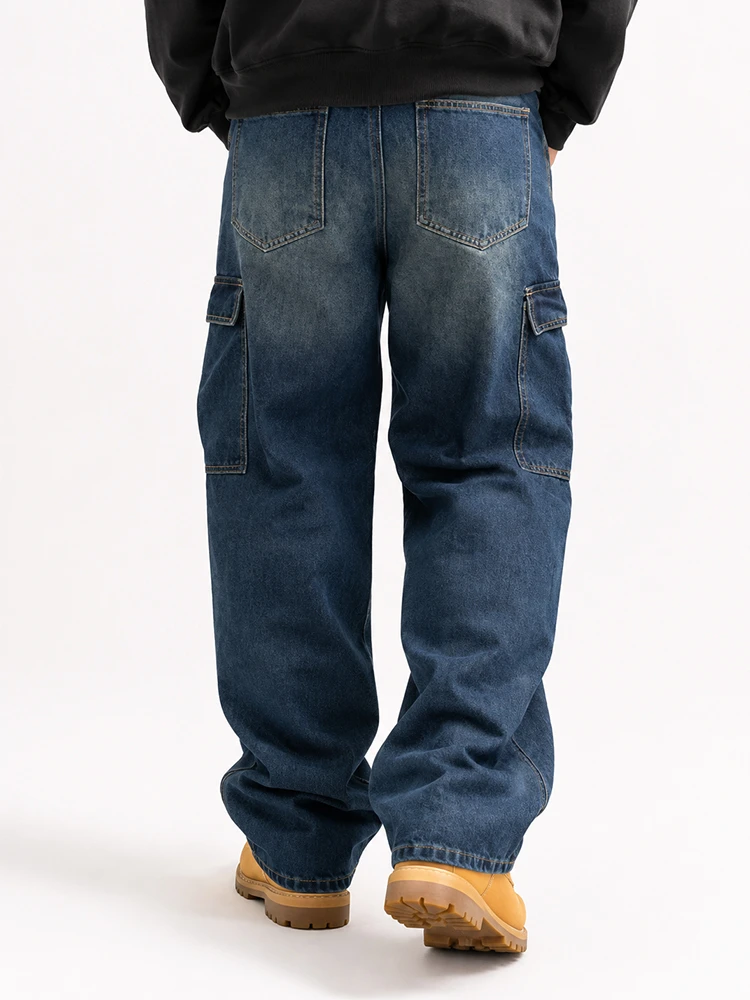
Shade control is a separate part of denim fabric inspection and can prevent more garment rejections than the numerical 4-point score alone. Indigo and sulphur-dyed fabrics can vary by dye lot, finishing batch, roll and position across the width. Washing may amplify a difference that looked small in raw fabric.
Build the shade set from every roll
Cut an identified full-width header or representative roll swatches according to the buyer’s procedure. Keep face direction consistent and label mill lot, finishing batch, roll number, beginning or end position and inspection date. Compare the pieces with the approved bulk standard under controlled lighting. AATCC EP9-2025 provides a procedure for visually assessing colour differences in textiles.
A spectrophotometer can support the visual decision, but a universal Delta E limit should not be invented after delivery. Instrument geometry, illuminant, observer, specimen preparation, texture and wash state affect results. The buyer should define the method and tolerance during development, then keep instrumental data linked to the physical shade standard.
Create operational shade bands
Group compatible rolls into bands such as A, B and C. These letters do not mean good, medium and bad. They mean visually compatible groups that should be cut and bundled separately. The cutting room should not mix panels from different shade bands in one garment unless the buyer has proved the result is acceptable.
For washed jeans, repeat the assessment after the approved wash route. A raw roll that matches before processing can diverge after enzyme, bleach, tint, resin or overdye. Use a controlled wash blanket or pilot pieces from each finishing batch and follow the denim wash development process before releasing all rolls.
Check side-centre-side shade
Compare specimens from the left, centre and right of the usable width. A roll-to-roll shade pass cannot detect cross-width variation. If the outer positions are visibly different from the centre, a single garment may show mismatched legs even though every panel came from the same roll.
Breite, Length and Fabric Weight Checks
Denim fabric inspection should verify the quantities that drive marker planning and cost. Points per area say nothing about whether the supplier delivered the ordered metres, usable width or weight.
Usable width versus overall width
ASTM D3774-18(2024) covers full-roll and short-specimen measurement of fabric width and allows overall width, usable width or both to be measured. A 60 in nominal fabric with 58.5 in usable width is not automatically a commercial failure, but the marker and price must use the same width basis.
Suppose a quote assumes 60 in usable width and 1.50 m consumption per jean. Bulk averages 58.5 in, so the original marker may no longer fit. If a revised marker consumes 1.56 m, a 4% consumption increase appears without any change in price per metre. At 5,000 Jeans, that difference is 300 m of fabric.
Record width at the frequency agreed in the specification, including narrow points. For marker planning, the minimum stable usable width may matter more than the arithmetic average.
Roll length and shortages
ASTM D3773/D3773M-10(2024) covers methods for measuring woven-fabric length. Compare measured length with the ticket and invoice, and state how splices, unusable ends and defect cut-outs affect payable quantity.
A 100-roll order ticketed at 100 m per roll contains 10,000 m. If actual average length is 98.7 m, the shortage is 130 m. At 1.55 m ordered consumption per jean, that is enough fabric for about 84 garments before cutting allowances. Small roll shortages become material shipment shortages at order scale.
GSM and ounces per square yard
The current ASTM listing identifies ASTM D3776/D3776M-20(2025) for fabric mass per unit area. Its options cover full pieces, Samples in voller Breite, kleine Muster und schmale Stoffe. ASTM notes that a small-swatch result applies to that sample and not necessarily the whole lot.
Use the conversion:
oz/yd2 = GSM / 33.906
GSM = oz/yd2 × 33.906
A nominal 12 oz/yd2 denim is approximately 406.9 GSM. Do not confuse finished-fabric weight with greige weight or use a rounded ounce name as the only acceptance criterion. State test option, Konditionierung, target and tolerance. The detailed denim fabric weight guide explains how weight interacts with fibre, weben, finish and garment silhouette.
Bow, Skew and Denim Leg-Twist Risk
Bow and skew belong in denim fabric inspection because twill denim naturally creates torque. Mills may apply controlled skew during finishing to offset rotation after washing, so zero initial skew is not automatically the correct target. The correct question is whether the original geometry and laundering-induced change produce an approved garment.
ASTM D3882-08(2025) covers bow and skew in the original woven or knitted fabric. ASTM notes that these defects can create sewing and drape problems, and that a specified amount of skew may sometimes be needed to prevent twisting in twill trouser legs. AATCC TM179-2025 covers skew change after home laundering. Do not compare values from different methods as though they measure the same condition.
Simple factory screening
For a quick screening calculation, measure the crosswise displacement and divide it by fabric width:
Screening skew % = displacement / measured width × 100
A 3.0 cm displacement across 150 cm gives 2.0%. This screening result does not replace the specified ASTM or AATCC procedure. It helps the factory recognise an outlier and hold the roll for formal review.
Cut representative legs, sew them with the production seam construction and run the approved wash. Fabric skew, pattern grain, spreading tension, seam feeding and wash action all influence leg twist. Use the full Denim-Einlauf- und Beinverdrehungsanleitung to connect fabric data to garment approval.
Shrinkage and Dimensional Change Before Cutting
Visual denim fabric inspection cannot predict dimensional stability. Test bulk fabric from representative rolls and finishing batches using the buyer’s specified method. AATCC TM135-2025 determines length and width changes in fabrics after home laundering and provides standard washing and drying parameters for comparison.
A common calculation is:
Dimensional change % = (after dimension – before dimension) / before dimension × 100
If a 100.0 cm marked distance measures 96.5 cm after the specified cycles, dimensional change is -3.5%, indicating shrinkage. If it measures 101.0 cm, the result is +1.0%, indicating growth. Record warp and weft separately.
Pattern compensation does not make unstable fabric acceptable by itself. If rolls vary widely, one shrinkage allowance cannot produce consistent finished measurements. Link the fabric test to the bulk jeans size and grading specification, pilot wash and measurement report.
Colourfastness and Other Laboratory Release Tests
The laboratory gate completes denim fabric inspection because a clean surface can still transfer indigo to upholstery, Etiketten, footwear or other garments. ISO 105-X12:2016 specifies dry and wet rubbing tests for the resistance of textile colour to rubbing off and staining other materials. It remains current according to ISO’s listing.
The laboratory release matrix should be product-specific. Typical denim properties include:
- fibre composition where verification is required;
- mass per unit area and fabric construction;
- dry and wet crocking or rubbing fastness;
- colour change and staining after laundering;
- dimensional change and skew change;
- tensile and tear strength;
- strecken, growth and recovery for elastic denim;
- pH, restricted substances and market-specific chemical compliance;
- Beschichtung, print or finish durability where relevant.
Set methods, cycles, specimen direction, rating scales and pass values in the fabric specification. A phrase such as „good colourfastness“ cannot be audited. Use the Anleitung zum Testen der Farbechtheit von Denim Und denim stretch recovery guide to build measurable requirements.
Turn the Defect Map Into a Cutting Tool
A denim fabric inspection pass/fail report is only the beginning. The cutting room needs defect position, affected width, estimated span and shade band. Without those data, operators may rediscover every fault after spreading.
Minimum roll-map fields
- purchase order, Stoffartikel, colour and mill lot;
- finishing batch, roll number and face direction;
- ticketed and measured length;
- overall and usable width readings;
- defect type, point value, metre or yard position and cross-width position;
- tag colour or physical marker used at the selvage;
- shade band and side-centre-side result;
- roll score, zero-tolerance result and disposition;
- laboratory sample reference and release status.
Estimate defect-related loss
Suppose one roll contains seven cross-width defects. Each requires removal of a 0.40 m affected section plus 0.25 m combined spreading and splice allowance:
7 × (0.40 + 0.25) = 4.55 m estimated loss
If net marker consumption is 1.55 m per jean, the roll loses fabric equivalent to almost three garments before the ordinary cutting allowance. That loss may be acceptable if included in the price and order quantity, or it may justify a claim when it exceeds the contract.
Modern marker software can avoid local defects when accurate coordinates are available, but avoidance has a cost. It can reduce marker efficiency, add splices, slow spreading and create short panels. Include defect allowance in the custom jeans manufacturing cost instead of pretending every inspected metre becomes a garment.
Prevent shade mixing in bundles
Assign shade band at roll release, then carry it through spreading, cutting tickets, bundle cards, replacement panels and sewing. If a damaged panel is recut from a different shade band, the garment may fail even though both rolls passed individually. Replacement rules matter especially for back yokes, Taillenbänder, pockets and adjacent leg panels.
Worked Example: Six-Roll Denim Lot
In this worked denim fabric inspection, a buyer checks six rolls using one agreed point-assignment option. The contract sets an illustrative maximum of 40 points per 100 yd2 for each roll, a weighted lot maximum of 35, and separate zero-tolerance, Schatten, width and laboratory conditions.
| Roll | Length inspected | Breite | Points | Points/100 yd2 | Shade band | Numerical result |
|---|---|---|---|---|---|---|
| R01 | 82 yd | 58.5 in | 40 | 30.0 | A | Pass |
| R02 | 76 yd | 58.3 in | 47 | 38.2 | A | Pass |
| R03 | 88 yd | 58.7 in | 62 | 43.2 | B | Fail |
| R04 | 69 yd | 58.4 in | 32 | 28.6 | A | Pass |
| R05 | 91 yd | 58.6 in | 54 | 36.5 | B | Pass |
| R06 | 84 yd | 58.2 in | 30 | 22.1 | B | Pass |
The rolls contain 265 total points across approximately 795.7 yd2 of inspected fabric. The area-weighted lot score is:
265 / 795.7 × 100 = 33.3 points per 100 yd2
The lot passes the illustrative weighted limit of 35, but R03 fails the individual-roll maximum and cannot be hidden by the average. Hold R03 for supplier review, replacement, downgrade or an agreed conditional use. The five passing rolls still belong to two shade groups. Cut A and B separately, and do not use a B-band recut inside an A-band garment.
Before release, confirm that both shade groups produce the approved wash result and that all laboratory properties pass. If B shifts outside the approved shade after washing, its numerical 4-point pass does not authorise cutting.
What a Denim Fabric Inspection Report Should Contain
A denim fabric inspection report should allow another person to reproduce the decision and trace affected garments. Include:
- Document control: report number, date, site, inspector and revision.
- Commercial identity: buyer, Anbieter, mill, purchase order, style and season.
- Fabric identity: Artikel, Zusammensetzung, Konstruktion, beenden, colour, dye lot and finishing batch.
- Roll identity: roll number, ticketed length, measured length, gross or net weight and packing condition.
- Method: ASTM version, selected option, inspection percentage, equipment and width basis.
- Defect data: type, dimensions, points, exact position, image and physical tag.
- Calculations: inspected area, total points and normalised roll score.
- Other measurements: width readings, bow, verzerren, shade and side-centre-side findings.
- Laboratory links: sample IDs, method, status and report numbers.
- Disposition: accept, conditional accept, segregate, rework, replace, downgrade or reject.
- Authorisation: names and dates for factory, supplier and buyer approval where required.
A photograph of a screen total is not a complete report. Keep roll-level data exportable so the brand can compare mills, articles and seasons. Useful supplier metrics include average points per 100 yd2, failing-roll rate, top defect categories, length shortage, shade-group count, claim rate and cutting loss.
What to Put in the Fabric Purchase Order
Denim fabric inspection becomes enforceable when the purchase order and approved specification define what happens before a dispute.
- Stoffartikel, fibre content, Konstruktion, finish and approved physical standard;
- current ASTM D5430 version and selected point-assignment option;
- inspection coverage, roll selection and escalation rule;
- individual-roll and weighted-lot point limits;
- zero-tolerance and repeated-defect rules;
- overall width, nutzbare Breite, measurement method and tolerance;
- roll-length method, minimum roll length, splice limit and shortage treatment;
- GSM or oz/yd2 method, Konditionierung, target and tolerance;
- shade standard, lighting, shade-band and side-centre-side criteria;
- original bow or skew and laundering-induced skew-change methods;
- dimensional-change method, cycles and warp or weft limits;
- colourfastness, Stärke, strecken, recovery and chemical requirements;
- defect tagging, map format, photographs and digital report fields;
- inspection timing, right to re-inspect and dispute laboratory procedure;
- replacement, credit, sorting, rework and freight responsibility;
- cutting prohibition until written release.
Connect this purchase-order specification to the Denim-Tech-Paket and approved fabric and wash brief. The fabric contract controls the material; the garment tech pack controls how that material becomes the product. Neither should contain a tolerance that contradicts the other.
Pre-Cut Denim Fabric Release Checklist
- Every roll can be traced to a mill lot and finishing batch.
- The correct fabric article and face direction are confirmed.
- The agreed proportion of rolls and length has been inspected.
- The correct D5430 version and option were used.
- Points per 100 yd2 or 100 m2 were calculated from actual inspected dimensions.
- Individual-roll and weighted-lot limits pass.
- No zero-tolerance defect is present.
- Defects are physically tagged and digitally mapped.
- Measured and invoice lengths reconcile.
- Minimum usable width supports the production marker.
- GSM or oz/yd2 meets the agreed test method and tolerance.
- Roll shade, side-centre-side shade and wash shade are approved.
- Shade bands are entered into the cutting and bundle system.
- Original bow or skew and wash-induced change pass.
- Warp and weft dimensional changes are within specification.
- Colourfastness, strength and stretch-recovery reports pass.
- The pilot garment matches hand, Schatten, measurements and appearance.
- Rejected or conditional rolls are physically quarantined.
- Claims and replacement quantities are agreed before cutting.
- An authorised person has issued written cutting release.
Häufig gestellte Fragen
What is denim fabric inspection?
Denim fabric inspection is the roll-level process used before cutting to identify visible defects, measure actual width and length, control shade, verify physical properties and decide whether each roll can enter production. It combines visual grading with separate laboratory and wash approvals.
What is the 4-point system in fabric inspection?
The 4-point system assigns 1 Zu 4 penalty points to visible fabric defects according to the agreed size-based option, then normalises the total against inspected area. It allows rolls of different lengths and widths to be compared using points per 100 square yards or 100 square metres.
How do you calculate 4-point fabric inspection results?
For imperial units, multiply total penalty points by 3,600 and divide by inspected length in yards multiplied by inspected width in inches. For metric units, multiply points by 10,000 and divide by length in metres multiplied by width in centimetres.
Ist 40 points per 100 square yards always acceptable?
NEIN. Forty points is a common commercial limit, not a universal ASTM pass value. The buyer and supplier should agree individual-roll and lot limits, zero-tolerance faults, shade requirements and end-use criteria before production.
Does ASTM D5430 define one 4-point method?
ASTM D5430 describes visual fabric inspection and grading options. ASTM warns that different point-assignment options can produce different values, so buyer and supplier must identify and use the same option when results are compared.
How much denim fabric should be inspected?
Inspection coverage should be risk based. New mills, new articles, high-value programmes and visually sensitive denim often justify inspection of every roll and 100% of roll length. Stable repeat articles may use an agreed sample with automatic escalation when a failure appears.
What is the difference between fabric 4-point inspection and garment AQL?
Four-point inspection grades visible defects in fabric rolls before cutting. Garment AQL samples completed products after sewing and finishing. The methods use different units, defect definitions and decisions and should not be substituted for one another.
Which denim defects are most important?
Important faults include holes, broken ends, filling bars, oil or rust, creases, width variation, bow, verzerren, side-to-centre shade, roll-to-roll shade, repeated streaks and unstable coatings or prints. The buyer should distinguish intentional slub or nep character from rejectable faults.
Why is usable width important in denim inspection?
Usable width determines whether the production marker fits and how many metres each garment consumes. A roll may meet its nominal overall width while tight selvages, damage or edge variation reduce the area available for cutting.
How are denim rolls grouped by shade?
Identified specimens from each roll are compared with the approved standard under controlled conditions and grouped into compatible shade bands. Rolls in different bands are spread, cut and bundled separately so panels from incompatible shades do not enter one garment.
Can a denim roll pass the 4-point system but still be rejected?
Ja. A roll can pass its visible-defect score but fail shade, nutzbare Breite, Gewicht, Schwindung, skew change, colourfastness, Stärke, stretch recovery or a zero-tolerance rule. Cutting release should require every specified gate to pass.
Who should approve denim fabric before cutting?
The mill or supplier provides fabric records, the garment factory performs incoming control and production trials, and the brand or authorised quality team approves the contractual result. The purchase order should identify who can release, conditionally accept or reject rolls.
Letzter Imbiss
A useful denim fabric inspection system does more than produce a point total. It tells the cutting room which rolls are clean enough, which rolls match in shade, what width the marker can use, where defects sit, how the fabric changes after washing and who approved the risk. That is the difference between a report filed for appearance and data that protects production yield.
Brands planning custom jeans can send Luokugg the fabric specification, approved swatch, Waschrichtung, roll-quality limits, testing protocol, order quantity and finished-garment requirements through the Individuelles Denim-Angebotsformular. The factory can then align incoming fabric checks, pilot washing, marker planning and bulk quality control before cutting begins.