
Jeans fabric consumption is the linear length of denim required to cut one garment from a specified usable width and marker plan. It is not a permanent number attached to a style name. A slim five-pocket jean, a wide-leg fit and a cargo jean can use the same fabric but require very different lengths. Change the size ratio, ancho utilizable, contracción, panel direction or number of components, and the answer changes again.
This matters because denim is usually the largest material cost in a pair of jeans. A small error multiplied across 1,000 o 20,000 pieces can create a material shortage, excess inventory or a quotation that no longer reflects the product. Yet adding every possible loss as a separate percentage is not safer. Marker waste may already be inside the CAD result, shrinkage may already be built into the production pattern, and a second allowance can quietly charge the same risk twice.
This guide explains how brands and manufacturers estimate, calculate, book and reconcile denim. It includes marker and pattern-area formulas, a width sensitivity table, a complete eight-garment example, a 1,000-pair booking model, kilogram conversion, size-ratio effects and a cutting-room variance calculation. All figures are transparent planning examples. The final purchase quantity must come from the approved graded patterns, bulk fabric, actual usable width, production marker and the factory’s documented loss history.
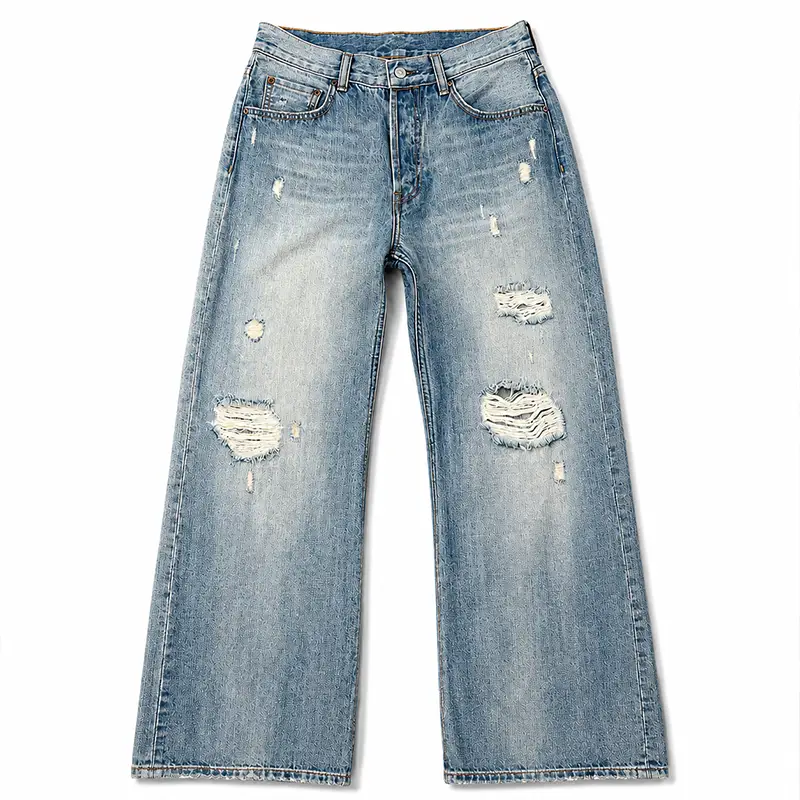
What Jeans Fabric Consumption Actually Measures
In a woven denim factory, consumption is normally expressed as linear metres or yards of main fabric per garment. The unit is linear because mills sell rolls by length, but each metre has an agreed width. Saying that a jean uses 1.58 m is incomplete unless the fabric width and the basis of that number are also stated.
Keep four quantities separate:
- Pattern area: the combined two-dimensional area of all pieces for one garment.
- Marker consumption: marker length divided by the garments laid in the marker.
- Booked consumption: marker consumption plus documented losses and purchasing allowance not already included.
- Actual consumption: net material issued and consumed divided by accepted output after cutting is complete.
These values answer different questions. Pattern area tells a pattern engineer how much useful cloth becomes product. Marker consumption includes the empty spaces between pieces. Booked consumption tells purchasing what to reserve. Actual consumption tells the factory whether the plan matched production. Substituting one for another is the source of many cost disputes.
Marker efficiency is not total factory utilisation
Marker efficiency measures the proportion of the marker rectangle covered by pattern pieces. It does not automatically include roll ends, splices, unusable selvage, rejected defects, shade segregation, sample cutting, damaged plies or replacement panels. A marker can show 82% efficiency while the order consumes more fabric than planned because losses occurred before and after the marker.
A May 2026 research article on marker parameters and jeans fabric consumption reported significant multivariate relationships between the studied marker inputs and both marker length and consumption. Its abstract identifies fabric width and the number of jeans components as important variables. The practical lesson is simple: a style name or remembered average cannot replace the current marker.
Early Planning Ranges by Denim Product Type
The following ranges are suitable only for concept budgets and supplier conversations. They assume adult products, approximately 145-155 cm usable-width fabric, a mainstream size mix and ordinary industrial markers. Pattern shape, order ratio and construction can move the result outside the range.
| Producto | Illustrative main-denim range | Factors that move the result |
|---|---|---|
| Adult denim shorts | 0.75-1.10 m per piece | Rise, entrepierna, turn-up, frayed allowance, pocket shape and size range |
| Slim or straight five-pocket jeans | 1.35-1.70 m per pair | Outseam, elevar, relación de tamaño, width and shrinkage-adjusted pattern |
| Wide-leg or baggy jeans | 1.55-2.10 m per pair | Leg opening, panel width, entrepierna, oversized ease and marker nesting |
| Cargo or multi-pocket jeans | 1.70-2.30 m per pair | Cargo pocket size, bellows, flaps, extra panels, straps and reinforcement |
| Cropped denim jacket | 1.40-1.90 m per piece | Sleeve volume, yokes, body length, pocket system and directional effects |
| Oversized denim jacket | 1.85-2.60 m per piece | Chest ease, body length, dropped shoulder, sleeve width and colour blocking |
| Narrow-width selvedge jeans | Often 2.40-3.30 m per pair | Actual narrow width, selvedge placement, size, seam design and one-way cutting |
Do not use a higher number merely because the denim is heavier. Fabric weight changes kilograms and cost per square metre, but a 12 oz and 14 oz fabric of the same usable width can require the same linear marker length. Thickness may influence spreading and cutting limits, not the pattern geometry itself. El denim fabric weight guide explains ounce and GSM selection separately.
Inputs Required Before a Factory Can Calculate Consumption
An accurate calculation begins after the product has enough definition to make a production pattern. The manufacturer needs:
- approved style drawing and construction details;
- finished garment measurement chart and base size;
- approved pattern or permission to develop one;
- full size range and exact order ratio by colour;
- fabric article, composición, construction and finish;
- nominal width, actual usable width and width tolerance;
- warp and weft dimensional-change data for the production wash;
- one-way, nap, stripe, imprimir, coating, slub or shade-direction restrictions;
- which components use main denim, contrast denim, pocketing or interlining;
- marker rules, pair-part direction and whether pieces may rotate;
- fabric inspection limits, shade-band plan and expected roll-loss basis;
- muestra, replacement and spare quantity requirements.
The final width must be usable width, not the width printed on a mill sales sheet. If a 155 cm roll has 2 cm unusable on each side, the marker width is 151 cm unless the buyer and factory approve another basis. A difference of only a few centimetres can prevent two panels from nesting side by side and increase marker length sharply.
Three Useful Jeans Fabric Consumption Formulas
1. Marker-length method
Marker consumption per garment = marker length / garments in marker
If a 12.64 m marker contains eight pairs:
12.64 / 8 = 1.58 m per pair
This is the preferred production calculation because the marker already reflects real graded pattern shapes, piece direction, width and nesting. State whether the reported marker length includes any end allowance. Do not add marker waste again; it is already represented by the uncovered spaces inside the marker rectangle.
2. Pattern-area method
Estimated length per garment = pattern area / (ancho utilizable × eficiencia del marcador)
Use metres for area and width, and convert efficiency from a percentage to a decimal. If one garment has 1.894 m2 of pattern area, usable width is 1.50 m and expected efficiency is 80%:
1.894 / (1.50 × 0.80) = 1.578 m
This method is useful before a final marker exists, but the assumed efficiency must come from comparable products and size ratios. It is not a substitute for production CAD.
3. Linear metres to fabric kilograms
Fabric mass (kg) = length (m) × ancho (m) × GSM / 1,000
If a pair consumes 1.58 m from 1.50 m wide fabric weighing 407 g/m2:
1.58 × 1.50 × 407 / 1,000 = 0.965 kg
This is the mass of the marker rectangle allocated to one garment, not the final garment weight. Cutting waste is included in the rectangle, while pocketing, hilo, trims and moisture are separate. Confirm actual GSM under the agreed method; a catalogue ounce value may be nominal.
Unit conversions
- Metres to yards: metres × 1.09361
- Yards to metres: yards × 0.9144
- oz/yd2 to GSM: oz/yd2 × 33.906
- GSM to oz/yd2: GSM / 33.906
Keep one unit system throughout each calculation. Rounding every intermediate number can create a large purchase difference at bulk quantity. Retain at least three decimal places during the calculation and round only the final booking decision according to roll or mill requirements.
Worked Example: An Eight-Garment Wide-Leg Jeans Marker
Consider a mixed-size marker with eight wide-leg five-pocket jeans. The shrinkage-adjusted production patterns are approved. The CAD report shows:
- usable marker width: 1.50 m;
- marker length: 12.64 m;
- garments: 8;
- total pattern-piece area: 15.15 m2;
- peso de la tela: 407 GSM, approximately 12 oz/yd2.
Linear consumption
12.64 / 8 = 1.580 m per pair
Marker efficiency
Marker area = 12.64 × 1.50 = 18.96 m2
Marker efficiency = 15.15 / 18.96 × 100 = 79.9%
The useful pattern area is 15.15 / 8 = 1.894 m2 per pair. The marker allocates 18.96 / 8 = 2.370 m2 of roll area per pair. The difference is the space between pattern pieces inside the marker.
Mass allocated per pair
2.370 × 407 / 1,000 = 0.965 kg
The useful pattern pieces theoretically contain 1.894 × 407 / 1,000 = 0.771 kg before sewing and washing. El 0.194 kg difference represents in-marker offcut at the stated GSM, not all factory loss. Roll ends, rejected defects and cutting damage sit outside this marker example.
This distinction is valuable in cost negotiations. A supplier can improve nesting without changing the garment. It cannot remove the area of an approved front leg or waistband without changing fit, seam allowance or construction.
How Usable Fabric Width Changes Consumption
Using the same 1.894 m2 pattern area, the early estimate changes as width and achievable efficiency change.
| Usable width | Assumed efficiency | Estimated length per pair | Change vs. 1.50 m case |
|---|---|---|---|
| 1.42 m | 78.0% | 1.710 m | +8.4% |
| 1.50 m | 80.0% | 1.578 m | Reference |
| 1.58 m | 80.5% | 1.490 m | -5.6% |
The wider option appears better in linear metres, but purchasing should compare delivered cost per usable square metre, verified GSM, quality and yield. A wider fabric may be priced higher per metre. It may also have edge defects that reduce cuttable width. Ask the factory to run the same approved pattern against actual width options rather than comparing nominal roll prices.
Why width changes are not always gradual
Pattern pieces do not behave like liquid filling a rectangle. One centimetre can be decisive if it allows two leg panels to sit side by side. The consumption curve may step down when a nesting opportunity becomes possible, then remain almost flat across the next few centimetres. This is why a width simulation is more reliable than a simple proportional adjustment.
Size Ratio, Grading and Marker Length
A base-size marker does not represent an order containing six sizes. Larger sizes need more area, while mixed sizes can sometimes nest better because small pieces fill gaps beside large ones. The final jeans size grading and order ratio must be available before the factory confirms bulk consumption.
Suppose a 1,000-pair order has this ratio:
| Size | Order share | Pairs |
|---|---|---|
| XS | 5% | 50 |
| S | 15% | 150 |
| M | 30% | 300 |
| L | 30% | 300 |
| XL | 15% | 150 |
| XXL | 5% | 50 |
A marker engineer might create a 20-garment ratio marker containing 1 XS, 3 S, 6 M, 6 L, 3 XL and 1 XXL. If its length is 31.60 m, average marker consumption is 1.580 m per pair. If colour-level orders cannot support that ratio and the factory must use short single-size markers averaging 1.640 m, the difference is 0.060 m per pair.
0.060 m × 1,000 pairs = 60 m additional fabric
This is one reason a low-quantity order split across many colours costs more than the same total quantity in one colour. The product has not changed, but each colour creates a smaller marker and more roll-balance risk.
How Silhouette and Details Change Fabric Yield
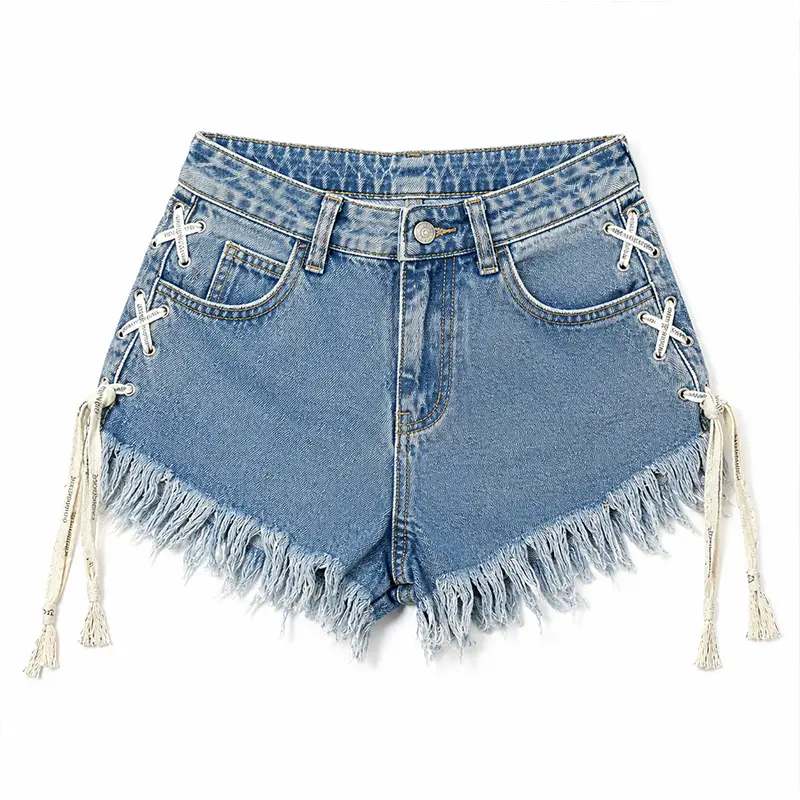
Consumption rises or falls through geometry, not product labels. Review the pieces that physically change.
Leg shape and length
Wide hems increase the width of front and back leg panels across most of their length. Flared jeans may create triangular spaces that smaller components can partly fill. Stacked or extra-long styles add length directly. Cropped styles remove area, but large turn-ups or raw-edge development allowance can return part of the saving.
Rise, yoke and waistband
A higher rise extends front and back body pieces. A contoured waistband may contain more sections and require specific grain direction. One-piece straight waistbands can be efficient on some widths but inefficient on others. Inner waistbands in contrast fabric should be calculated in that material rather than hidden inside main-denim consumption.
Pockets and cargo components
Standard pocketing fabric often replaces the hidden front pocket bag, while the denim facing remains in the main marker. Cargo pockets add outer panels, bellows, flaps, gussets and reinforcement. Six visually small components can consume more than one simple patch pocket because grain, symmetry and seam allowance limit where they fit.
Distressing and placement restrictions
Rips and laser artwork do not necessarily add pattern area, but they may impose orientation and placement restrictions. If a stripe, coating, gradient or engineered print must align across panels, the marker loses rotational freedom. A cuttable remnant may be too small or visually incompatible for recuts.
Colour blocking and multiple materials
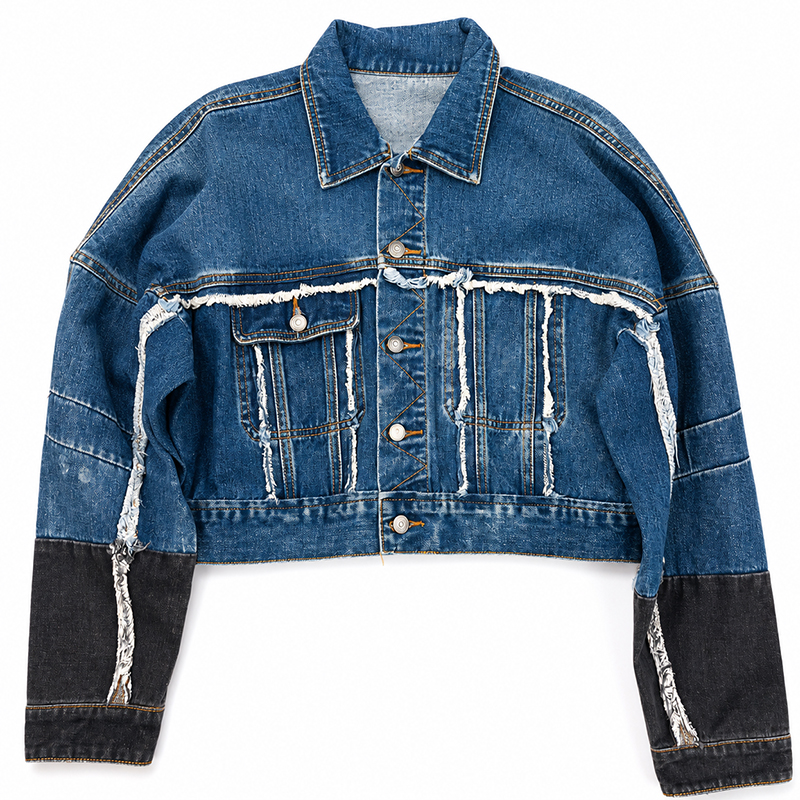
When a jacket uses blue denim for the body and black denim for lower sleeves, calculate each article separately. Small contrast orders can have poor marker efficiency and mill minimum conflicts even when total garment quantity is healthy. The bill of materials should state consumption, ancho, GSM, supplier, shade and allowance for every material line.
Shrinkage Belongs in the Pattern Before the Final Marker
Washed jeans are cut larger than their finished measurements where the tested material and process require compensation. Warp and weft change are rarely identical, so the pattern must use directional values. Applying one percentage to total marker length after the marker is made is a rough estimate, not production pattern engineering.
If the finished inseam target is 80.0 cm and validated length shrinkage is 3.5%, the theoretical pre-wash dimension is:
Required pre-wash length = finished dimension / (1 – contracción)
80.0 / (1 – 0.035) = 82.90 cm
Simply adding 3.5% gives 82.80 cm, which is close but not mathematically equivalent. Across multiple pattern dimensions, sizes and a sensitive fit, the difference matters. Growth uses a different relationship and must be treated from validated test data.
The production workflow should be:
- test bulk-representative fabric through the approved wash;
- measure warp and weft dimensional change under the specified method;
- adjust the production pattern by direction and critical location;
- sew and wash a size set or pre-production sample;
- approve measurements and fit;
- generate the final graded marker from the corrected patterns.
Once the shrinkage-adjusted pieces are inside the final marker, do not add the full shrinkage percentage again to marker consumption. Add only genuine outside-marker risks. See the denim shrinkage and leg-twist guide for the measurement and approval system.
Defects, Shade Bands and Cuttable Width
A CAD marker assumes a continuous usable rectangle. Real rolls contain ends, splices, width variation, shade groups and defects. The purchasing allowance should reflect verified material history and the agreed inspection standard rather than a habit such as «always add 10%.»
Before booking, review:
- minimum guaranteed usable width and measured width distribution;
- individual-roll and lot defect limits;
- zero-tolerance holes, oil, severe streaks and repeated faults;
- minimum roll length and allowed splices;
- roll-to-roll and side-centre-side shade control;
- shade groups that must be spread and cut separately;
- short-roll and roll-end handling;
- whether mapped local defects can be avoided by the cutting system;
- claim, replacement and freight responsibility for rejected fabric.
El denim fabric inspection guide explains roll scoring, usable width and shade banding. A roll may pass a points limit but still reduce yield if defects cluster where large leg panels must be cut. Conversely, accurate defect coordinates can allow local avoidance without rejecting the entire roll. The allowance should be supported by actual cutting data over time.
Worked Example: Booking Denim for 1,000 Pairs
Continue with the approved marker consumption of 1.580 m per pair. The factory and buyer agree that the following risks are not already in the marker:
| Outside-marker item | Illustrative allowance | Basis |
|---|---|---|
| Spreading ends and joining | 1.2% | Recent cutting records for comparable rolls |
| Defect and shade loss | 1.8% | Agreed incoming-fabric quality history |
| Cutting damage and approved recuts | 1.0% | Factory performance for this product class |
| Roll balance and purchase rounding | 1.5% | Mill roll and final shade-group constraints |
| Total illustrative allowance | 5.5% | Use one documented basis; do not duplicate included losses |
Booked production consumption = 1.580 × 1.055 = 1.667 m per pair
Para 1,000 pairs = 1,667 m
Assume the sampling, testing, wash trials and salesman samples require another 30 m outside the bulk order:
Total planned booking = 1,667 + 30 = 1,697 m
El 30 m should appear as its own line rather than being hidden in a percentage. If samples are already complete from a separate development lot, purchasing should not add them again.
Additive or compounded allowances?
The example adds the agreed percentages to one common base. Some companies compound losses at different process stages. Either approach can work if buyer and factory define it consistently. The dangerous approach is combining a supplier’s consumption that already includes loss with a second blanket percentage whose content is unknown. Ask for a line-by-line bridge from marker consumption to booked consumption.
Convert the Booking into Kilograms and Fabric Cost
Para 1,697 m of fabric at 1.50 m usable width and 407 GSM:
1,697 × 1.50 × 407 / 1,000 = 1,036.0 kg
If the mill invoices by net roll weight, compare calculated and actual kilograms. Differences can arise from actual width, actual GSM, moisture, selvage basis and measurement tolerance. The purchase order should state whether width is total or usable and how mass per unit area is determined.
If delivered main denim costs USD 5.20 per metre, the booked main-fabric cost allocated per bulk pair is:
1.667 × USD 5.20 = USD 8.67 per pair
This excludes pocketing, interlining, etiquetas, hilo, hardware, lavar, labour, testing, embalaje, freight and commercial overhead. Use the custom jeans manufacturing cost guide to connect material consumption to the complete FOB model.
What a small saving is worth
A 1% reduction from the 1.667 m booked consumption saves 0.01667 m per pair. At 1,000 pairs, that is 16.67 m or USD 86.68 at USD 5.20/m. At 20,000 pairs, the same controlled improvement is 333.4 m or USD 1,733.68. The saving is useful only if fit, grain, seam allowance, shade control and cut quality remain unchanged.
MOQ bajo, Colour Splits and Leftover Risk
Low MOQ does not necessarily change the area of one pattern. It changes the factory’s ability to build efficient markers, use full rolls and absorb leftovers. A 600-piece order in one colour is not operationally equal to six colours of 100 piezas.
Each colour may require:
- a separate wash standard and production lot;
- its own size-ratio marker;
- a minimum roll or mill quantity;
- separate shade bands and spreading lays;
- new spreading ends and roll balances;
- colour-specific replacement pieces;
- leftover material that cannot be used in another colour.
Brands can reduce this penalty by concentrating colour quantity, using the same approved fabric article across related styles, avoiding unnecessary contrast articles, confirming size ratios early and allowing the factory to combine compatible marker demand. These decisions belong in the denim tech pack and purchase forecast before the mill booking is placed.
How to Calculate Actual Cutting-Room Consumption
The standard is not complete until it is compared with production. Record roll receipts, issued length, returned unopened rolls, reusable remnants, rejected fabric, recuts and accepted garment output.
Assume the cutting room reports:
- fabric issued: 1,725 m;
- unopened roll length returned: 20 m;
- measured reusable remnants returned to stock: 9 m;
- accepted output: 1,000 pairs.
Net consumed length = 1,725 – 20 – 9 = 1,696 m
Actual consumption = 1,696 / 1,000 = 1.696 m per accepted pair
Compared with the booked production standard of 1.667 m:
Variance = (1.696 – 1.667) / 1.667 × 100 = 1.74% unfavourable
The next step is not automatically to increase the standard. Break the 29 m difference into cause codes: width below plan, roll-end loss, defects, short rolls, recuts, spreading error, marker substitution, count discrepancy or unrecorded remnants. A repeated verified cause may justify a new allowance; a one-time control failure needs corrective action.
Report consumption against accepted output
If the factory cut 1,020 pairs but only 1,000 were accepted, dividing by cut quantity makes material performance look better while hiding quality loss. Report both cut output and accepted output. Connect the result to the denim final inspection plan so replacement and rejected garments are visible in yield data.
Reduce Fabric Consumption Without Weakening the Product
Responsible optimisation removes avoidable empty area and process loss. It does not shave approved seam allowances or distort grain lines without testing.
- Simulate real width options. Compare cost per garment, not cost per metre alone.
- Use the actual size ratio. Mixed-size markers often fill spaces better than repeated base-size markers.
- Review component geometry. Small changes to pocket facings, inner waistband joins or hidden reinforcement may improve nesting without changing appearance.
- Separate material correctly. Do not place pocketing or contrast pieces in the main-denim marker unless the bill of materials requires it.
- Control shrinkage before marker approval. Stable wash data prevents repeated pattern enlargement.
- Improve roll quality. Consistent width, longer rolls, fewer defects and reliable shade groups reduce outside-marker loss.
- Map defects digitally. Accurate coordinates may allow avoidance instead of blanket rejection.
- Standardise recut control. Trace replacement panels to the same shade group and record their material use.
- Review actual variance. Use factory data to replace guessed allowances with evidence.
Do not rotate pieces merely to improve the percentage if denim shade, twill direction, stretch direction or wash appearance will change. Left and right panels must remain compatible. The approved jeans fit and size-set samples should confirm any pattern-engineering change before a revised marker becomes the production standard.
What to Send a Manufacturer for an Accurate Fabric Quotation
A factory can issue a quick estimate from a reference garment, but an accountable quote needs a controlled input package. Send:
- technical flat and clear reference images;
- finished measurement chart and tolerance;
- base size, full grade and intended fit;
- sample or digital pattern if available;
- composición de la tela, ounce or GSM, stretch and finish;
- actual or required usable width;
- wash target and dimensional-change data;
- main, contrast, pocketing and lining material allocation;
- colour quantities and exact size ratios;
- directional, selvedge, print or shade restrictions;
- inspection and testing requirements;
- muestra, spare and replacement quantities;
- quotation currency, unit basis and Incoterm.
Ask the supplier to state the marker width, garments per marker, marker length, consumption before allowance, each outside-marker allowance and final booked consumption. A single number without that bridge cannot be audited when the design or fabric changes.
Pre-Booking Checklist
- The approved pattern reflects the correct fit and construction.
- The complete size range and colour-level order ratios are final.
- Bulk fabric article and usable width are confirmed.
- Warp and weft dimensional change come from the approved wash route.
- Shrinkage compensation is built into the production pattern.
- Marker direction and rotation rules reflect the denim surface.
- Main denim, contrast denim and pocketing are calculated separately.
- The CAD marker uses the real graded ratio.
- Marker length and efficiency report are retained.
- In-marker waste is not added a second time.
- Outside-marker allowances have named causes and evidence.
- Fabric defects, shade bands and usable width are covered by the purchase specification.
- Development and testing metres are listed separately.
- Metres, yards, GSM and ounce units have been checked.
- Fabric cost uses the same width and unit basis as consumption.
- The final quantity meets the mill’s roll or lot requirement.
- The cutting room will reconcile actual issue, return and accepted output.
Preguntas frecuentes
How much fabric is needed for one pair of jeans?
For an early estimate, many adult five-pocket jeans in 145-155 cm usable-width denim may require roughly 1.35-2.10 linear metres before agreed booking allowances. The production quantity must come from the final graded marker because silhouette, relación de tamaño, ancho, shrinkage and direction rules change the result.
What is the formula for jeans fabric consumption?
For a completed marker, divide marker length by the number of garments in the marker. Before a marker exists, divide pattern area by usable fabric width multiplied by expected marker efficiency. The marker calculation is more reliable for bulk production.
Does marker efficiency include fabric defects and roll ends?
No. Marker efficiency measures pattern area against the marker rectangle. Roll ends, splices, rejected defects, shade segregation, cutting damage, samples and replacement panels normally sit outside the marker and must be handled separately.
How do you convert denim consumption from metres to kilograms?
Multiply length in metres by fabric width in metres and GSM, then divide by 1,000. The result represents fabric mass for the stated rectangle and does not equal final garment weight.
Why do wide-leg jeans use more fabric?
The front and back leg panels remain wider through more of their length, increasing pattern area and sometimes preventing side-by-side nesting. The actual increase depends on fabric width, size mix and marker layout.
Does heavier denim require more metres per pair?
Not automatically. If usable width and pattern geometry are unchanged, heavier denim can use the same linear marker length but weigh and cost more. Thickness can affect spreading and cutting, which should be assessed separately.
How does fabric width affect jeans consumption?
Wider usable fabric often reduces linear metres because pattern pieces can nest across more width. The improvement is not always proportional: a small width increase may suddenly allow two large panels to fit side by side.
Should wash shrinkage be added to marker consumption?
Shrinkage should first be built directionally into the production pattern and verified with washed samples. Once those adjusted pieces are in the final marker, adding the full shrinkage percentage again would count it twice.
Why does low MOQ increase fabric consumption?
Small colour lots may require short or single-size markers, separate roll ends, additional shade groups and leftover balances that cannot be shared across colours. The pattern area is unchanged, but operational losses per garment rise.
What is the difference between marker consumption and booked consumption?
Marker consumption is marker length divided by garments in the marker. Booked consumption adds only the documented roll, spreading, defect, recut and purchasing allowances that are outside the marker, plus separately identified development material.
How can a brand verify a factory’s fabric consumption?
Request the CAD marker report, ancho utilizable, relación de tamaño, marker length, garment count, efficiency, allowance breakdown and final booking calculation. After production, compare the standard with net issued fabric divided by accepted output.
Can fabric consumption be reduced after sample approval?
It can be improved through marker engineering, width selection, size-ratio nesting and loss control. Any pattern, seam allowance, grain or component change must be reviewed and tested so savings do not alter fit, appearance or durability.
Final Takeaway
Reliable jeans fabric consumption is a chain of evidence: an approved pattern, a real size ratio, a verified usable width, a production marker, named outside-marker losses and a cutting-room reconciliation. When those numbers remain separate, a brand can compare quotations, understand fabric cost and improve yield without bargaining away the product.
Brands can send Luokugg the tech pack, tabla de medidas, relación de tamaño, denim specification, referencia de lavado, order quantity and target market through the custom denim quotation form. The factory can then develop the pattern, confirm bulk-representative shrinkage, build the graded marker and return an auditable fabric-consumption basis with the quotation.