Oversized denim jacket manufacturing requires more technical control than simply enlarging a standard jacket pattern. The shoulder position, chest volume, sleeve shape, body length, denim weight, pocket scale and wash all have to work together. When these elements are poorly balanced, an oversized jacket quickly changes from intentionally relaxed to simply looking one or two sizes too large.
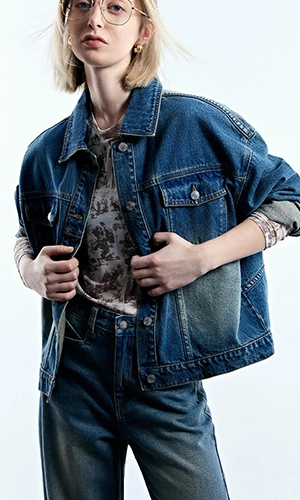
Oversized Denim Jacket Manufacturing Is Not Simply Making a Jacket Bigger
One of the easiest mistakes in denim product development is taking a regular jacket pattern and grading every measurement upward. The finished garment becomes larger, but it does not necessarily become a convincing oversized silhouette.
A deliberate oversized fit is created through proportion. The shoulder may drop beyond the natural shoulder point, but the collar still needs to sit properly around the neck. The chest may carry more volume, while the hem remains controlled enough to preserve shape. The sleeve may be wider, but the cuff should still feel intentional rather than unfinished.
These relationships become especially important with denim because the fabric has more structure than many lightweight woven fabrics. Extra volume does not simply drape away. Depending on the fabric weight and finish, it may hold its shape, collapse at certain points or create unwanted bulk.
For this reason, brands developing oversized jackets should work with a custom denim manufacturer that can evaluate pattern, fabric and wash as one product instead of treating them as unrelated production steps.
Start With a Product Brief Before Requesting a Jacket Quote
A front and back reference image can communicate style, but it cannot define a production standard. The factory still needs to know where the shoulder should sit, how wide the chest should be, whether the hem is cropped or long, what weight of denim is required and how the finished garment should feel after washing.
Before sample development begins, prepare the main design direction:
- Men’s, women’s or unisex fit
- Target customer and retail positioning
- Dropped or natural shoulder
- Chest and body volume
- Cropped, standard or long body length
- Rigid or soft denim construction
- Target fabric weight
- Wash shade and vintage character
- Pocket size and placement
- Hardware and branding
- Size range
- Estimated order quantity
A complete technical package is useful when the brand already knows exactly what it wants. It should include a measurement chart, construction details, stitching, hardware, artwork, pocket positions, labels and packaging.
Brands without a completed technical package can instead work through ODM denim development . Reference garments, sketches and market samples can be converted into a working pattern and sample specification before bulk manufacturing.
Brands that already control pattern development and product specifications may use OEM denim manufacturing for production according to an approved technical standard.
Choosing Denim Fabric for an Oversized Jacket
Fabric selection determines whether the jacket holds a structured silhouette or falls softly around the body. For an oversized design, this decision is especially visible because there is more fabric across the shoulder, sleeve and body.
According to CottonWorks denim technical guidance , denim character is influenced by yarn, dyeing, weaving, design and finishing. For product development, this means two fabrics with a similar ounce weight can still behave differently after washing.
Lightweight denim
Lighter denim works well when the brand wants an oversized jacket with movement rather than heavy structure. It can be useful for spring and summer collections, shirt-jacket hybrids and women’s relaxed silhouettes.
The risk is that very lightweight denim may not support large chest pockets, heavy metal hardware or exaggerated seams. A jacket that looks structured in a digital drawing may appear flatter once made in a soft fabric.
Midweight denim
Midweight fabric provides a useful balance between structure and comfort. It can support traditional jacket construction while still responding well to stone, enzyme and vintage washes.
For many commercial oversized jackets, this is a practical starting point because the garment retains recognizable denim character without becoming unnecessarily heavy.
Heavyweight denim
Heavy denim creates a stronger workwear or heritage silhouette. Dropped shoulders, large pockets and thick seams become more architectural.
However, additional weight changes comfort. Oversized sleeves already contain more fabric than regular sleeves, and double-layer pocket construction adds further bulk. The design needs to justify the extra weight.
Brands can compare different weights, fiber compositions, twills, colors and special constructions through Luxappare’s custom denim fabric selection service.
The Shoulder Is the Most Important Part of an Oversized Denim Jacket
The shoulder line is often the first thing customers notice in an oversized jacket. Moving it outward creates a relaxed appearance, but the amount of drop must be controlled.
If the shoulder is only slightly extended, the jacket may still look like a normal fit in a larger size. If it extends too far, the armhole can fall too low and restrict movement despite the garment appearing loose.
The shoulder angle also matters. A nearly horizontal shoulder can create a boxier, more structured appearance. A softer slope follows the body more naturally. Neither is automatically better; the correct choice depends on the intended silhouette.
During fitting, the sample should be reviewed from the front, side and back. A garment can appear acceptable from the front while the back shoulder collapses or creates excess folds around the armhole.
Buyer tip: When commenting on shoulder fit, do not write only “make it more oversized.” Specify how far the shoulder point should move and whether the armhole depth should change with it.
Body Volume, Hem Width and Jacket Length Must Be Balanced
Oversized jackets need additional chest and body ease, but adding width everywhere can destroy the silhouette. The body shape may be straight, slightly tapered, cocoon-like or intentionally boxy.
A cropped oversized jacket is a good example. The upper body can be very wide while the shorter length prevents the garment from overwhelming the wearer. A long oversized jacket uses the opposite strategy: more vertical length may require a more controlled width.
The hem deserves particular attention. If it is too narrow, the jacket can pull around the hips when worn closed. If it is too wide, the back may stand away from the body and create an unintended tent shape.
Brands should therefore review the relationship between chest width, sweep, back length and front length rather than evaluating each measurement separately.
Oversized Sleeve Construction and Mobility
An oversized sleeve is not simply a wider sleeve. Sleeve cap height, armhole depth, bicep width, elbow width and cuff circumference all influence the way the garment moves.
A dropped shoulder normally changes the sleeve cap because part of the traditional shoulder length has moved into the body pattern. If the sleeve pattern is not adjusted accordingly, the garment may develop twisting or excess fabric around the upper arm.
Brands also need to decide whether the sleeve should remain wide from shoulder to cuff or taper strongly toward the wrist. A wide cuff creates a more exaggerated streetwear appearance, while a tighter buttoned cuff gives the garment more traditional denim-jacket structure.
During fitting, the wearer should raise the arms, bend the elbows and cross the arms in front of the body. A jacket that looks relaxed while standing still can still restrict movement if the armhole and sleeve were not balanced correctly.
Collar and Neckline Engineering
The collar is a relatively small component, but it can determine whether an oversized jacket looks refined or awkward.
Increasing the overall garment size does not mean the neckline should become equally large. If the neckline expands too much, the jacket sits away from the back neck and the collar loses its intended position.
Collar height, point length and spread should also match the scale of the body. A tiny standard collar on a heavily oversized jacket may look visually weak, while an excessively large collar can dominate the entire design.
Fabric thickness affects collar construction as well. Heavy denim may require different seam allowances or internal construction to avoid excessive bulk at the collar points and stand.
Pocket Scale and Placement Need to Follow the Oversized Proportion
Standard-size pockets placed on an oversized jacket can look unexpectedly small. For this reason, chest pocket dimensions often need to increase with the garment, but not necessarily at the same grading percentage as the chest.
Pocket position should be measured from fixed reference points. When the shoulder drops and the body becomes wider, simply centering the pocket on the front panel may move it too far outward.
Brands should check:
- Pocket width and height
- Flap depth
- Distance from center front
- Distance below shoulder or yoke seam
- Left-to-right symmetry
- Button or snap alignment
- Whether the pocket remains functional
Large pockets add weight, particularly when made from heavy denim. If a design uses oversized utility pockets, the factory may need to control layer count or use different internal finishing to prevent excessive stiffness.
Sewing Construction and Reinforcement
Denim jackets contain several areas where multiple fabric layers intersect. Collars, front plackets, cuffs, waistbands, yokes and pockets can all become bulky. The problem becomes more visible with heavier denim.
Sewing construction should therefore be developed around the actual fabric rather than copied blindly from a previous style.
Important construction points include:
- Shoulder and yoke seams
- Armhole construction
- Front placket stability
- Chest pocket reinforcement
- Collar point cleanliness
- Cuff and sleeve placket construction
- Buttonhole size
- Hem or waistband attachment
Thread thickness and stitch color should also be approved after wash development. A thread that looks subtle against dark indigo may become much more visible after the fabric fades.
Wash Development Changes the Character of an Oversized Denim Jacket
Wash is one of the strongest design tools in denim jackets. The same pattern can appear clean and contemporary in a dark rinse, authentic and workwear-inspired in a medium wash, or strongly fashion-driven after vintage fading and abrasion.
CottonWorks’ technical material on denim finishing covers common processes such as stone washing, enzyme treatment and softening. In commercial development, these processes are often combined rather than used in isolation.
An oversized jacket reacts differently from jeans during washing because the garment contains larger flat panels, collars, cuffs, plackets and chest pockets. Raised seams may fade faster than broad body areas, producing strong contrast.
Brands should decide whether they want:
- Clean dark indigo
- Medium commercial blue
- Light vintage blue
- Grey or washed black
- High-contrast seam fading
- Whiskering or localized abrasion
- Grinding around collar, cuffs or pockets
- Distressed or destroyed construction
Luxappare’s custom denim crafting and wash development covers garment washing, stone wash, enzyme wash, bleaching, overdying, whiskers, destroy effects, hardware and other finishing options.
For heavily distressed jacket programs, brands can also review distressed denim jacket manufacturing as a separate technical direction.
Wash Shrinkage Must Be Built Into the Pattern
A denim jacket should be evaluated after the production wash, not only in the unfinished sewing sample.
Washing can change chest width, sleeve length, body length, cuff circumference and shoulder measurements. The amount depends on fabric construction and the finishing recipe.
This is particularly important for oversized garments because a small percentage change across a large measurement creates a noticeable absolute difference. A wide chest losing a few centimeters can change the intended relaxed silhouette.
The sample room should therefore compare pre-wash and after-wash measurements, then adjust the production pattern according to the approved final specification.
The brand should approve the finished garment measurements rather than relying only on the dimensions of the pattern or unwashed sample.
How an Oversized Denim Jacket Sample Should Be Developed
Sampling should be treated as product engineering rather than as a formality before bulk production.
Review the Design
Confirm silhouette, shoulder position, body length, fabric, pockets, hardware, wash and size range before pattern development.
Develop the Pattern
Build the oversized proportion intentionally instead of grading a standard jacket upward without changing its balance.
Sew the First Prototype
Check basic volume, collar scale, pocket size, shoulder drop and sleeve shape before spending unnecessary time on detailed wash development.
Fit the Garment
Review the sample on a model or dress form from front, back and side. Test movement instead of reviewing the jacket only while standing still.
Develop the Wash
Apply the intended wash and recheck shade, fabric hand, shrinkage and final measurements.
Approve the Production Standard
Confirm final fabric, measurements, hardware, wash, branding and workmanship before bulk cutting begins.
Every major revision should be measurable. Instead of writing “make it more oversized,” specify the required chest width, shoulder measurement, sleeve width or body length.
This makes communication clearer and allows the same pattern to be reproduced on future orders.
What Determines Oversized Denim Jacket Manufacturing Cost?
The cost of a custom denim jacket depends on much more than fabric weight. Oversized garments normally consume more fabric than regular-fit styles, but construction complexity can have an even greater effect on price.
Important cost factors include:
- Total fabric consumption
- Fabric weight and composition
- Number of pockets
- Custom metal hardware
- Contrast stitching
- Embroidery or printing
- Patches and appliques
- Wash complexity
- Manual distressing
- Custom labels and packaging
- Order quantity
- Number of colorways
A clean oversized jacket with two chest pockets can be relatively efficient to produce. A visually similar jacket with embroidery, custom buttons, destroyed edges and multiple wash treatments can require much more labor.
This is why brands should request pricing from a defined specification rather than asking for a generic “denim jacket price.”
Low MOQ Oversized Denim Jacket Production
Smaller production runs can be useful when a brand wants to test an oversized silhouette before committing to substantial inventory.
Luxappare’s low MOQ custom denim manufacturing program supports selected small-order projects. The exact minimum still depends on fabric, wash, trims and the complexity of the style.
For low-volume development, the most efficient approach is usually to control the number of custom variables. A new brand does not necessarily need three different fabrics, four washes and separate hardware finishes in the first collection.
One proven fabric can often be used across several jackets, while different washes, pockets or branding create visual separation.
This keeps material purchasing more efficient and gives the brand useful market feedback before expanding the range.
Quality Control for Oversized Denim Jackets
Quality inspection needs to cover both measurable construction and the visual balance of the garment.
| Inspection Area | What Should Be Checked | Common Problem |
|---|---|---|
| Shoulders | Width, symmetry and drop position | Uneven or incorrectly placed shoulder line |
| Chest & Body | Width, length and sweep | Oversized volume becomes unbalanced |
| Sleeves | Length, bicep, cuff and twisting | Different sleeve lengths or restricted movement |
| Collar | Shape, symmetry and neckline fit | Collar rolling or standing away from neck |
| Pockets | Size, position and flap alignment | Left and right pocket mismatch |
| Hardware | Button finish and attachment | Loose buttons or inconsistent finish |
| Wash | Shade, abrasion and hand feel | Variation beyond approved range |
| Measurements | Final measurements after wash | Shrinkage changes approved fit |
An oversized garment should not be given excessively loose tolerances simply because the fit is relaxed. Customers can still see when shoulders are uneven, pockets are misaligned or sleeves differ in length.
The physical approval sample should remain the visual reference while the measurement specification defines numerical tolerance.
Material Claims and Chemical Management
If a denim jacket is marketed with organic, recycled or chemical-safety claims, the claim should be supported by the appropriate documentation rather than based only on a supplier’s verbal description.
For organic material programs, Textile Exchange’s Organic Content Standard provides a third-party certification framework for organic materials and chain of custody.
For textile products tested for harmful substances, brands can review OEKO-TEX STANDARD 100 .
Brands managing chemical requirements in dyeing, washing and finishing can also refer to the ZDHC Manufacturing Restricted Substances List .
The important point is scope. A certified material does not automatically mean every later process, trim or finished garment is covered by the same claim. Documentation needs to match the actual product and supply chain.
Building an Oversized Denim Jacket Collection That Can Scale
For fashion brands, the goal should rarely be to develop one isolated jacket. A more useful approach is to create a repeatable product system.
A successful oversized base pattern can become the starting point for several commercial variations. One version may use medium blue denim with a clean vintage wash. Another can use black denim with faded charcoal finishing. A third can add embroidery, patches or distressing while retaining the same core fit.
This approach makes development more efficient because the brand is not rebuilding fit from zero for every new style.
The same logic applies to hardware and trims. A signature button finish, contrast thread or leather patch can become part of the brand language across jackets, jeans and shorts.
Brands can review existing products through the custom denim jackets collection and the broader Luxappare denim product gallery before preparing a new development brief.
The advantage of building a consistent product system is not only aesthetic. Repeat fabrics, hardware and approved fits make later sourcing easier and reduce the number of completely new variables introduced in each collection.
Practical development rule: Do not approve an oversized jacket from measurements alone. Review the garment on a body after the final wash. The relationship between shoulder, body volume, sleeve shape and fabric structure is what creates the silhouette.
What Information Should You Send to a Denim Jacket Manufacturer?
The clearer the first inquiry, the more useful the factory’s response will be. A buyer does not need a perfect tech pack to start a conversation, but the manufacturer should receive enough information to understand the intended product.
A practical inquiry can contain:
- Front and back reference images
- Target fit or reference garment
- Preferred denim color and weight
- Target wash
- Required pockets and hardware
- Embroidery, printing or patch details
- Brand labels and packaging
- Size range
- Estimated quantity
- Target delivery date
If the product has unusual proportions, a physical reference garment is especially valuable. A factory can measure it, evaluate construction and identify which details need to be changed rather than trying to estimate everything from a photograph.
After the technical review, the manufacturer can recommend suitable fabric, sampling requirements and production steps.
Why the Final Approval Sample Matters for Repeat Orders
The first production run should create more than inventory. It should create a repeatable technical standard.
A brand planning repeat orders should keep records of the approved pattern, measurement chart, fabric code, wash standard, hardware, thread, labels and packaging.
The physical approval sample is particularly important with washed denim because photographs do not capture shade, fabric hand and surface character perfectly.
If the same jacket is reordered six months later, the factory should compare the new production against the original standard instead of relying on memory.
If the original fabric becomes unavailable, the replacement material should be sampled again. A different denim construction may react differently to the old wash recipe, even when the color looks similar before washing.
This documentation is what allows a small private-label project to develop into a stable supply program.
Frequently Asked Questions About Oversized Denim Jacket Manufacturing
How is an oversized denim jacket different from a regular jacket in a larger size?
A properly developed oversized jacket changes the relationship between shoulder, chest, sleeve, body length and hem rather than increasing every measurement by the same amount. This creates intentional volume while maintaining balance around the neck, armhole and body.
What fabric weight is best for an oversized denim jacket?
There is no single ideal weight. Lightweight denim creates more drape, midweight denim balances comfort and structure, and heavyweight denim produces a more rigid workwear or heritage silhouette. The correct fabric depends on fit, season, wash and construction.
Can I manufacture an oversized denim jacket from reference photos?
Yes. Reference photographs can be used during ODM development, although the factory will still need to define measurements, fabric, construction, hardware and wash before the garment becomes a repeatable production specification.
Can oversized denim jackets be made with custom washes?
Yes. Dark rinse, vintage blue, stone wash, enzyme wash, washed black, bleaching, abrasion and distressed effects can be developed depending on the selected denim fabric and design requirements.
Can I customize buttons, labels and patches?
Yes. Private-label programs can include custom metal buttons, woven labels, care labels, leather or jacron patches, embroidery, printing, hangtags and packaging. Availability and minimum quantities depend on the individual component.
What is the MOQ for custom denim jackets?
Luxappare supports selected custom denim jacket projects with low MOQ production. The required quantity depends on fabric sourcing, wash, trims, colors and overall customization requirements.
Should I approve the jacket before or after washing?
Final fit and production measurements should be approved after the intended wash because finishing can change dimensions, hand feel, shade and garment structure. An unwashed sewing sample alone is not a sufficient final production standard.
Develop Your Oversized Denim Jacket With Luokugg
Send your sketches, reference photos, tech pack, target quantity, fabric direction and wash requirements to Luokugg. Our team can review the silhouette, construction, denim fabric, wash, trims and production requirements before developing your sample.